
How Much Emergency Savings Do You Need When Your Hours Can Be Cut?
Start with the gap your household would have to cover
When your income depends on overtime, seasonal demand or available shifts, a useful emergency-fund exercise starts with a question: if the schedule changed, how much would the household still need each month after the income that continued?
That question produces a scenario, not a universal savings requirement. The Consumer Financial Protection Bureau says the right emergency-fund amount depends on your circumstances, and suggests using past unexpected expenses to help establish a goal. CFPB emergency-fund guide.
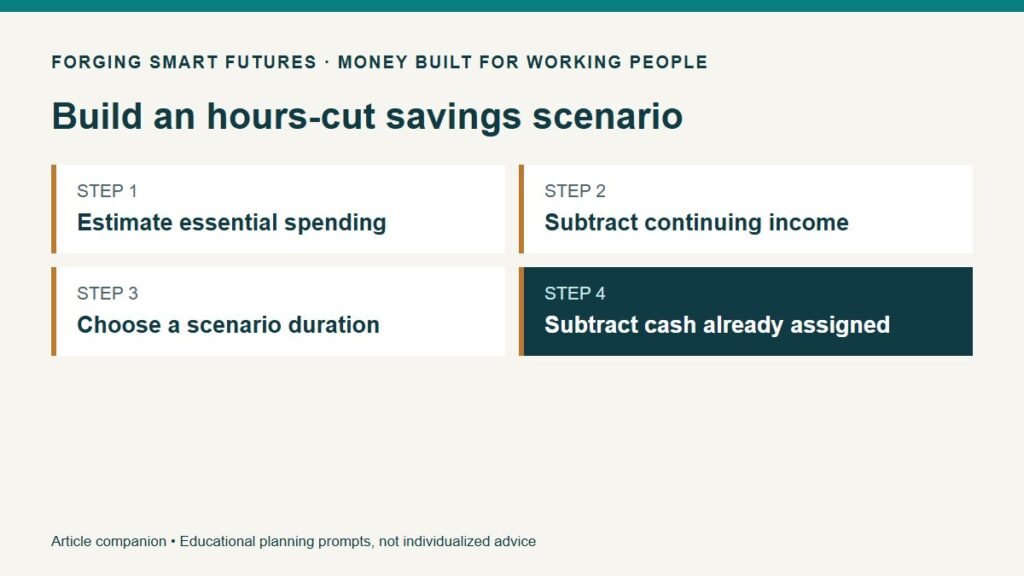
For this FSF exercise, estimate essential monthly spending, income expected during the disruption, the number of months you want to model, an additional emergency allowance, and cash already set aside. Keep the assumptions visible. Changing one can materially change the result.
Separate three different kinds of money
Your checking balance may contain next week's rent, money for a known annual bill and an emergency reserve. The account total does not tell you which dollars are available for a lost shift.
Give each amount a purpose:
- Current bills: money needed for commitments already coming due.
- Known future bills: a reserve for a predictable cost, such as registration or an insurance renewal.
- Unexpected disruption: money available for a shock outside the ordinary plan.
These can be labels in a worksheet; separate accounts are not required for the arithmetic. What matters is avoiding double-counting. A $900 vehicle reserve is not also $900 of unassigned emergency money if you intend to buy tires with it next month.
Model an hours cut without assuming all income disappears
Sam and Riley are fictional workers with $2,800 in essential monthly spending. In one scenario, they expect $1,600 of household take-home income to continue after hours are reduced. They choose a three-month modeling period and a $500 additional emergency allowance. They already have $1,000 set aside, beyond current bills and known-bill reserves.
| Calculation | Amount |
|---|---|
| Essential monthly spending | $2,800 |
| Less income expected to continue | $1,600 |
| Monthly shortfall | $1,200 |
| Shortfall for three modeled months | $3,600 |
| Plus one-time allowance | $500 |
| Scenario target | $4,100 |
| Less cash already assigned to this scenario | $1,000 |
| Additional amount needed for this scenario | $3,100 |
The three-month period and $500 allowance are chosen assumptions, not recommended amounts. The example also assumes the same spending and remaining income throughout the modeled period. Actual cash flow may vary week by week.
The formula is:
Positive monthly spending gap x months modeled + one-time allowance = scenario target.
If expected income exceeds spending, the monthly gap is zero. The tool does not subtract that excess income from the one-time allowance, because the income has not necessarily arrived when an emergency occurs.
Test a second scenario before settling on a target
Keep the example's spending, period and allowance, but reduce remaining income to $1,000. The monthly shortfall becomes $1,800. Over three months, that is $5,400; adding $500 produces $5,900. With $1,000 saved, the additional amount is $4,900.
Now model complete income loss over the same three months. The target becomes $2,800 x 3 + $500 = $8,900. The difference does not mean the first scenario was wrong. It means it answered a narrower question.
Write down what could cause the income to change together. Two household earners may work for the same employer, industry or local customer base. A plan that assumes one income will continue untouched should say why that assumption seems reasonable and what would trigger reconsideration.
Avoid counting benefits whose eligibility, timing or amount you have not verified. Likewise, available credit is not the same as cash savings; it creates a separate repayment obligation if used.
Choose a first milestone you can work toward
Seeing a large scenario target can make saving feel pointless. Break the task into a first meaningful milestone and a longer-term scenario target. For the fictional household, one milestone might be enough to cover a specific transport repair or part of a reduced paycheck. The household chooses the amount based on its needs and available money.
After that, decide how to add to the reserve without unfunding the next bill cycle. One extra-hours deposit might allow a larger contribution; another may need to cover a known bill first. A transfer schedule should fit actual cash flow, not an ideal month.
Keep a small progress record: date, starting reserve, addition or withdrawal, ending reserve and reason. The purpose is to see the direction and understand what happened, not to punish yourself for using money set aside for emergencies.
Check access as well as the balance
An emergency reserve needs to be usable when the problem happens. When comparing where to keep it, check fees, minimums, withdrawal restrictions, transfer timing and the terms of the actual account. Do not choose an account from a rate headline alone.
The CFPB emphasizes keeping emergency money safe and accessible and cautions that automatic transfers can cause overdraft problems if the checking account lacks enough money. CFPB emergency-fund guide.
This article does not rank banks or recommend a product. A future FSF comparison should verify account terms and any material affiliate relationship before making claims.
Decide what triggers a review
Revisit the worksheet when hours change, an earner changes jobs, a household cost changes materially, a reserve is used, or you learn that an assumption about benefits or available work was wrong. Replace estimates with evidence as it becomes available.
Do not keep a long-term target while ignoring an immediate cash shortage. If a reduction has already occurred, build a dated bill calendar and identify the next realistic deposits. Contact providers about options before deadlines where possible. The emergency-fund worksheet helps size a scenario; it is not a substitute for near-term bill decisions.
A practical check-in for this week
Choose one plausible hours-cut scenario. Gather recent spending records. Write the income you expect to continue and its dates. Pick a modeling period, clearly labeled as an assumption. Exclude savings already needed for other bills. Calculate the gap, then choose one achievable next action.
Use the Hours-Cut Cash Cushion Calculator to work through your own example.
Financial-education disclaimer: General education only, not individualized financial, investment, tax, legal or credit advice. All household figures are fictional. The calculator does not predict layoffs, benefit eligibility, interest, inflation or future expenses.
Source: CFPB, An Essential Guide to Building an Emergency Fund, accessed September 8, 2026. Scenario calculations and worksheet method are original FSF illustrations.
Prepared by FSF Editorial Team. Last editorial review: September 8, 2026.
Editorial attribution: Paul Foster
Published: September 9, 2026
Sources & References
Put this into practice
Separate true surprises from bills you can see coming. Free Saving checklist — no membership required.
Related decisions
- Build a Cash Plan Before a Seasonal Shutdown
- How to Budget When Overtime Changes Your Paycheck Every Month
- Stop Letting Tires and Work Boots Become Financial Emergencies
Expanded member resource: Cash Cushion and Planned Expenses Workbook. Guided exercises with local save, reopen and print controls. Worksheet answers are not automatically calculated. Compare free resources and FSF membership benefits.
Human-reviewed, AI-assisted content; how FSF creates articles.