
What Does Your Side Gig Really Pay After Expenses and Unpaid Time?
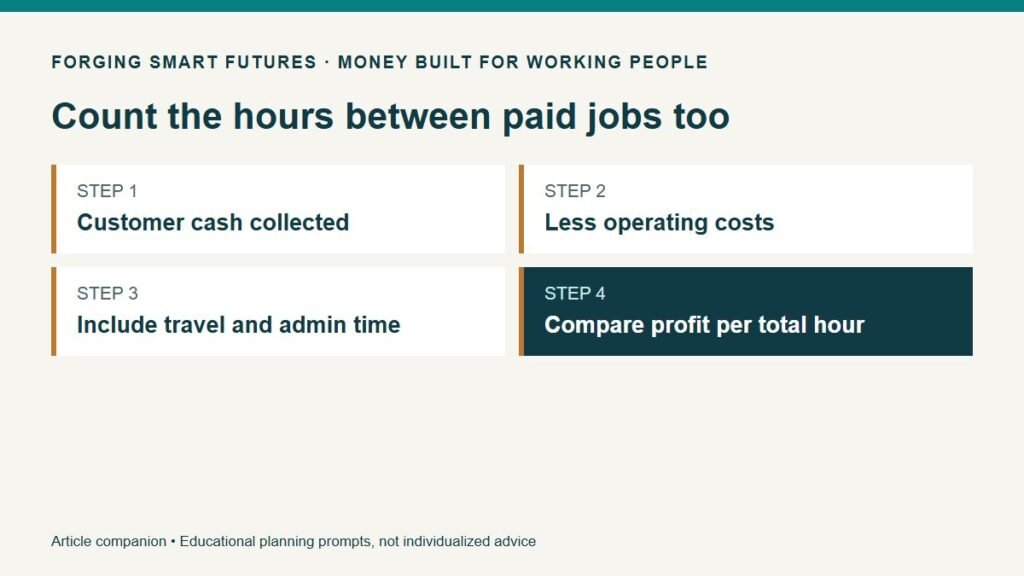
The customer payment is the beginning of the calculation
A $600 weekend job can sound like excellent extra income. Whether it is worthwhile depends on what you spent, how much time the job consumed, and what costs have not shown up yet.
For a simple operating view, subtract the business costs you assign to the period from revenue collected, then divide the result by all the hours spent earning it. Include unpaid travel, estimates, supply runs, setup, cleanup, scheduling and bookkeeping. Keep taxes separate unless you have independently determined an appropriate reserve.
This calculation gives an educational estimate of profit per total hour before taxes. It is not a payroll wage, an after-tax return or a legal determination of employment status.
Start with one consistent period
Use one completed job, week or month. Do not mix a month's revenue with one weekend's expenses. If a customer has not paid, distinguish the invoice from money actually collected. The FSF calculator uses collected revenue so its result is easy to trace to cash.
Keep another record of unpaid invoices. A profitable quote can still leave you short if the customer pays after your material bill is due. Payment timing belongs beside profitability when you evaluate a gig.
Write the job or period at the top of the worksheet. Record the evidence you used: invoice, payment confirmation, receipt and time log. You do not need a complicated software system to begin with accurate records.
Count costs that belong to the work
List materials, job-specific rentals, payment or platform fees, parking and other direct spending. Add a reasonable, documented way of recognizing recurring business costs in your management view. Insurance, equipment maintenance and replacement do not disappear because they are paid only occasionally.
Avoid double-counting. If a vehicle-cost estimate already includes fuel, adding the same fuel purchase again overstates the cost. If you charged a customer separately for materials, ensure both the collected reimbursement and the related material expense are treated consistently in your operating worksheet.
A cash worksheet also has limits. Buying a $700 tool this weekend creates a large cash outflow, but the tool may support many jobs. A per-job management estimate may allocate equipment use across jobs while a cash-flow sheet records the actual purchase. Keep both views and label them; do not confuse either with tax accounting rules.
Record the hours that disappear between jobs
Someone may pay you for twelve hours onsite, while the business consumes eighteen hours overall. The difference matters when the side gig shares time with a full-time job, commuting, family responsibilities and rest.
Track time in practical categories: doing the work, travel, estimates and customer messages, purchasing and preparation, cleanup, and administration. Use the same start/stop approach consistently. If you estimated the time afterward, mark it as an estimate and improve the record next time.
Do not omit unsuccessful quotes. They are part of finding paying work. A single job calculation may look strong while the month's total reveals many hours spent chasing jobs that never happened.
Work through a fictional weekend
Alex collects $600 for a weekend service job. The worksheet includes $180 of assigned costs: materials, travel costs and a share of other operating costs. Alex spends twelve hours performing the job and six more on travel, preparation, quoting and administration.
| Measure | Calculation | Result |
|---|---|---|
| Revenue collected | Customer payment | $600 |
| Assigned operating costs | Entered costs | $180 |
| Profit before taxes | $600 – $180 | $420 |
| Total time | 12 + 6 hours | 18 hours |
| Profit per total hour before taxes | $420 / 18 | $23.33 |
Looking only at customer payment divided by onsite time would produce $50 per hour. That number omits both costs and unpaid time. The $23.33 figure is more informative for this example, but still depends on whether Alex included every relevant cost.
Suppose Alex separately chooses a $90 tax reserve based on information outside this calculator. The cash left after that reserve is $330. The tool does not claim $90 is Alex's actual tax liability, and it does not turn the $330 into a guaranteed spendable paycheck. Unpaid upcoming business bills may still need funding.
Compare changes one at a time
If Alex could reduce total time from eighteen to fifteen hours without reducing quality or leaving work uncounted, the same $420 profit would be $28 per total hour. If instead costs rose by $60 while time stayed at eighteen hours, profit would be $360, or $20 per total hour.
Use these comparisons to identify questions, not to justify optimistic assumptions. Could batching supply purchases actually save time? Does a farther-away customer add costs? Would a clearer written scope reduce unpaid return visits? Would a higher quote cover the work, and would customers accept it?
A loss should remain visible. If collected revenue is $100 and costs are $150, the result is a $50 loss before taxes. The calculator should not hide it by displaying zero. Investigate why it happened and whether it is a one-time startup event or a recurring feature of the work.
Keep tax questions separate and documented
The IRS says gig-economy income must be reported even when it is part-time, temporary or side work, and even when no information form is issued. Its Gig Economy Tax Center links to guidance on records, expenses and paying taxes. IRS Gig Economy Tax Center.
A cost included in a personal profitability worksheet is not automatically a deductible expense. The tax treatment of equipment, vehicles and other costs can differ from your management estimate. Use current IRS guidance or qualified help for your circumstances. Do not apply a universal tax percentage from a social post.
Decide whether the work is worth repeating
Money is one part of the decision. Compare the operating result with the schedule, physical effort, reliability of demand, payment delays and risk. A side gig that uses skills you already have may be appealing, but it still needs a clear scope, appropriate permissions and realistic costs.
Before taking the next job, write the minimum information needed for a sound quote: work included, estimated materials and operating costs, total time, payment terms and what would count as extra work. Do not rely on a customer's casual description when the difference could mean hours of unpaid work.
Review a month of jobs once you have it. A business with several modest, repeatable jobs can have a different profile from a single large weekend payment. Use the records to see the pattern.
Use the True Hourly Side-Gig Calculator to work through your own example.
Financial-education disclaimer: General educational information, not individualized financial, investment, tax, legal or credit advice. All examples are fictional. The calculator does not determine tax liability, deductible expenses, insurance needs, worker classification or legal authority to perform a service.
Source: IRS Gig Economy Tax Center, accessed September 8, 2026. All figures, comparisons and calculations are original FSF examples.
Prepared by FSF Editorial Team. Last editorial review: September 8, 2026.
Editorial attribution: Paul Foster
Published: September 9, 2026
Sources & References
Put this into practice
Find out what a job earns after costs and all your time. Free Side Income checklist — no membership required.
Related decisions
- How to Price a Weekend Job Without Forgetting Your Costs
- Tool Rental or Purchase for a Side Job? Compare the Break-Even Point
- App-Based Gigs or Your Own Customers? Compare the Tradeoffs
Expanded member resource: Side-Gig Profit and Pricing Workbook. Guided exercises with local save, reopen and print controls. Worksheet answers are not automatically calculated. Compare free resources and FSF membership benefits.
Human-reviewed, AI-assisted content; how FSF creates articles.