
How to Budget When Overtime Changes Your Paycheck Every Month
The short answer
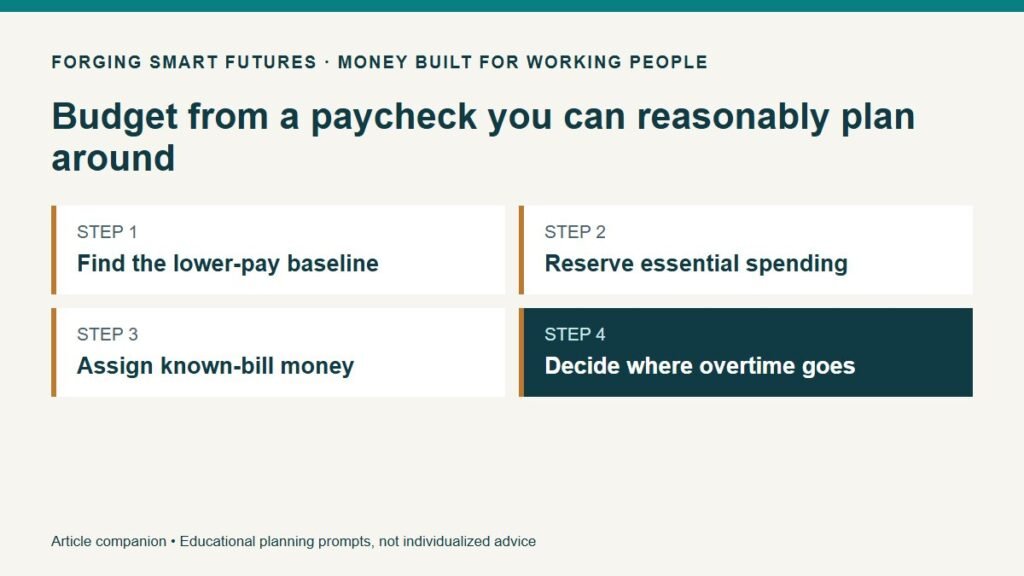
Build two views of your money: a baseline plan for a reasonably predictable lower-pay month, and an actual-pay plan for the money that really arrives. Cover the commitments in the baseline first. Decide how overtime will help before you spend it. Then put paydays and bill dates on a calendar, because a monthly surplus cannot pay a bill that comes due before the paycheck.
This approach will not make an inadequate paycheck adequate. Its purpose is to show which bills depend on extra hours, so you can make decisions with a clearer picture.
When the schedule changes but the bills do not
You work extra Saturdays for a few months. The larger deposits begin to feel normal. A truck payment, grocery spending and a few subscriptions settle around the bigger number. Then production slows, a project ends, or the schedule returns to forty hours. Your bills stay where they were.
That is a timing and commitment problem as much as a spending problem. A useful budget needs to distinguish money you regularly receive from money that depends on an uncertain schedule. It also needs to make room for the costs of earning it: fuel, meals away from home, childcare, parking or other work-related spending.
Use take-home deposits for this household exercise. Gross wages help you understand compensation, but your bank account receives what is left after payroll deductions. Do not estimate take-home overtime by multiplying extra hours by an assumed flat tax percentage. Your pay stub and actual deposit are the starting evidence; payroll and tax questions belong in a separate review.
1. Gather enough history to see the range
Collect recent pay stubs, deposit records and a bill list. Include a period with fewer extra hours if you have one. If work is seasonal, look back far enough to see the season that matters. A record from a busy project alone can give a misleading picture.
Write down the amount and date of each deposit. Mark unusual amounts: bonuses, travel reimbursements, retroactive pay or a one-time correction. A reimbursement that repays a work expense is not automatically spare household income.
Choose a baseline you can explain. It might be the take-home pay from a normal schedule without optional overtime, adjusted for deductions you know have changed. Someone with no guaranteed hours may need several scenarios instead of one confident number. Label the assumption rather than treating it as guaranteed income.
Keep the actual-pay view beside the baseline. You are not pretending that a larger check does not exist. You are deciding which commitments should rely on it.
2. List the commitments the lower-pay month must carry
Start with housing, basic utilities, food, transport needed for work, insurance, care responsibilities and required debt payments. These are household-specific categories, not a universal ranking of which bill to pay first. If you cannot pay everything, examine consequences and contact the relevant provider early; a calculator cannot resolve that decision for you.
Next, account for expenses that are predictable but do not arrive monthly. Tires, work boots, vehicle registration and annual premiums can make a good month look worse than it really is if you never reserve for them.
For a known bill, use the amount still needed and the paydays remaining. If a $480 bill is due in eight paydays and you have nothing set aside, the simple reserve is $60 per payday. If you already have $160 saved, the remaining $320 works out to $40 per payday. These are planning examples, not predictions of what a bill will cost.
Do not count a reserve twice. If you transfer $200 into a separate annual-bills account, that money is already assigned. When you later use it for the planned bill, do not also treat it as newly available spending money.
3. Work through a lower-pay and higher-pay example
Consider Jordan, a fictional equipment operator. Jordan's baseline monthly take-home pay is $3,200. The listed essential spending is $2,850, including debt minimums. Another $200 is assigned to known future bills.
| Monthly scenario | Baseline month | Overtime month |
|—|—:|—:|
| Take-home income | $3,200 | $3,800 |
| Listed essential spending | $2,850 | $2,850 |
| Known-bill reserve | $200 | $200 |
| Balance before other allocations | $150 | $750 |
The overtime month has $600 more income. The full $750 balance is not automatically free to spend: Jordan still needs to check omitted expenses and decide what belongs in savings, flexible spending or extra debt payments.
Suppose Jordan assigns the $600 increase as $300 toward a cash cushion, $200 toward an extra debt payment and $100 for flexible household spending. That is one illustrative allocation, not a recommended percentage split. A household behind on an essential bill would have a different problem to address.
Now test a worse month. At $2,800 take-home pay, the same commitments produce a $250 shortfall: $2,800 − $2,850 − $200. That tells Jordan to review the plan before the month starts. It does not mean Jordan failed at budgeting. The assumptions no longer support the commitments.
4. Check the dates, not just the total
The Consumer Financial Protection Bureau's cash-flow worksheet focuses on when income and expenses occur and carries each week's ending balance into the next week. That helps reveal a shortage hidden by a monthly total. CFPB cash-flow budgeting tool.
For example, suppose Jordan begins the month with $200 available, receives $1,600 on the fifth, and owes $1,200 rent on the first. The later paycheck does not solve the first-day shortage. The plan needs money reserved from a prior paycheck, an agreed timing change, or another realistic arrangement before that date.
Build a simple running balance:
- Start with cash available for this bill cycle, excluding money already assigned elsewhere.
- Add deposits on their expected dates.
- Subtract bills, realistic daily spending and planned transfers on their dates.
- Highlight any date the running balance becomes negative.
Include automatic payments and pending card transactions. A visible bank balance can overstate what remains available. Ask providers about due-date changes where appropriate, but do not assume the date has changed until they confirm it.
5. Give overtime a decision order
Before the next extra check arrives, write a short decision order. One example is: cover this pay period's commitments, replenish a reserve used for an essential need, fund upcoming known bills, then compare other goals. Your order should reflect your circumstances and any urgent obligations.
Make the rule specific enough to use after a tiring shift. “Be better with extra money” is difficult to act on. “After the next two weeks of bills are covered, move the amount agreed at our money check-in into the vehicle reserve” creates a concrete step.
Avoid committing the entire anticipated overtime amount before the hours are worked and the deposit is known. Schedules change. So do deductions and the work expenses that accompany extra shifts.
6. Make a low-hours response plan while things are calm
Identify expenses that can be adjusted quickly, those that require notice, and those that would be expensive or difficult to change. Canceling an optional renewal is different from changing housing or transportation. Record renewal dates and actual contract terms instead of assuming everything is immediately flexible.
Review automatic savings transfers when income falls. Do not let a well-intended transfer create an overdraft or leave a required payment unfunded. If the baseline regularly depends on overtime, label that clearly. You may need a broader income, benefits, debt or fixed-cost review; moving numbers between categories cannot eliminate a recurring gap.
If money is already short, use a near-term bill calendar first. A twelve-month spreadsheet can wait while you identify the next deposit, food and transport needs, bills due, and calls that could prevent avoidable fees or service disruption.
Common mistakes to catch
- Using the busiest month's deposit as normal income.
- Mixing weekly spending with a four-week monthly estimate. Most months cover more than four weeks.
- Treating a reimbursement or already-assigned reserve as extra cash.
- Sending a large extra debt payment before checking the next pay period's bills.
- Counting a positive monthly total as proof that every bill date is covered.
- Leaving the budget unchanged after a shift, benefit deduction or household responsibility changes.
Your next payday checklist
Before deciding what the overtime money can do, confirm the deposit, review bills through the following payday, allow for work and household spending, account for planned reserves, and update the running balance. Then choose the next useful job for any money left.
The FSF Variable Pay Budget Planner compares baseline and actual monthly pay with essential spending and known-bill reserves. The tool shows a scenario; it does not calculate payroll taxes or promise that future hours will be available.
Use the Variable Pay Budget Planner to work through your own example.
Financial-education disclaimer: FSF provides general educational information, not individualized financial, investment, tax, legal or credit advice. Examples are fictional and simplified. Your employment, household and account terms may differ.
Source: CFPB, Creating a Cash Flow Budget, accessed September 8, 2026. All Jordan figures and allocation examples are original FSF illustrations, independently calculated.
Prepared by FSF Editorial Team. Last editorial review: September 8, 2026.
Editorial attribution: Paul Foster
Published: September 9, 2026
Sources & References
Put this into practice
Build a plan that still makes sense when overtime falls. Free Budgeting checklist — no membership required.
Related decisions
- Why Your Overtime Check Is Smaller Than the Number in Your Head
- How Much Emergency Savings Do You Need When Your Hours Can Be Cut?
- Paid Every Two Weeks? Build a Bill Calendar That Fits
Expanded member resource: Variable Pay Household Planning Workbook. Guided exercises with local save, reopen and print controls. Worksheet answers are not automatically calculated. Compare free resources and FSF membership benefits.
Human-reviewed, AI-assisted content; how FSF creates articles.