
Small Investment Fees Can Become a Large Career-Long Cost
The short answer
Compare all relevant costs, then translate percentages into dollars on your balance. Recurring fees reduce the money left invested, which can also reduce future growth. The effect depends on the fee structure, balance, contributions, returns and time—not a guaranteed market outcome.
For a worker adding modest amounts after each paycheck, a fee may be easy to overlook because it is never presented as a bill to pay on Friday. It can still affect the account.
Separate the layers
The SEC distinguishes transaction costs from ongoing expenses and encourages investors to ask what they pay and how professionals are compensated. An investment can have costs even if placing the trade has no commission. Investor.gov understanding fees.
Look for account charges, fund expenses, advice or management charges, transaction costs and possible transfer or closure charges. Avoid double-counting: ask which costs are already included in a quoted total and which are additional. A fund's expense ratio and an adviser fee may describe different layers.
For workplace plans, use the actual participant fee information and fund disclosures. Do not compare one fund expense with another account's all-in charge and label the smaller figure the winner. Match the service and investment exposure being compared.
Translate a quote into dollars
Fictional example: assume a constant $10,000 balance for a simple annual screening comparison, with no growth, contributions or withdrawals.
| Fee layer | Option A | Option B |
|---|---|---|
| Fund expense assumption | 0.10% = $10 | 0.05% = $5 |
| Separate annual account fee | $0 | $60 |
| Simplified annual total | $10 | $65 |
Option B has the lower fund expense and the higher illustrated total. Real fund expenses generally affect fund assets rather than arriving as a separate annual invoice, and actual dollar costs vary with balances and terms. Do not expect this table to reproduce a statement to the penny.
If one option includes advice and the other does not, price is only part of the comparison. Describe the service you receive and whether you need it. Paying more does not establish better results, but comparing different services as if they were identical also misleads.
Watch small fixed charges on small balances
A $5 monthly charge is $60 per year. On a constant $1,000 balance, that equals 6% for this simple fee-to-balance comparison, before investment gains or losses. This does not mean the account literally applies a 6% annual rate; it shows why a modest-looking fixed fee deserves attention when the balance is small.
Ask whether waivers apply and whether your household can reliably meet them. A condition you satisfy during heavy overtime may not hold after reduced hours or a withdrawal.
A fictional 30-year illustration
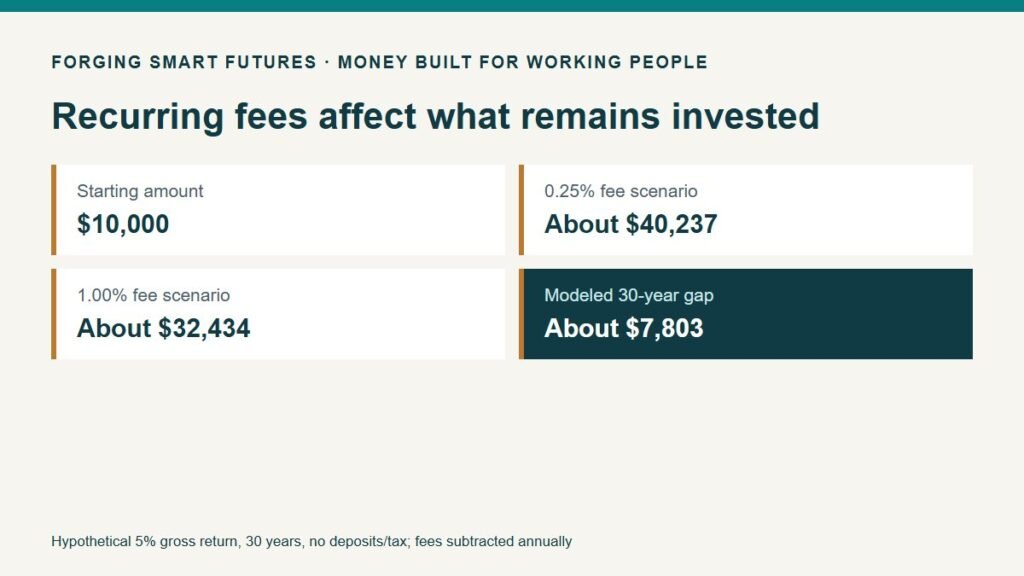
Assume a one-time $10,000 investment, no later deposits or withdrawals, a constant hypothetical 5% gross annual return, and annual fees modeled by subtracting 0.25 or 1 percentage point from that return before annual compounding. Ignore taxes and other costs.
| Simplified scenario | Modeled annual net growth | Value after 30 years |
|---|---|---|
| 0.25% annual fee | 4.75% | About $40,237 |
| 1.00% annual fee | 4.00% | About $32,434 |
The modeled difference is about $7,803. The formula is $10,000 × (1 + net annual rate)^30. This is an intentionally simplified fee illustration, not a forecast or an exact representation of daily fund expense accounting. Actual returns are uneven and can be negative.
The gap includes both higher modeled charges and growth no longer earned on the money removed. It should not be described as a bill of $7,803 that a provider necessarily collected.
Ask what you receive for a higher charge
Lower cost matters when comparing otherwise similar choices. It is not the only question. If an account charges for advice, ask what service is included, who provides it, how often it occurs, what limits apply and whether the service addresses your actual needs.
Someone starting with a straightforward account may value different support from someone coordinating several old workplace plans. A higher price does not prove better advice; a lower price does not explain whether two services are comparable. Ask for a clear description and fee schedule before deciding.
Do not sell or move investments solely from a quick fee calculation. Check potential taxes, transfer charges, investment changes and account rules first. The cost of a change belongs in the comparison too.
Run an annual fee check
Gather the latest statement, applicable fee schedule and investment disclosures. List each recurring charge, its basis and the dollar amount if known. Mark estimates as estimates. Identify any temporary waiver and its expiration date.
Then ask one focused question: “For my balance and intended activity, what would I pay over a year, including underlying investment expenses and any advisory charge?” Save the answer and compare it with the next statements. Revisit after a job change, account transfer or meaningful fee change.
Use the free Investing checklist at FSF Resources. For a workplace account, also read FSF's 401(k) match guide so that fees and employer benefits are evaluated in their proper context.
General financial education, not individualized investment, financial, tax, legal or credit advice. Investing involves risk. All modeled results are hypothetical; no affiliate relationship is included.
Editorial attribution: Paul Foster
Published: September 10, 2026 Last reviewed: September 18, 2026
Sources & References
- https://www.investor.gov/introduction-investing/getting-started/understanding-fees
- https://www.investor.gov/introduction-investing/general-resources/news-alerts/alerts-bulletins/investor-bulletins/updated
Put this into practice
Prepare better questions before choosing an account or investment. Free Investing checklist — no membership required.
Related decisions
- A Coworker Shared an Investment Tip: Check These Things Before Sending Money
- Target-Date Fund or a Few Index Funds in Your Workplace Plan?
- Company Stock in Your Retirement Plan: Your Job and Savings Can Share a Risk
Expanded member resource: Investing Foundations Research Workbook. Guided exercises with local save, reopen and print controls. Worksheet answers are not automatically calculated. Compare free resources and FSF membership benefits.
A simple portfolio framework: Our Bogleheads-style investing guide explains broad diversification, low costs, Fidelity fund examples and the limits of historical returns. Compare your own assumptions in its free scenario explorer.
Human-reviewed, AI-assisted content; how FSF creates articles.