
Paid Time Off, Sick Leave, and Unpaid Days: Build a Time-Off Budget
The short answer
Calculate how many scheduled hours the absence uses, what pay the leave replaces and which costs continue. A balance labeled “three days” can mean different things for an eight-hour worker and a twelve-hour shift worker. Verify the employer's rules before estimating the paycheck.
The federal FLSA generally does not require vacation or sick pay, but other laws, contracts and employer policies may create rights. Do not treat that federal baseline as the whole answer for your workplace. DOL leave-benefit guidance.
Convert days into scheduled hours
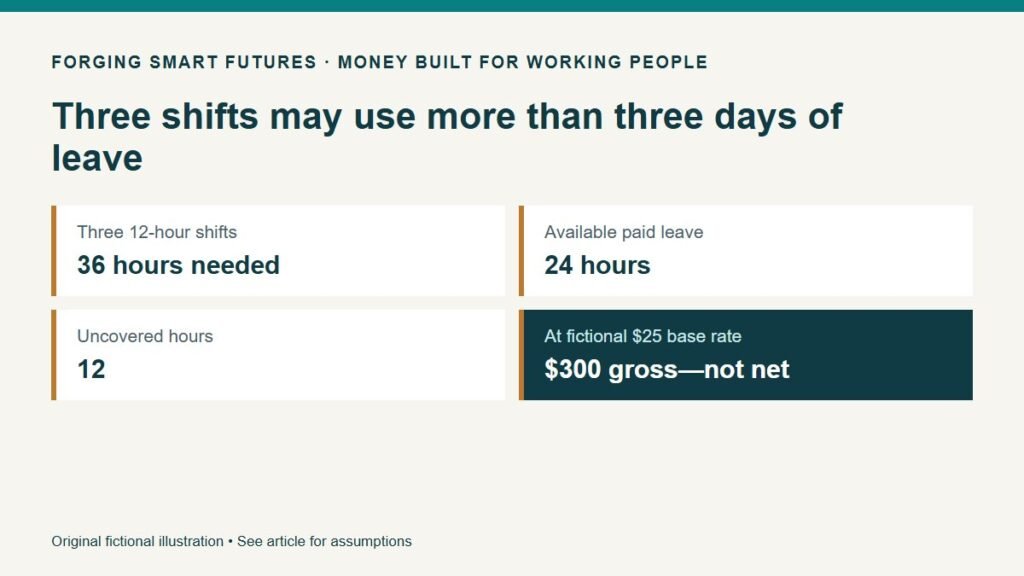
In a fictional schedule, you need three twelve-hour shifts off, totaling thirty-six hours. Your available paid-leave balance is twenty-four hours. If the policy requires leave for all scheduled hours and permits the remaining time unpaid, twelve hours are not covered by that balance.
At an illustrative base rate of $25 per hour, those twelve hours represent $300 of gross base pay. The change in take-home pay is not necessarily $300 because taxes and other payroll items may change. Ask payroll for an estimate using the actual schedule and leave rules.
Do not assume a leave balance is immediately usable merely because it appears in the portal. Approval, eligibility, accrual timing or restrictions may apply. For protected leave, confirm the applicable process and rights rather than relying only on a supervisor's informal description.
Check what paid leave replaces
Ask whether leave pay includes shift differentials, overtime or only a defined base amount. Check how benefit deductions are handled during a smaller or missing paycheck. A full week of paid leave may still produce a different deposit from a busy overtime week.
Keep job protection, permission to be absent and wage replacement distinct. They can overlap but are not identical. Medical or caregiving leave may involve additional rules and documentation; use benefits staff, the relevant labor agency or qualified advice for those questions.
Build the cash gap from expected deposits
Suppose payroll estimates that the absence will reduce one take-home check by $240. Travel for the time off will cost $180, while commuting and work meals are expected to fall by $60. The fictional net cash need is $360: $240 plus $180 minus $60.
With six paychecks before the absence, setting aside $60 from each would cover that estimate. If only four paychecks remain, the target becomes $90 each. Treat this as a dated savings goal and revise it when costs or leave approval change.
Do not count savings that will not actually occur. A monthly parking pass already paid may cost the same even if you miss several shifts. Likewise, childcare may require payment to retain a place during your absence.
Leave room for unplanned days
Using every available paid hour for a planned trip can leave no balance for another absence. Whether that is acceptable depends on the policy, household cash and other coverage. Write down the remaining hours after the planned leave and compare them with a realistic contingency.
If your employer uses one combined bank for vacation and illness, the same hours cannot fund both plans. If separate banks exist, do not assume unused hours in one can be used for another purpose.
Verify the return-to-work paycheck
An absence can affect more than one payroll period depending on cutoff dates. Record which check will be smaller and when regular pay is expected to resume. Keep the next bill dates visible so an apparently small annual cost does not create a short-term overdraft.
After the absence, compare the deduction and leave balance with the approved request. Raise discrepancies through the employer's process and retain the confirmation.
Your next action
Write the scheduled hours, paid hours and estimated take-home change before committing to optional spending. Use the FSF bill-calendar guide and irregular-expense plan to fund the gap. Existing free and member tools are identified on the Resources page.
General education, not individualized employment, legal, tax or financial advice. Examples are fictional and conditional on stated policy assumptions. No affiliate relationship is presented.
Editorial attribution: Paul Foster
Published: September 10, 2026 Last reviewed: September 10, 2026
Sources & References
- https://www.dol.gov/general/topic/benefits-leave
Put this into practice
Compare written pay, time and benefit terms on the same basis. Free Work & Compensation checklist — no membership required.
Related decisions
- Training Reimbursement and Sign-On Bonuses: Read the Payback Clause
- Pay for Trade School Without Letting the Monthly Payment Hide the Total Cost
- Returning to Work After Caregiving: Budget the Gap Before the First Paycheck
Expanded member resource: Total Compensation Decision Workbook. Guided exercises with local save, reopen and print controls. Worksheet answers are not automatically calculated. Compare free resources and FSF membership benefits.
Human-reviewed, AI-assisted content; how FSF creates articles.