
When a Five-Week Month Breaks Your Grocery and Fuel Budget
The short answer
Count the shopping trips and workdays that actually fall in the month. A budget built as “weekly spending times four” funds only 48 weeks across twelve months. Use an annualized average for planning, but keep enough cash available for months with more spending occasions.
The calendar, not a change in your habits, can explain why an apparently normal month costs more than expected.
Four weeks is not an average month
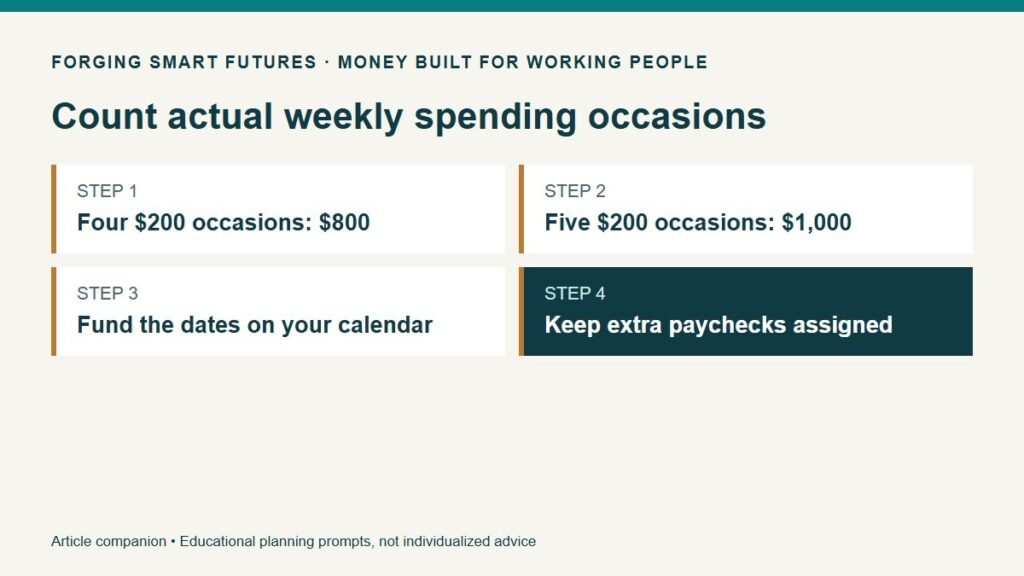
Suppose your fictional household spends $140 on groceries and $60 on fuel each week: $200 total. Multiplying by four gives $800. Repeating that twelve times budgets $9,600 for the year.
Using a 52-week planning assumption gives $10,400, or about $866.67 per month. The four-week method misses $800 across that assumed year. Actual calendar dates can produce different counts for a chosen weekday, so use the real schedule when planning payments.
Neither $200 nor the resulting monthly amount is a suggested spending target. The point is the counting method. Use your own receipts and work schedule.
Average funding and actual spending are different
An average helps spread funding across months. It does not mean your fifth grocery trip can be paid for with money that arrives next month.
| Fictional month | Weekly spending occasions | Spending at $200 each |
|---|---|---|
| Month A | 4 | $800 |
| Month B | 5 | $1,000 |
If you allocate $866.67 each month, Month A leaves $66.67 in that category. Month B needs $133.33 beyond that month's allocation. The first surplus alone does not cover the second difference; the reserve depends on the full sequence and your starting balance.
This is why “it averages out” is not a complete cash plan. You need to retain the category's unspent money, know how much is there and check the next month before treating it as spare cash.
Count your real triggers
Groceries may happen every seven days, twice a month or whenever the refrigerator runs low. Fuel may depend more on commuting days and distance than shopping dates. Separate those patterns instead of forcing everything into one weekly label.
For fuel, count expected trips and use a realistic cost estimate from recent use. If you work fewer shifts, commuting may fall while household driving continues. If extra shifts are added, add the associated transport and meal costs as well as the hoped-for pay.
For groceries, note whether a larger trip replaces a later one. A stock-up purchase followed by lower spending is different from a fifth ordinary trip. Avoid counting the full stock-up amount and an unchanged weekly pattern unless both are actually expected.
The CFPB's money-management toolkit includes spending trackers and bill calendars. Those records can help distinguish a calendar effect from an increase in the amount spent each time.
Choose a funding method you can maintain
One option is a monthly average with a carried-forward category balance. Another is funding the number of spending occasions between each payday. A third is a simple calendar with an amount written beside each planned shop or workweek.
Whatever you choose, write down the opening category balance, new funding, actual spending and remaining balance. The total allocation across categories must still fit the money you have. A category reserve is not additional cash on top of the bank balance.
If your current month is already short, changing the average does not create the missing money. You may need to adjust purchases, use an existing appropriate reserve or revise other flexible spending. Keep necessary nutrition and travel needs realistic; a number that cannot be followed is not a workable correction.
Do not automatically spend an additional paycheck
A month with an extra payday may also contain extra weekly expenses. Before assigning that deposit to a goal, list the costs it must cover through the next deposit. This is especially useful for weekly or every-other-week pay.
Separate genuine remaining money from the part that simply funds more days. You can still use an unusually strong month to advance a goal, but make the calendar comparison first.
Your next ten-minute check
Mark the next six weeks of shopping dates and workdays. Write an amount beside each expected spending occasion. Compare the total with what your current budget actually allocates during those dates.
Then check the FSF Variable Pay Budget Planner using the corrected spending total. If the monthly comparison improves but a particular week remains short, solve the timing separately. The goal is to stop treating a predictable calendar pattern as a recurring surprise.
General education only, not individualized financial, investment, tax, legal or credit advice. Examples are fictional and depend on the stated assumptions. Prepared with AI assistance by FSF Editorial Team; reviewed for publication by the FSF publisher.
Editorial attribution: Paul Foster
Published: September 10, 2026 Last reviewed: September 10, 2026
Sources & References
Put this into practice
Build a plan that still makes sense when overtime falls. Free Budgeting checklist — no membership required.
Related decisions
- Paid Every Two Weeks? Build a Bill Calendar That Fits
- Stop Letting Tires and Work Boots Become Financial Emergencies
- A First-Paycheck Budget for Apprentices Living Away From Home
Expanded member resource: Variable Pay Household Planning Workbook. Guided exercises with local save, reopen and print controls. Worksheet answers are not automatically calculated. Compare free resources and FSF membership benefits.
Human-reviewed, AI-assisted content; how FSF creates articles.