
A Coworker Shared an Investment Tip: Check These Things Before Sending Money
The short answer
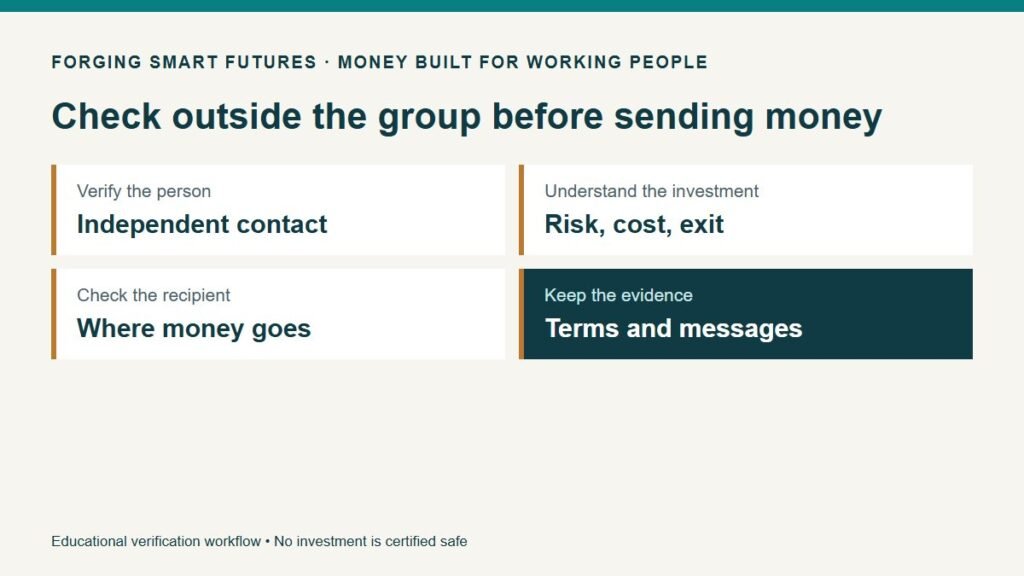
A trusted coworker can unknowingly pass along an untrustworthy investment offer. Independently verify the person, firm, investment and destination for money. Group activity, profit screenshots and familiar names are not substitutes for that work. Pressure to act before you can verify is a reason to stop.
After a long shift, a message promising an easier way to grow an overtime check can be appealing. The useful response is a repeatable pause-and-check routine, not embarrassment about having considered it.
Separate the messenger from the investment
Ask where the coworker found the offer and what they have verified personally. “My balance went up in the app” is different from independently confirmed ownership of an investment. “The group says the adviser is licensed” is different from checking official records and contacting the firm through independently obtained details.
FINRA warns about investment groups whose organizers impersonate professionals and may move participants into manipulated-stock schemes. Apparent fellow investors can help make an offer look credible. FINRA investment-group alert.
Treat a real person's name or registration number as something to cross-check, not final proof. An impersonator can copy accurate public details. Verify contact information independently rather than using the phone number or link supplied by the person seeking money.
Use a four-part verification sheet
Person and firm: Record the claimed legal names. Use official regulator resources to investigate the professional and firm, then contact them through independently verified channels. Ask whether this particular communication and offer are theirs.
Investment: Write what you would own, how it could make money, how it could lose money, its fees and how you could exit. If the explanation depends on a secret method or a guarantee that nothing can go wrong, the unanswered questions remain.
Money destination: Identify the legal recipient and why payment is going there. Do not send funds merely because a chat administrator provides instructions. A new personal account or unexplained change in recipient needs resolution before any payment.
Documents and pressure: Save the offer, terms and messages privately. Note deadlines and reasons given for secrecy. A legitimate-looking document does not verify itself; compare it with information obtained outside the solicitation.
These checks help expose problems. They cannot certify that an investment is safe or suitable.
A fictional claim worth slowing down for
Suppose a chat promises 2% every week with no losing weeks. Simple compounding of that claim gives 1.02^52, or about 2.80 times the starting money after one year—a gain of roughly 180%, assuming every promised gain is reinvested.
That arithmetic does not validate the claim. It makes its scale explicit. A $1,000 starting amount would supposedly become about $2,800 under those assumptions. Before admiring the number, ask what economic activity could support the promise and who bears losses. A screenshot of an increasing app balance does not answer either question.
The SEC identifies unrealistic returns and online promotion as recurring fraud concerns. Investor.gov internet and social-media fraud guidance.
A reply that does not start a workplace argument
Try: “Thanks for thinking of me. I do not send money from a chat link. I need to verify the firm independently and understand the investment first.” This states your process without accusing your coworker of wrongdoing.
If someone keeps pushing, you do not owe them account details, screenshots or an explanation of your savings. Protect employer information too; a workplace connection is not permission to share payroll records or coworker contacts.
If money or personal information has already been sent
Stop further transfers and contact the financial institution involved through its official channel promptly. Preserve messages, transaction details and recipient information. Follow the FTC's steps for people who were scammed. Do not pay a new unsolicited “recovery expert” simply because they promise to retrieve the money; the FTC also warns about refund and recovery scams.
Change compromised credentials through official sites and investigate identity-protection steps if personal information was exposed. Avoid deleting the entire conversation before preserving evidence. There is no guarantee that funds can be recovered, but quick, documented action is more useful than sending another payment to unlock a supposed withdrawal.
Keep the free Investing checklist from FSF Resources available for future decisions. Your overtime took real hours to earn; an investment can wait while you establish what it actually is.
General financial education, not individualized investment, financial, tax, legal or credit advice. The scenario is fictional. No investment return or recovery is promised, and no affiliate relationship is included.
Editorial attribution: Paul Foster
Published: September 10, 2026 Last reviewed: September 10, 2026
Sources & References
- https://www.finra.org/investors/insights/investment-group-imposter-scams
- https://www.investor.gov/protect-your-investments/fraud/types-fraud/internet-and-social-media-fraud
- https://consumer.ftc.gov/articles/what-do-if-you-were-scammed
- https://consumer.ftc.gov/articles/refund-and-recovery-scams
Put this into practice
Prepare better questions before choosing an account or investment. Free Investing checklist — no membership required.
Related decisions
- Target-Date Fund or a Few Index Funds in Your Workplace Plan?
- Company Stock in Your Retirement Plan: Your Job and Savings Can Share a Risk
- Investing During a Market Drop When Your Overtime Has Also Disappeared
Expanded member resource: Investing Foundations Research Workbook. Guided exercises with local save, reopen and print controls. Worksheet answers are not automatically calculated. Compare free resources and FSF membership benefits.
Human-reviewed, AI-assisted content; how FSF creates articles.