
Investing During a Market Drop When Your Overtime Has Also Disappeared
The short answer
Address the household cash shortage and the investment decision separately. Recalculate income and essential commitments first. Then review whether your investment plan still fits your time horizon and ability to take losses. Neither “sell everything” nor “buy the dip” is a complete answer when the next rent payment is uncertain.
FINRA emphasizes cash flow and emergency reserves as part of an investment foundation. SEC guidance connects allocation to time horizon and risk tolerance. Together, those ideas support reviewing changed circumstances without pretending anyone can identify the market bottom. FINRA financial foundations, SEC allocation guidance.
Work out the new monthly gap
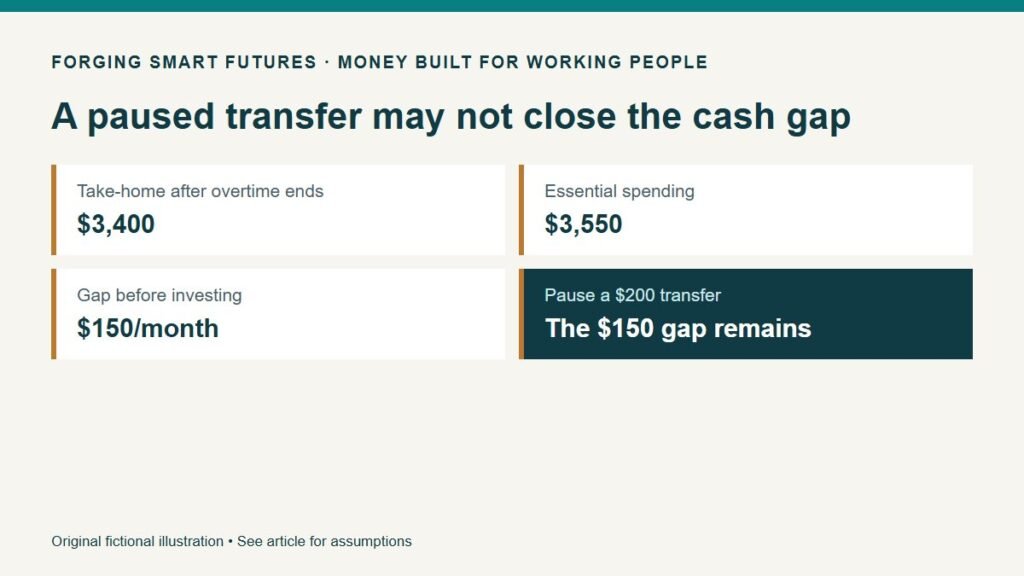
In a fictional household, take-home pay falls from $4,200 with overtime to $3,400 without it. Essential bills and ordinary spending total $3,550. Before any other changes, the household has a $150 monthly shortage.
Suppose it also makes a $200 monthly transfer from checking into a taxable investment account. Including that transfer, checking falls by $350 each month. Pausing that particular transfer would reduce the drain to $150, but it would not make the household budget balanced.
The example deliberately uses an after-tax bank transfer, not a payroll 401(k) contribution. Changing a pre-tax payroll election affects take-home pay differently and may affect an employer match. Ask payroll for the actual result rather than assuming every stopped contribution adds the same amount to your deposit.
Map the first shortage, not just the average
Put current cash, upcoming deposits and bills on dates. A monthly deficit of $150 can contain a larger shortage before payday. Contact providers early about available options rather than waiting until an automatic payment fails.
Review flexible spending, upcoming irregular bills and any temporary income that is realistic. Keep estimates marked as estimates. Do not fund next week's bill with overtime that has not been scheduled or a side job that has not paid.
The FSF variable-pay budget and hours-cut emergency-savings guide focus on this cash problem.
Give the investment money a time horizon
Money needed for near-term bills has a different job from money intended for retirement decades away. If a downturn reveals that near-term spending depended on selling volatile investments, record that mismatch. Do not assume a recovery will arrive before the bill.
At the same time, a lower account balance alone does not establish that selling is appropriate. Review the investment's purpose, diversification, costs and risks alongside your changed capacity. A decision based on cash needs is different from a prediction about tomorrow's market.
If selling or withdrawing is necessary, understand taxes, account restrictions and any additional tax before acting. This article does not recommend a specific sale order or retirement withdrawal.
Test reserve duration without calling it a guarantee
With $1,200 of available reserves and an unchanged $150 monthly shortfall, simple division gives eight months. That assumes no new expense, no income change and no need to preserve a separate minimum balance. A $600 repair would cut the remaining $600 to four months at the same deficit.
This is a stress test, not permission to wait eight months before adjusting. Update the cash plan as facts change and distinguish money truly available from funds already reserved for insurance or another known bill.
Decide what to revisit and when
Write the temporary changes, their effect on cash and a review date. Track whether hours return, expenses stabilize or reserves keep falling. If you pause an investment transfer, set a prompt to reconsider it when the household has room again rather than letting a temporary decision become invisible.
Avoid borrowing simply to speculate on a recovery you cannot time. Be especially careful with claims that a product offers guaranteed high returns during a market crisis; verify the person, product and risks independently.
Your next action
Calculate the next thirty days of cash before opening the investment app. Bring unresolved allocation or withdrawal questions to a qualified professional. Existing free and member planning resources are clearly labeled on the FSF Resources page.
General education, not individualized investment, debt or tax advice. Examples are fictional. No market recovery date, return or affiliate relationship is promised.
Editorial attribution: Paul Foster
Published: September 10, 2026 Last reviewed: September 10, 2026
Sources & References
- https://www.finra.org/investors/investing/investing-basics/financial-foundations
- https://www.investor.gov/introduction-investing/getting-started/asset-allocation
Put this into practice
Prepare better questions before choosing an account or investment. Free Investing checklist — no membership required.
Related decisions
- Your First Investing Steps When There Is Finally Room in the Paycheck
- Compare Brokerage Accounts When You Are Starting Small
- What an Index Fund Actually Owns—and Why That Matters to Your First Portfolio
Expanded member resource: Investing Foundations Research Workbook. Guided exercises with local save, reopen and print controls. Worksheet answers are not automatically calculated. Compare free resources and FSF membership benefits.
A simple portfolio framework: Our Bogleheads-style investing guide explains broad diversification, low costs, Fidelity fund examples and the limits of historical returns. Compare your own assumptions in its free scenario explorer.
Human-reviewed, AI-assisted content; how FSF creates articles.