
Your Hours Were Cut: What to Review Before the Next Payday
The short answer
Confirm when the reduced hours affect take-home pay, place that smaller deposit on the bill calendar and identify the first date money runs short. Contact providers and relevant benefits agencies early. Do not wait for a monthly average to reveal a shortage already arriving next week.
This article handles the immediate response. Building a reserve before a future reduction is a separate task covered in FSF's hours-cut savings guide.
Verify the paycheck change
Ask which pay period contains the cut, the hours actually scheduled and whether payroll deductions will change. A reduction from forty hours to thirty is not necessarily an identical percentage reduction in take-home pay because deductions may not move proportionally.
Use a conservative estimate until the actual pay statement is available. Keep confirmed hours separate from offered shifts and unapproved overtime. If hours may recover, show that as a second scenario rather than using it to erase the lower-pay case.
Also ask whether the schedule change affects health coverage, paid leave or other benefits. Obtain the plan's answer and effective dates; do not infer eligibility from a coworker's experience at a different employer.
Find the first shortage, not just the monthly shortage
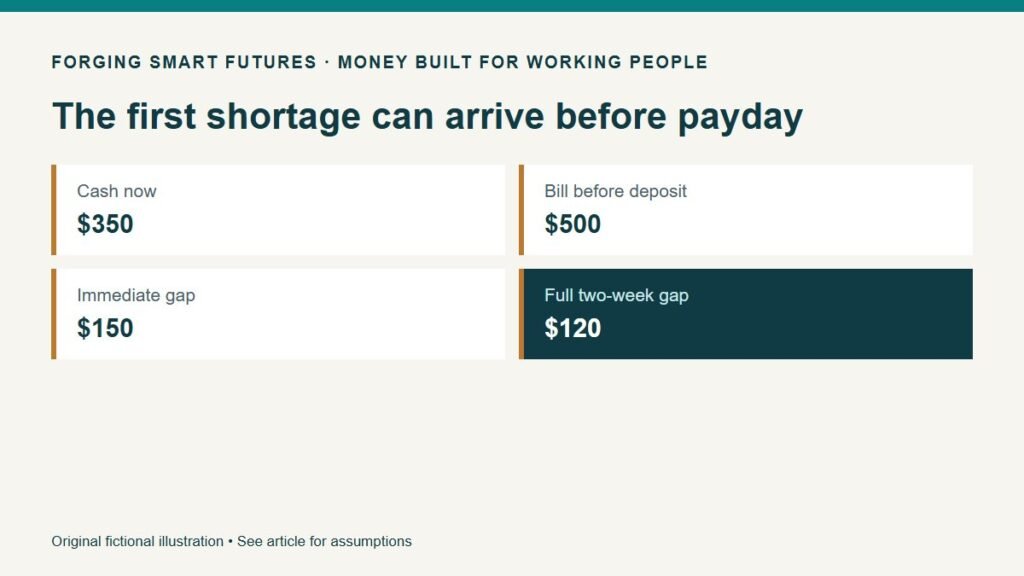
Here is a fictional two-week window. Available cash is $350. A reduced deposit of $950 arrives Friday. Before the following payday, listed essentials and required payments total $1,420. The overall window is short $120: $350 + $950 − $1,420.
But if $500 is due Thursday, the immediate shortage is already $150 before Friday's deposit. Solving only the $120 end-of-window total would miss that earlier problem. Put every major outflow on its actual date and include groceries, transport and childcare between formal bills.
The FSF biweekly bill-calendar guide provides a practical timeline method. Update it when the actual deposit arrives.
Call with a specific request
For a bill you cannot cover, prepare the account reference, due date, amount available and when income is expected. Ask about available hardship arrangements, changes to due dates or payment plans. Ask what fees, interest, credit reporting or later catch-up obligations apply. Get any agreement documented.
The CFPB's job-loss guidance recommends contacting lenders and providers when finances change and reviewing bills and coverage. Available help is not automatic. CFPB employment-disruption guidance.
Do not cancel insurance or ignore a court obligation simply because it is a large line item. Understand the consequences and seek appropriate help for the decision. Pause optional commitments where their actual cancellation terms allow it, and confirm automatic payments before assuming they have stopped.
Check official assistance without counting it prematurely
Ask the state unemployment agency whether reduced hours may qualify under its rules. The federal-state program's eligibility and benefit amounts depend on state law and individual facts. Start with the Department of Labor's unemployment information and the linked state contacts.
An application, an eligibility estimate and an approved payable benefit are different stages. Do not put an unconfirmed amount on Friday's cash calendar as though it were an employer deposit. Track information requests and reporting obligations through the official agency.
Check employer, union or community resources where applicable. Avoid paying a stranger who guarantees access to benefits or asks for account credentials through an unsolicited message.
Use the next payday as a checkpoint
Compare the actual pay statement with the estimate. Revise the following window and note which arrangements have been confirmed. If the cut persists, rebuild the baseline rather than treating each short check as an isolated surprise.
The free Starting Over checklist in FSF Resources can organize calls, dates and next actions. The first success is a realistic next-payday plan with its gaps visible—not a forecast that assumes work will immediately return to normal.
General financial education, not individualized financial, investment, tax, legal or credit advice. Fictional example; benefits eligibility is not determined here. No affiliate relationship is included.
Editorial attribution: Paul Foster
Published: September 10, 2026 Last reviewed: September 10, 2026
Sources & References
- https://www.consumerfinance.gov/consumer-tools/unexpected-job-loss/
- https://www.dol.gov/general/topic/unemployment-insurance?lang=en
Put this into practice
Make the next few weeks manageable before rebuilding the long term. Free Starting Over / Late-Starters checklist — no membership required.
Related decisions
- Find and Organize Old Accounts Before Making a New Money Plan
- Can You Afford a Career Change Later in Life? Build a Transition Budget
- A Payday Routine for Rebuilding Financial Confidence
Expanded member resource: Financial Restart Organizer. Guided exercises with local save, reopen and print controls. Worksheet answers are not automatically calculated. Compare free resources and FSF membership benefits.
Human-reviewed, AI-assisted content; how FSF creates articles.