
Can You Afford a Career Change Later in Life? Build a Transition Budget
The short answer
Build a transition timeline from the last dependable paycheck in the current job to stable take-home pay in the new one. Include training, missed earnings, benefits changes and the possibility that hiring takes longer than expected. Compare that funding need with cash actually available for the transition.
Later-career changes can improve working conditions or create a path out of physically demanding work. They can also occur when housing, family support and retirement obligations are less flexible. A transition budget makes the tradeoffs visible without deciding whether the career itself is right for you.
Describe the route, not just the destination salary
Write the actual steps: required training, application, examination, licensing where relevant, job search, start date and payroll schedule. Verify each with the school, employer or relevant authority. A completion certificate and a job offer are different milestones.
For earning expectations, use current local information and actual offers where available. CareerOneStop, sponsored by the Department of Labor, provides career, training and salary research tools. A published occupation figure is context, not a promise of starting pay. CareerOneStop.
Separate costs that happen once from costs that continue: tuition versus commuting; an exam versus recurring professional fees. Include earnings forgone during unpaid training, but do not add both lost gross pay and the same household cash gap in one total without explaining the different measures.
Calculate the funding gap using cash flow
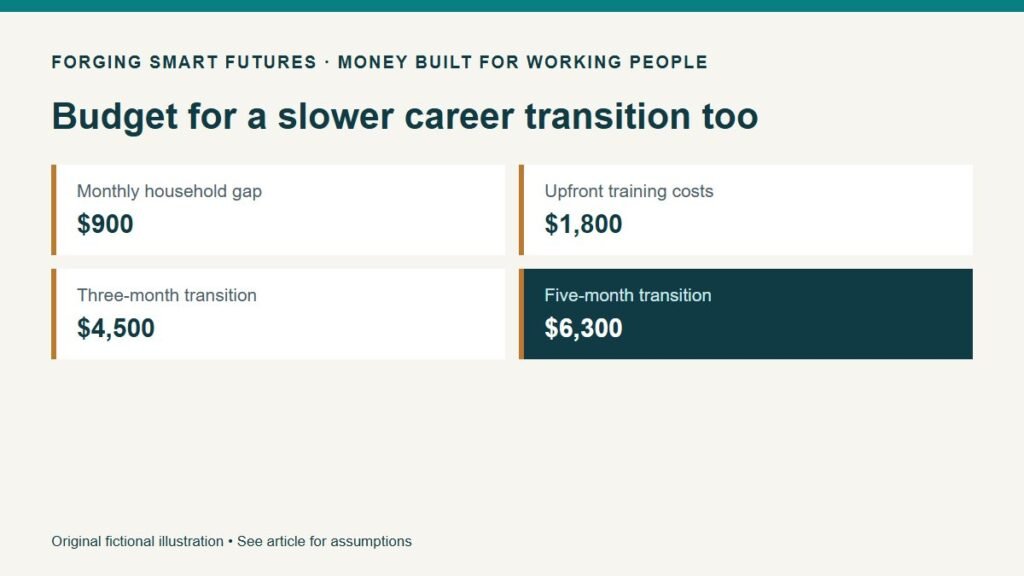
In a fictional transition, the household expects three months with $2,200 of monthly take-home income while essential outflows remain $3,100. That creates a $900 monthly gap, or $2,700 across three months. Upfront training and equipment cost $1,800. The planned funding need is $4,500 before contingencies.
If the transition takes five months at the same income, the gap becomes $4,500, plus $1,800 upfront, totaling $6,300. Two extra months add $1,800. This is why a single optimistic start date can make an otherwise careful plan look affordable.
Do not count emergency savings already assigned to another purpose as fully available here. Identify what reserve would remain after funding the transition and whether that remainder can handle household risks.
Put benefit changes on the same calendar
Ask when existing coverage ends and new coverage starts, what premiums the household must pay, and what happens to paid leave or other employer benefits. Get dates and amounts from the actual plans. Investigate continuation or alternative coverage using official information if a gap is possible; do not assume the new job covers the family immediately.
Review retirement-plan contributions, match eligibility and vesting terms separately. Avoid treating an old plan balance as easy transition cash before understanding withdrawal, tax and long-term implications. This article does not determine those consequences.
The FSF cost-of-going-to-work guide can help compare commuting, childcare and schedule-related costs between the two roles.
Define a decision point before spending
Set a date and evidence requirement for the next commitment. For example: enroll only after confirming the full training cost and employer demand; reduce hours only after a written schedule is available; leave the old job only after verifying the offer and first-paycheck timing where possible.
These are examples, not universal requirements. Some circumstances require leaving sooner. The value is making assumptions explicit so you know which change would require a revised plan.
Consider staged alternatives: part-time study, employer-supported training, a transfer within the same organization or testing the new work before a full switch. Compare their total time and cash demands rather than assuming slower always means cheaper.
Keep a transition dashboard
Track available transition cash, next commitment, actual spending, hiring progress and the date for reassessment. Update it after each material change. If the slower scenario exhausts cash, address that before paying another nonrefundable fee.
Use the free Starting Over and Work & Compensation checklists at FSF Resources. A useful budget lets you explain how the household gets from one job to the next, not just what the new salary might be.
General financial education, not individualized financial, investment, tax, legal or career advice. Numerical scenario is fictional; no employment result is promised. No affiliate relationship is included.
Editorial attribution: Paul Foster
Published: September 10, 2026 Last reviewed: September 10, 2026
Sources & References
- https://www.careeronestop.org/
Put this into practice
Make the next few weeks manageable before rebuilding the long term. Free Starting Over / Late-Starters checklist — no membership required.
Related decisions
- HSA or FSA at Open Enrollment: Compare Your Actual Plan Rules
- Paid Time Off, Sick Leave, and Unpaid Days: Build a Time-Off Budget
- Training Reimbursement and Sign-On Bonuses: Read the Payback Clause
Expanded member resource: Financial Restart Organizer. Guided exercises with local save, reopen and print controls. Worksheet answers are not automatically calculated. Compare free resources and FSF membership benefits.
Human-reviewed, AI-assisted content; how FSF creates articles.