
Rent or Buy When Your Income Depends on Overtime?
The short answer
Compare the full cost of each housing option on ordinary pay, then test a period without overtime. Include upfront cash, repairs and the possibility of moving for work. Mortgage approval and a manageable household budget answer different questions.
The CFPB includes taxes, insurance, association fees, maintenance and utilities in home-affordability planning, alongside the loan payment and cash needed to close. CFPB home-spending guidance.
Use two income scenarios
Write a regular-pay budget and an overtime-supported budget using actual take-home estimates. Do not assume every busy season repeats. Identify which housing costs could still be paid if overtime ended and how long reserves would support any gap.
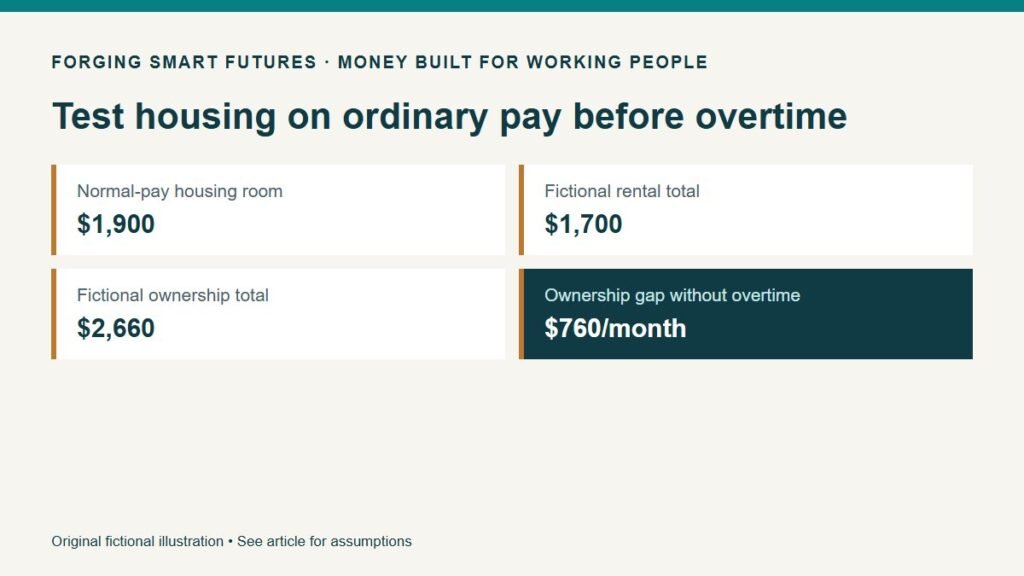
In a fictional example, normal take-home pay is $4,200 and overtime raises it to $5,000. Nonhousing spending and commitments total $2,300. That leaves $1,900 for housing and any remaining goals on ordinary pay, compared with $2,700 during the busy period.
The extra $800 may be useful for a down payment or reserves. Building an unavoidable monthly commitment around it creates a different risk from using it for optional progress.
Compare complete monthly cash commitments
Suppose renting costs $1,500 plus $25 renters insurance and $175 utilities: $1,700 total. A purchase scenario includes $1,650 principal and interest, $350 property taxes, $180 insurance, $60 association fees, $220 utilities and a $200 maintenance reserve: $2,660 total.
Against the normal-pay $1,900 allowance, renting leaves $200 while ownership creates a $760 monthly gap. On overtime pay, ownership leaves only $40. These are fictional numbers, not a recommendation to rent everywhere or an estimate for a specific home.
Avoid counting taxes and insurance twice if already included in the quoted mortgage payment through escrow. Conversely, do not omit them because a calculator displays only principal and interest. A maintenance reserve is a planning allocation, not a promise that repairs will stay within it.
Keep cash cost distinct from wealth building
Part of a mortgage payment may build equity, while interest, taxes and other costs do not. That matters in a long-term comparison, but equity does not directly pay next month's utilities. A home value increase is uncertain and accessing equity can involve costs or borrowing.
Rent also buys a place to live and shifts some maintenance responsibilities under the lease. Calling it “throwing money away” does not substitute for comparing the actual alternatives.
For a long-term rent-versus-buy analysis, include transaction costs, expected time in the home, opportunity cost of cash, maintenance and possible sale outcomes. This article's monthly test is an affordability screen, not a full investment-return model.
Protect the cash left after closing
List down payment, closing costs, moving costs and near-term work on the property. Then show what remains accessible. Do not spend the same savings on both closing and an emergency reserve.
If your job may require relocation, test a shorter stay. Selling can take time and cost money, and a sale price is not guaranteed. Renting has its own moving and lease costs; include those rather than assuming one route is frictionless.
Use a payment rehearsal
Before committing, consider setting aside the difference between your current housing cost and the projected new cost for several ordinary-pay periods. In the fictional comparison, the difference is $960 monthly. The exercise does not prove mortgage suitability, but it can expose a budget that only works when overtime is strong.
Keep the rehearsal money accessible and track whether other bills are being pushed onto cards to make it appear successful. Update the estimate when actual tax, insurance and repair information arrives.
Your next action
Build the normal-pay version first using the FSF variable-pay budget. Compare written loan and housing costs with a qualified professional where needed. Existing free and member tools are labeled on the Resources page.
General education, not individualized mortgage, investment, tax or real-estate advice. All prices and income figures are fictional. No loan approval, property return or affiliate relationship is promised.
Editorial attribution: Paul Foster
Published: September 10, 2026 Last reviewed: September 10, 2026
Sources & References
- https://www.consumerfinance.gov/owning-a-home/prepare/figure-out-how-much-you-want-to-spend/
Put this into practice
Compare the full commitment against a lower-income month. Free Major Financial Decisions checklist — no membership required.
Related decisions
- Helping Family Financially Without Missing Your Own Bills
- Cash, Payment Plan or Loan for an Urgent Home Repair?
- Lease or Buy a Vehicle When Work Puts on Heavy Mileage?
Expanded member resource: Big Purchase and Household Decision Workbook. Guided exercises with local save, reopen and print controls. Worksheet answers are not automatically calculated. Compare free resources and FSF membership benefits.
Human-reviewed, AI-assisted content; how FSF creates articles.