
Buy Now Pay Later for Tools and Work Gear: Add Up Every Due Date
The short answer
Evaluate the total purchase and every installment date against money available after existing commitments. Several small plans can create one large payday obligation. “No interest” does not mean no cash-flow risk or no possible fees.
The CFPB explains that missed BNPL payments can lead to consequences such as late fees where applicable, blocked further purchases and collection activity. Terms differ, so read the agreement for the actual product. CFPB BNPL repayment guidance.
Start with the work need
Write what the tool or gear is needed for, when it must be available and whether a lower-cost alternative can do the job safely. Check employer reimbursement, rental, repair or a delayed purchase where appropriate. Do not assume a work-related purchase is automatically deductible or that an employer must reimburse it in every situation.
Keep required protective equipment and safety specifications separate from price shopping. A cheaper item that does not meet the actual requirement is not a useful substitute.
Build one installment calendar
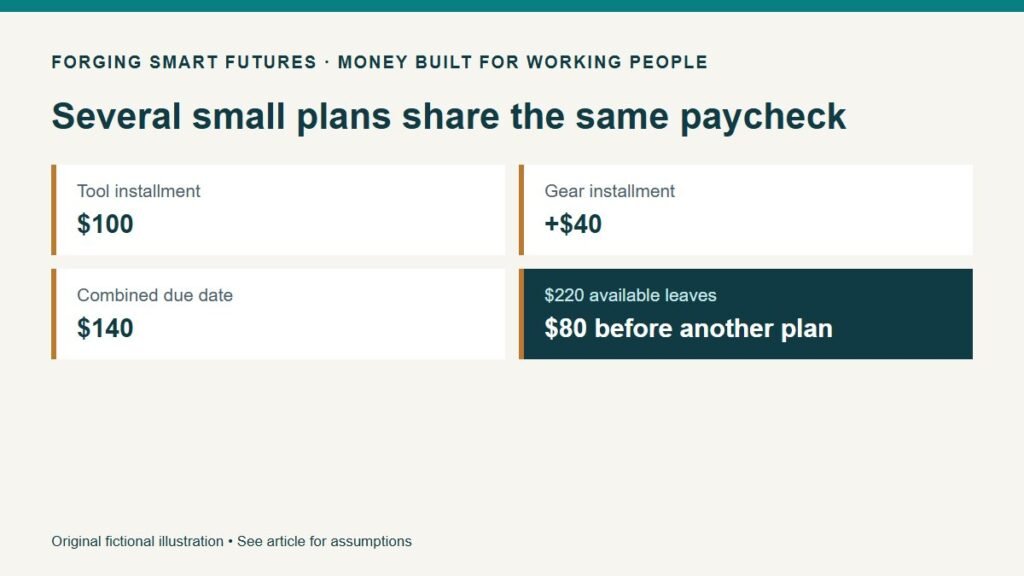
In a fictional offer, a $400 tool is paid in four $100 installments: today and at two-week intervals. A separate $160 gear purchase is paid in four $40 installments on the same dates. Together they require $140 each time and $560 in total, assuming no additional charges.
If the next paycheck has $220 left after existing bills and essentials, the combined installment leaves $80. Adding another plan with a $90 payment on that date creates a $10 shortfall. Each checkout page may show an affordable-looking amount while the combined calendar does not.
Record every existing plan before adding a new one. Include plans with another provider, since one app may not show obligations held elsewhere.
Stress-test the ordinary check
Use take-home pay without hoped-for overtime. If a payment falls before payday, use the cash available before that date, not the deposit arriving afterward. Leave room for ordinary costs between payments rather than allocating the entire balance to installments.
An automatic debit may still occur when your hours are cut or a customer has not paid. Check the payment method, timing and what happens if funds are insufficient. Understand both lender charges and possible bank charges under the relevant agreements.
Changing or canceling an automatic payment method does not necessarily cancel the debt. Follow the provider's process and confirm the remaining obligation rather than assuming the payment control is the loan agreement.
Read returns and disputes before you need them
Ask how a returned or defective item affects scheduled payments, when a refund is credited and which party handles the dispute. A store accepting a return does not necessarily mean the next installment has already stopped.
Keep the receipt, installment terms and return confirmation. Monitor the account until the balance or refund is correctly reflected. Do not invent a pause in payments based on an expected refund; obtain the provider's instructions and confirmation.
Compare total cost with the alternative
If the cash price and installment total are identical and all terms are met, the main difference may be timing. If a fee, higher product price or missed-payment charge applies, include it. Compare that cost with a realistic alternative, not with a savings plan you cannot complete before a genuine work need.
Avoid using repeated small plans to hide a recurring budget deficit. If ordinary gear replacement repeatedly requires financing, create a dated reserve target from actual replacement history. A small regular contribution may make the next purchase less dependent on the checkout offer.
Your next action
Enter the proposed payments beside all other bills using the FSF bill-calendar method. Review planning for tires and work gear for the next replacement. Existing free and member tools are labeled on the Resources page.
General education, not individualized credit, legal, tax or financial advice. All purchases and terms are fictional. No lender or affiliate relationship is endorsed.
Editorial attribution: Paul Foster
Published: September 10, 2026 Last reviewed: September 10, 2026
Sources & References
- https://www.consumerfinance.gov/ask-cfpb/what-happens-if-i-cant-pay-back-a-buy-now-pay-later-bnpl-loan-en-2116/
Put this into practice
Put balances, dates and written terms in one usable plan. Free Debt & Credit checklist — no membership required.
Related decisions
- How to Use Overtime to Pay Down Debt Without Leaving Yourself Short
- Debt Snowball or Avalanche When Your Extra Pay Changes Each Month?
- Balance Transfer or Consolidation Loan? Compare the Whole Payoff Job
Expanded member resource: Debt Organization and Decision Workbook. Guided exercises with local save, reopen and print controls. Worksheet answers are not automatically calculated. Compare free resources and FSF membership benefits.
Human-reviewed, AI-assisted content; how FSF creates articles.