
Rebuilding a household budget around a smaller paycheck
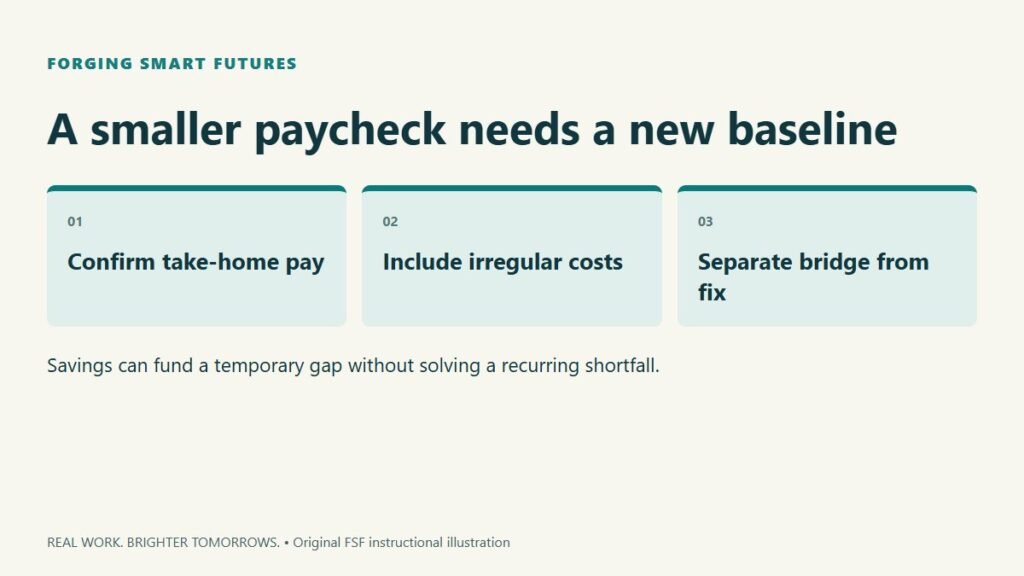
When take-home income drops for more than a pay period or two, the old budget may need a new foundation. Small cuts can help, but they should not be asked to solve a structural gap they are too small to cover. Start with dependable income and actual obligations, then separate immediate adjustments from decisions that need time.
This article addresses the ongoing household reset. For the first urgent days after reduced hours, use the hours-cut guide.
Find the size of the gap before choosing a fix
In this fictional example, take-home income falls from $4,400 to $3,600. Known monthly expenses are $3,850. Canceling $60 of optional subscriptions reduces expenses to $3,790, leaving a $190 shortfall. The canceled subscriptions helped; they did not finish the job.
Now add a $120 monthly reserve for known irregular expenses that were missing from the original list. The remaining gap is $310. A budget can look balanced only because costs have been omitted. Review insurance renewals, work expenses, transport repairs and household care needs before calling a plan complete.
The CFPB's cash-flow tools organize income and spending by timing. Here, use that approach to find both the recurring monthly gap and any earlier bill-date shortage. CFPB cash-flow and bill tools
Sort changes by when they can work
| Time window | Possible action to evaluate | What must be checked |
|---|---|---|
| This week | Pause optional new spending; confirm bill amounts | Cancellation conditions and essential needs |
| This month | Ask about available billing arrangements; revise household routines | Written approval, total cost and effective date |
| Longer horizon | Housing, transport, work pattern or care arrangement | Transition costs and whether the change really reduces total spending |
A lower monthly payment can come with a longer repayment term or higher total cost. A cheaper home can require moving expenses and a longer commute. Compare the whole change rather than just the advertised monthly number.
Separate a temporary bridge from a permanent answer
Savings can cover a shortfall for a period, but that does not make the recurring budget sustainable. Write the amount of savings actually available, the expected draw each month, and what would end the draw. Mark uncertainty explicitly if replacement income has no confirmed start date.
Do not automatically count overtime, a new side business or an unapproved benefit as the answer. Show those as separate scenarios. If household separation or caregiving changed the finances, clarify account responsibilities and care costs before reallocating money.
Keep one affordable source of enjoyment visible
An ongoing budget needs to fit a life, not only a list of obligations. If there is room after necessary commitments, deliberately name a modest recreation amount rather than assuming every enjoyable activity must disappear. If there is no room yet, look for an option without a new financial commitment. Avoid financing “one last purchase” before cutting back.
Use account organization after divorce, returning after caregiving, or the overtime budget for the circumstances that apply. Recheck after the first full month of real results. The revised plan should explain what happens next, including what still does not fit.
Human-reviewed, AI-assisted content; how FSF creates articles.
Editorial attribution: Paul Foster
Published: September 27, 2026 Last reviewed: September 18, 2026