
Before buying a course or app, name the job it will do
Buying something can feel like making progress. Sometimes it is: a useful tool removes a real obstacle. Other times, you have bought another task, subscription or folder of lessons you do not have time to use.
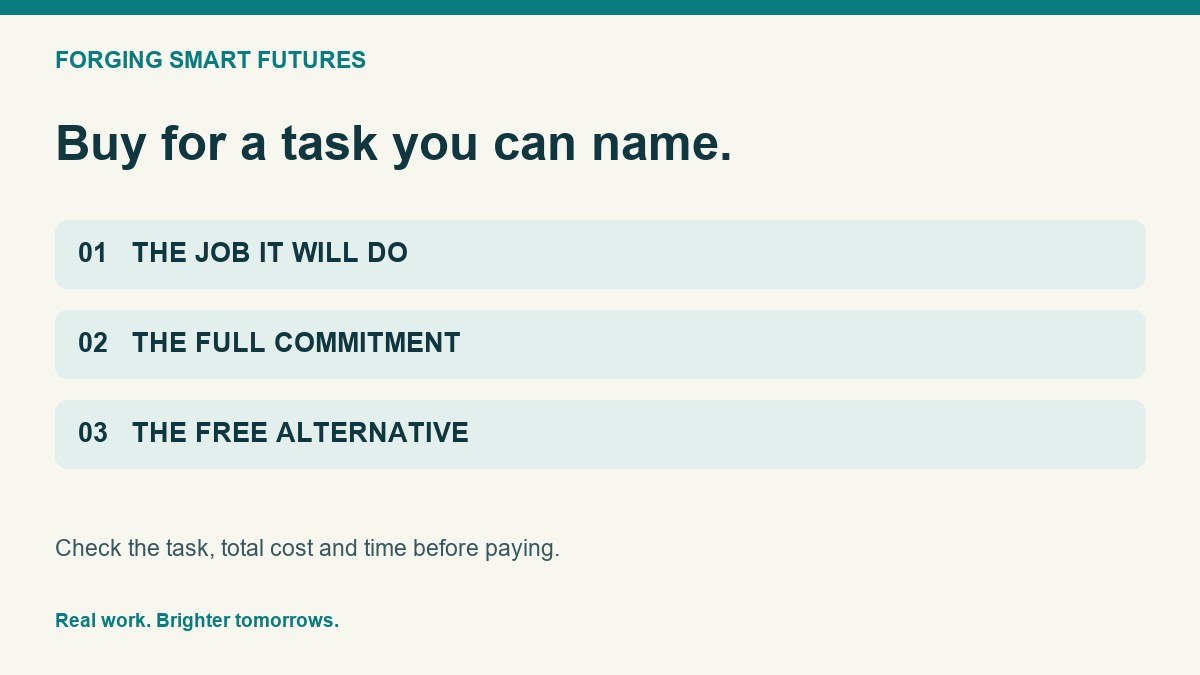
Before paying, finish this sentence: “I need this to help me complete ___, and I will use it on ___.” If the answer is only “get better with money” or “start a business someday,” make the task smaller before making the purchase.
Separate the problem from the product
Suppose you need to see which bills arrive before payday. Your immediate problem is a dated list of income and expenses. A notebook, calendar or free worksheet may already solve it. A paid application could add useful features, but a large feature list does not establish that you need them.
Try the existing or free option on one real task. Write down where it fails: repeated manual entry, a missing comparison, an inaccessible format or something else specific. That gives you a requirement to test in a preview rather than a feeling that the paid version must be better.
Calculate the whole commitment
Fictional example: a course costs $99 and requires software costing $15 monthly for a three-month project. The direct commitment is $144 before any applicable tax or other expenses: $99 + (3 × $15). If you planned a $100 learning budget, the purchase does not fit just because the course alone does.
Time is a separate constraint. Six hours of lessons plus four hours practicing means finding ten hours, not merely watching a promotional video. Time spent learning can be valuable even without producing income, but it still has to fit around work, family and rest.
| Question | Evidence to collect before buying |
|---|---|
| What will I complete? | A specific output: a bill calendar, a job estimate or a first website page |
| What else must I buy? | Required software, supplies, later modules, renewals and applicable taxes |
| Can I use it? | A sample lesson or preview that works on my device and at my skill level |
| What happens if I stop? | Actual cancellation and refund terms, including deadlines and exclusions |
| Does it fit my cash plan? | The full amount due now and the next renewal, after essential obligations |
Treat pressure as a reason to pause
The FTC identifies guaranteed earnings, large returns for little work and supposedly proven money-making systems as warning signs in business-coaching offers. Investigate the seller and the specific offer rather than treating testimonials as your expected result. FTC: How to spot and avoid business coaching scams
A legitimate course can still be a poor fit. You do not need to prove that something is a scam to decide it is too expensive, too advanced or unnecessary for your next step. Be especially cautious when a salesperson suggests debt as the solution to your inability to afford an optional purchase.
Write a purchase decision you can revisit
Try this note: “I will use ___ to complete ___. My full spending limit is ___. I have compared it with ___. I will evaluate whether to keep using or renewing it on ___.” For a one-time purchase, the review is about future use and additional spending; it does not create a refund right.
Apply the same test to FSF. Our free articles and resources may be enough. Member previews explain expanded tools, but buying access does not guarantee a better budget or a successful business. If the purchase competes with necessities, keep the money for necessities.
General education. The cost example is fictional. No course, app or earnings outcome is endorsed by this checklist.
If the offer is built around catching up quickly, use our guide to evaluating big-promise offers alongside this purchase checklist.
AI-assisted content. Publication authorized by Paul Foster. How FSF creates articles.
Editorial attribution: Paul Foster
Published: September 30, 2026