
Using AI to Prepare for a Raise Conversation Without Inventing Achievements
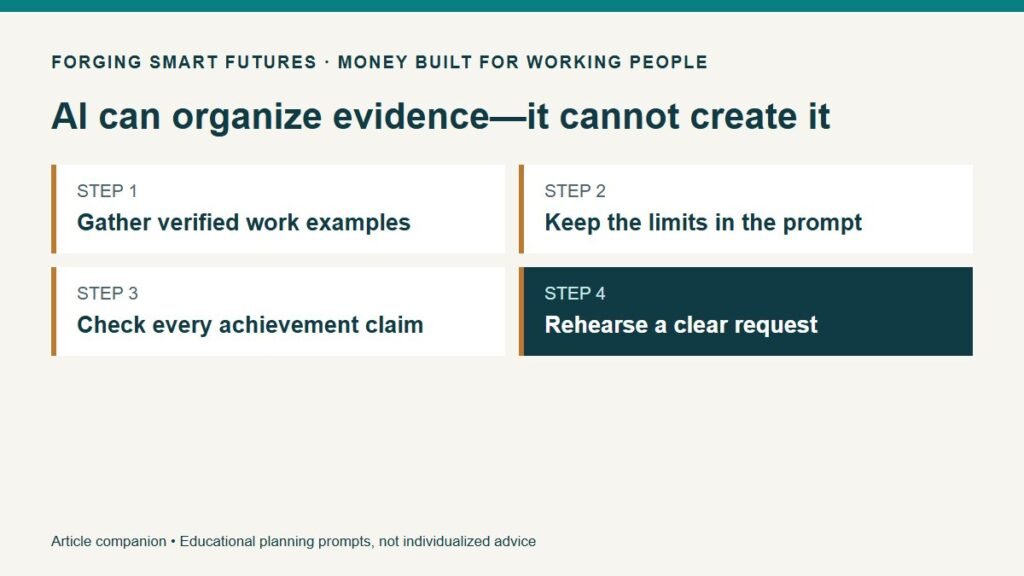
A stronger paragraph cannot replace evidence
After a long shift, you may know you contributed more this year but struggle to explain it clearly. An AI tool can help organize your notes into a short conversation outline. It cannot establish what you achieved, what your employer can afford or what compensation you are entitled to receive.
Start with real examples. Separate what you personally did from what the team accomplished. Keep measured results distinct from observations and estimates. Then ask the tool to improve the organization while preserving those boundaries.
NIST's generative-AI profile identifies confidently incorrect generated content as a risk. The workflow below is an FSF application of that concern, not a NIST-approved compensation method. NIST Generative AI Profile.
Build a small evidence record before opening the tool
For each example, write the date or period, the task, your role, what changed and where the supporting information lives. Keep confidential records in the employer's approved system. Your preparation sheet can point to a record without copying it into an outside tool.
Useful evidence may include completing an approved qualification, taking on a documented responsibility, training someone under an assigned plan, or consistently handling a type of work that was previously outside your role. Whether these support a pay change depends on the employer's process and circumstances.
Avoid unsupported shortcuts such as “I am the most productive person on the shift.” If the evidence shows only that you covered three additional assignments, say that. It is specific and can be discussed without a ranking you cannot substantiate.
A fictional example: from notes to an accurate outline
Casey works in a fictional distribution operation. The preparation notes say:
- Completed the employer's approved inventory-system training in May.
- Covered the evening handoff on six documented shifts in June.
- Helped a new colleague use the existing checklist during three assigned training sessions.
- Noticed fewer missing handoff details afterward, but has no measured before-and-after error rate.
An accurate outline could say: “Since May, I have completed the inventory-system training and taken on additional evening handoff coverage. I also supported three assigned checklist-training sessions. I would like to discuss how these responsibilities fit my role and the pay-review process.”
A draft that says “I reduced handoff errors by 40% and led the department's training program” would introduce two claims the notes do not support. Do not keep invented figures because they sound persuasive. Remove them and return to the evidence.
Casey can mention the observed improvement as an observation, but should not turn it into a measured result. A useful next step may be agreeing on a way to measure the work going forward.
Use a prompt that preserves the limits
Before using any work information, confirm the employer permits the tool and the material you plan to enter. Use fictional or appropriately sanitized notes for practice. Removing a person's name may not remove confidential business information.
An example prompt for permitted notes:
Organize these notes into a two-minute conversation outline about responsibilities and a compensation review. Use only the facts provided. Keep team achievements separate from my role. Do not invent savings, percentages, titles, qualifications or market-pay claims. Put missing evidence under “Questions to verify.” Keep the tone direct and respectful.
Read the output beside the original notes. Check each number, date, responsibility and verb. “Helped,” “handled” and “led” describe different roles. A tool can strengthen the language in ways that accidentally change the claim.
Decide what you are asking for
The conversation should end with a clear request. That may be a compensation review, an explanation of the pay range for the role, or a discussion of the steps needed to move to a different level.
Do not let the AI choose a target salary from an unsupported statement about “industry standards.” If you use market information, verify its date, location, job definition, compensation components and source. A national figure for a different occupation may not describe the job in front of you.
For an hourly worker, distinguish the base hourly rate from overtime, shift differentials, bonuses and benefits. A change in scheduled hours can affect total earnings even when the base rate stays the same. This article does not estimate taxes or the value of a particular benefit package.
Rehearse the questions, not a perfect speech
Ask the tool to play a manager who needs clarification. Useful questions include: Which responsibilities are new? What evidence supports the result? What would success in the expanded role look like? When is the next review decision made?
Practice answering from the record. If the tool suggests an objection involving a company policy, treat it as a hypothetical until you verify the actual policy. Do not quote an invented policy back to a supervisor.
A short outline usually works better than memorizing a polished paragraph. Bring the three points you want to cover, the evidence you can discuss appropriately, and the specific follow-up you want agreed.
Record the next step accurately
After the conversation, note what was decided, what remains undecided, who owns each action and the next review date. “The supervisor will review the request” is different from “the raise was approved.” If you send a follow-up, check it yourself before sending.
If the answer is not yet, ask what evidence or responsibilities would support another review and when that review can happen. Do not fabricate a competing offer or threaten an action you have not decided to take.
The useful role for AI is preparation: organizing evidence, finding gaps and rehearsing clear explanations. The quality of your records and the actual conversation still matter.
Start with the FSF Before You Paste checklist. For other small practical uses, see Five Useful AI Tasks for Working People.
Educational disclaimer: General career and financial education, not individualized employment, legal, financial or tax advice. No raise, promotion or other outcome is guaranteed. All Casey examples are fictional.
Source checked September 8, 2026: NIST profile linked above. Prompts, examples and compensation-preparation workflow are original FSF material.
Editorial review: Owner reviewed and approved this article for release on September 9, 2026. Prepared with AI assistance by FSF Editorial Team; no professional adviser review is claimed.
Editorial attribution: Paul Foster
Published: September 9, 2026
Sources & References
- https://nvlpubs.nist.gov/nistpubs/ai/NIST.AI.600-1.pdf
- https://forgingsmartfutures.com/ai-before-you-paste-checklist/
- https://forgingsmartfutures.com/ai-for-working-people-first-tasks/
Put this into practice
Use AI for drafts and organization while keeping facts and judgment with you. Free AI for Work & Real Life checklist — no membership required.
Related decisions
- Build a Raise Request Around the Value of Your Work
- AI at Work: Five Useful Tasks to Try Before Paying for Another App
- AI for Service-Business Quotes: Draft the Scope, Then Check the Numbers
Expanded member resource: AI for Work and Real Life Practice Workbook. Guided exercises with local save, reopen and print controls. Worksheet answers are not automatically calculated. Compare free resources and FSF membership benefits.
Human-reviewed, AI-assisted content; how FSF creates articles.