
Build a Raise Request Around the Value of Your Work
The short answer
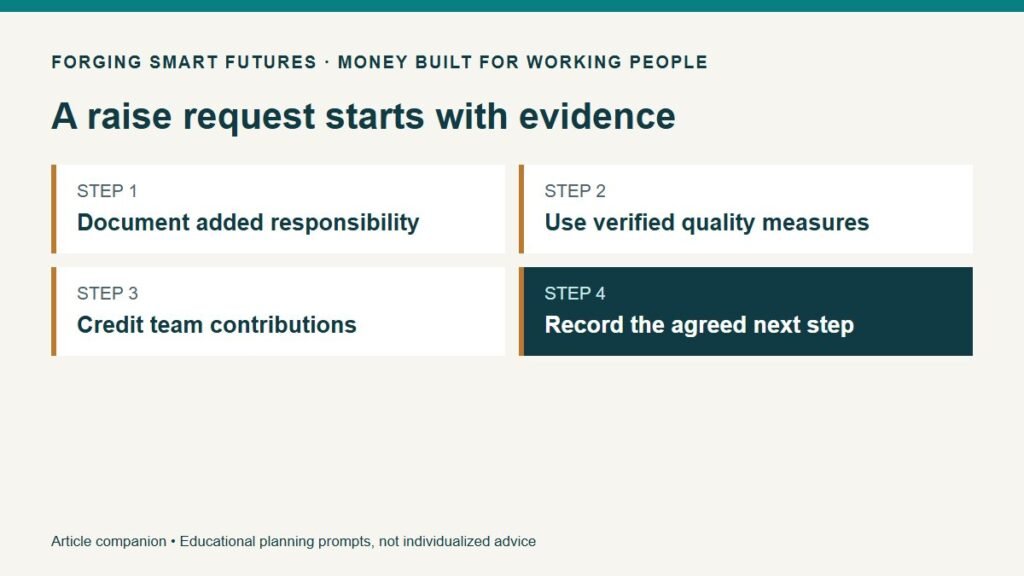
Bring a specific request supported by changes in responsibility, reliable work results and relevant pay context. Separate facts you can document from estimates and team achievements. Ask how the decision is made and what happens next, so the conversation ends with more than “we will see.”
You do not need to sound like a salesperson. You need a clear account of the work you are doing and the adjustment you are asking the employer to consider.
Start with the job you actually perform
Write down your current responsibilities and compare them with the role you originally accepted. Have you begun training people, covering another process, coordinating a shift or handling work requiring an additional qualification? Record when the change started and how often it occurs.
Do not treat being busy as proof of increased responsibility. Describe the difference a reviewer could recognize. “Trained three incoming operators on the approved process over six weeks” is more specific than “I help everyone.” Use only records you are entitled to use and avoid including coworkers' private information.
If pay is governed by a schedule, agreement or formal progression, ask which process applies. This article offers conversation preparation, not a claim that an employer must grant an increase or depart from its rules.
Build an evidence page, not a pile of anecdotes
| Evidence category | What to record | What not to claim |
|---|---|---|
| Added responsibility | The task, frequency and date it began | A permanent role change that was never assigned |
| Quality or reliability | The documented measure and period | A perfect record you cannot verify |
| Process improvement | What changed and who contributed | Sole credit for a team result |
| Training or qualification | Completion record and relevance to current work | A qualification you are still pursuing |
Keep the page short enough to explain during the meeting. Put supporting detail behind it rather than making the manager reconstruct your point from dozens of screenshots.
For a fictional example, a team reduces average changeover time from 50 minutes to 42 minutes across twelve comparable runs. That is 96 minutes of observed time difference: eight minutes times twelve. It is not automatically 96 minutes of payroll savings, and it does not establish that one worker caused the improvement. State your contribution, measurement limits and the team context.
Use market information as context
The BLS provides wage information by occupation and geography. It can help you find a relevant starting point for comparison, but it is not a personalized wage quote or a promise of an offer. BLS wage data overview.
Check that the occupation matches the duties, not just a similar title. Record the area, data period and measure. Compare hourly and annual figures carefully; do not assume an annual number represents your actual hours or overtime pattern.
If you use job postings, separate advertised ranges from verified offers and note differences in schedule, qualifications and benefits. Avoid presenting the top of a broad range as the rate every comparable worker receives. The strongest request connects your actual responsibilities with relevant context and the employer's decision process.
State the request directly
A fictional opening might be: “Since March, I have taken responsibility for the weekly inventory handoff and trained new team members on the approved process. I would like to discuss adjusting my base rate from $24 to $26 an hour. Here is the work and evidence behind that request.”
At forty paid hours per week for 52 weeks, a $2 hourly change is $4,160 in gross annual pay. That illustration assumes every week is paid at those hours and excludes taxes, deductions and overtime effects. Do not use the gross amount as a take-home budget increase.
You can request a different amount or a defined progression. The example is a communication structure, not a suggested market rate or negotiation outcome.
Prepare for the answer you do not want
If the answer is no, ask whether the obstacle is the role, budget, timing or evidence. Ask what measurable change would support reconsideration and who decides. A specific review date and criteria are more useful than repeatedly raising the subject without new information.
Do not invent another offer or threaten to leave unless you intend to act on it. You can assess your outside options privately while keeping the discussion factual. If a promised follow-up does not happen, return to the agreed date and criteria rather than assuming an approval that never occurred.
Leave with a record
Write a concise summary of the request, response and next step. Confirm any agreed details through the normal workplace process. Keep private evidence in an appropriate location; do not upload internal records to a personal AI account for convenience.
The FSF Before You Paste checklist can help if you use AI to organize a blank outline. The achievements themselves must remain yours, accurately described and supported. The purpose of preparation is to make the value of your work easier to assess, not to manufacture a stronger story.
General education only, not individualized financial, investment, tax, legal or credit advice. Examples are fictional and depend on the stated assumptions. Prepared with AI assistance by FSF Editorial Team; reviewed for publication by the FSF publisher.
Editorial attribution: Paul Foster
Published: September 10, 2026 Last reviewed: September 10, 2026
Sources & References
Put this into practice
Compare written pay, time and benefit terms on the same basis. Free Work & Compensation checklist — no membership required.
Related decisions
- Using AI to Prepare for a Raise Conversation Without Inventing Achievements
- Is That Certification Worth the Cost? Compare Time, Pay and Opportunity
- Compare Disability Coverage When Your Pay Depends on Physical Work
Expanded member resource: Total Compensation Decision Workbook. Guided exercises with local save, reopen and print controls. Worksheet answers are not automatically calculated. Compare free resources and FSF membership benefits.
Human-reviewed, AI-assisted content; how FSF creates articles.