
Use AI to Clean Up a Shift Handoff Without Inventing What Happened
A clearer note must still mean the same thing
At the end of a shift, the hardest part of a handoff can be turning scattered notes into something the next person can use. A drafting tool can help organize words. It cannot know that a delivery arrived, a check was completed or a supervisor approved an action unless the source information says so.
That difference matters even in ordinary work. “Waiting for confirmation” and “confirmed” lead the next person to do different things. A polished paragraph can make missing information harder to notice if it quietly fills the gap.
Start with a permitted, low-risk administrative example. Keep safety, operating and compliance records within your employer's approved procedures. This article teaches a writing check; it does not authorize using an AI tool with workplace information or replacing a required handoff process.
Keep four kinds of information separate
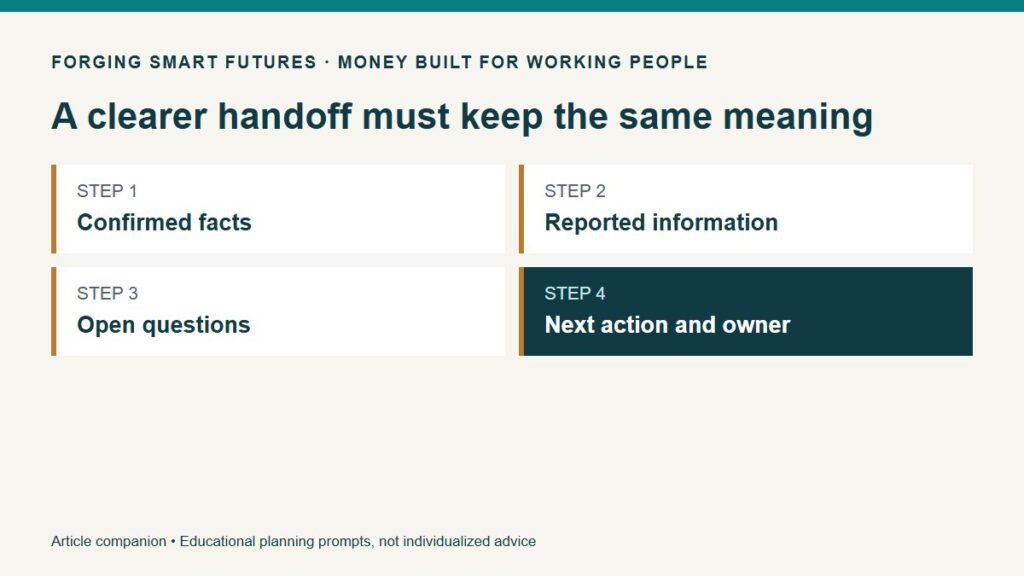
For a basic practice exercise, sort the note into confirmed facts, reported information, open questions and next actions. Add an owner or due time only when the original note supplies it. If the owner is missing, label it as missing.
A confirmed fact is something the record actually establishes. Reported information attributes a statement to its source without turning it into independently verified fact. An open question is something the next person must still resolve. A next action is a task, not proof that the task happened.
These labels are a writing aid. If your workplace uses different fields, use its form and terminology. Do not introduce a second unofficial record that conflicts with the required system.
Work through a fictional note
Here is an invented administrative note with no real customer or employee information:
“Order B is due Thursday. Supplier email says dispatch is planned, but no arrival time given. Receiving lead asked for an update. Pat will check with supplier tomorrow morning. Two cartons from Order A are waiting for count confirmation.”
A reasonable organized version is:
| Section | Checked draft |
|---|---|
| Confirmed from the note | Order B is due Thursday. Receiving lead requested an update. Two cartons from Order A await count confirmation. |
| Reported information | Supplier email says dispatch is planned. |
| Open question | Arrival time for Order B is not supplied. Order A count confirmation remains open. |
| Next action | Pat to check with the supplier tomorrow morning. |
The draft must not say Order B has shipped. Planned dispatch is different from completed dispatch. It must not say Order A is complete, assign a precise arrival time, or mark Pat's follow-up as done.
In a real handoff, relative words such as “tomorrow” may become confusing when a note is read later. Resolve the calendar date from a verified source before finalizing. Do not let the AI guess it from today's date or from an unrelated timestamp.
A brief that makes missing facts visible
For fictional practice, try this structure:
“Organize the following note into Confirmed from the note, Reported information, Open questions and Next actions. Use only the supplied information. Preserve uncertainty. Do not invent names, dates, times, quantities, causes, approvals or completed actions. Mark missing owners or dates as not supplied. Return a draft for human checking.”
The instruction reduces ambiguity; it does not guarantee compliance. Check the result even when the model says it followed every rule. A second request asking the same tool to verify itself is not a substitute for comparing the output with the original record.
Check meaning before style
Read the original and the draft side by side. For each sentence, identify the exact part of the source that supports it. If you cannot find support, remove the claim or return to the responsible person for clarification.
Look closely at verbs. “Requested” must not become “approved.” “Scheduled” must not become “completed.” “Reported” must not become “verified.” “Could” must not become “will.” Keep units and quantities attached to the correct item; two cartons are not necessarily two complete orders.
Then check names, dates and references. Similar job numbers can be easy to transpose. A neat table is still wrong if its action belongs to the next row. Finally, check whether the next reader can distinguish an unresolved question from work they are expected to perform.
Only after meaning is correct should you shorten the prose. Removing a repeated phrase can improve readability. Removing the words “not yet confirmed” can change the message.
Keep the source and approved record intact
Use only tools and information your employer permits. Access to a document does not automatically authorize sharing it with an external AI service. Practice with fictional material when permission is unclear.
Keep the original note and the checked final record according to workplace requirements. Do not delete the source because the rewritten version looks better. Avoid copying sensitive examples into a personal prompt library. You can retain a blank brief structure without retaining the workplace data used to test it.
If the content affects safety, equipment operation, legal reporting or another controlled decision, follow the approved workflow and qualified review. This writing exercise cannot establish that the use is appropriate for those tasks.
Measure whether the extra step is worthwhile
Suppose a fictional routine handoff takes eight minutes to organize manually. An AI attempt takes two minutes to prepare, one to generate and six to check and correct. Total effort is nine minutes. Faster drafting did not save time overall.
That does not require a verdict on every AI tool. It tells you this particular workflow did not improve this particular task in the example. Try several comparable, permitted tasks and record the complete effort. Also record meaningful mistakes, because time alone does not describe the result.
For short notes, a blank four-section template may be enough. The manual alternative is useful even if you never use AI. If a tool consistently helps with longer permitted notes, preserve the checking process rather than treating familiarity as proof of accuracy.
Your next handoff exercise
Write one fictional note with an unresolved date, a reported statement and an unfinished action. Organize it manually first. If permitted, compare an AI draft with your version. Circle every added fact and every change in certainty. Keep the version that communicates the source accurately.
Use the FSF Before You Paste checklist before trying a workplace task. The AI for Work & Real Life hub introduces other practical starting points.
Further reading: NIST AI Risk Management Framework. NIST's framework is voluntary risk-management guidance; this original FSF exercise is not a NIST certification. The example is written by FSF and is not presented as output from a tested AI product. General education only; follow employer rules and approved professional procedures.
Editorial review: Owner reviewed and approved this article for release on September 9, 2026. Prepared with AI assistance by FSF Editorial Team; no professional adviser review is claimed.
Editorial attribution: Paul Foster
Published: September 9, 2026
Sources & References
- https://forgingsmartfutures.com/ai-before-you-paste-checklist/
- https://forgingsmartfutures.com/ai-for-working-people/
- https://www.nist.gov/itl/ai-risk-management-framework
Put this into practice
Use AI for drafts and organization while keeping facts and judgment with you. Free AI for Work & Real Life checklist — no membership required.
Related decisions
- AI at Work: Five Useful Tasks to Try Before Paying for Another App
- Use AI to Organize Household Paperwork Without Uploading Your Private Records
- Using AI to Prepare for a Raise Conversation Without Inventing Achievements
Expanded member resource: AI for Work and Real Life Practice Workbook. Guided exercises with local save, reopen and print controls. Worksheet answers are not automatically calculated. Compare free resources and FSF membership benefits.
Human-reviewed, AI-assisted content; how FSF creates articles.