
Compare Brokerage Accounts When You Are Starting Small
The short answer
Compare the account you will actually use: its fees, permitted investments, minimums, recurring-purchase rules, uninvested cash and support. For small balances, a flat account charge can matter more than an attractive sign-up feature. Choose the account type deliberately, including whether borrowing is enabled.
This is a comparison method, not a ranking of brokerage brands. FSF has not opened or tested specific accounts for this article, and no product pays for a place in it.
Write your intended use before looking at offers
A worker planning $40 per payday needs a different checklist from someone making occasional large transfers. Record contribution size and frequency, intended account type, investment types and whether the account must accommodate a month without deposits.
Check whether recurring transfers merely move cash or also place purchases. Ask about purchase minimums, fractional-share availability for the particular investment and restrictions on moving those holdings to another provider. Do not assume every security or account receives the same features shown in a general advertisement.
Compare the costs that fit your activity
The SEC explains that account and investment expenses reduce returns. Its detailed fees guidance identifies costs beyond trade commissions, including account, transfer and closing charges. Review the provider's fee schedule and applicable disclosure documents. Investor.gov fee guidance.
Use a worksheet with these rows: recurring account fee; purchase/sale charge; investment expense ratio; advice fee if any; transfer-out/closure cost; paper statement charge if applicable; and conditions for waivers. Mark “not disclosed” rather than assuming zero.
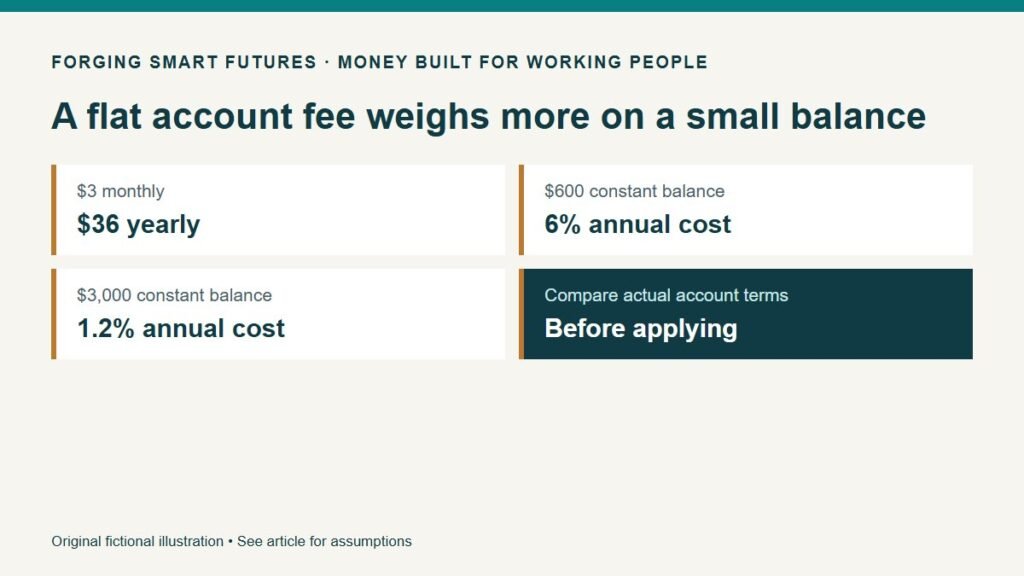
Suppose a fictional service charges $3 monthly. That is $36 annually. Against a constant $600 balance, it equals 6%; against $3,000, 1.2%. These percentages are cost comparisons, not investment returns or a forecast for a growing account. They show why the same flat fee has a different weight at different balances.
A free account with an unsuitable investment menu is not automatically better. Compare cost after confirming that the account serves the actual task.
Check cash versus margin settings
A cash account requires paying for securities without a brokerage margin loan. A margin account can involve borrowing against account assets. The SEC warns that margin can produce losses beyond the amount deposited and that a firm can sell assets to address requirements. SEC margin-account bulletin.
Do not accept a borrowing feature because it is presented as a convenient default or extra buying power. Ask what account is being opened and how to disable features you do not intend to use. Options approval, margin and securities lending are separate terms to understand; a simple-looking application can contain consequential choices.
Find out what happens between deposit and purchase
Ask where uninvested money is held, how its yield is determined and what protections apply to that exact arrangement. Brokerage investments and bank deposits are different products. Do not infer protection from a familiar brand or a blanket “cash” label.
Record deposit availability, trade settlement and withdrawal timing from the current account terms. Avoid relying on an investment account to pay a bill tomorrow without understanding when money can actually leave it.
Test the support route before it becomes urgent. Can you find help for an incorrect transfer, inaccessible account or deceased account holder? What hours and communication methods are available? Someone on nights may need a support path that works outside a normal lunch break.
Keep a dated decision record
For each finalist, save the specific account name, fee schedule date, unresolved questions and why it fits or fails your use case. Promotional bonuses belong at the bottom, after eligibility and holding requirements—not at the top as the main reason to open the account.
Recheck material terms immediately before applying. An old review or a screenshot from a coworker is not the current account agreement. Keep the final agreement with the decision sheet and review the first statement for the features and costs you expected.
Use the free Investing checklist at FSF Resources and review emergency savings for reduced hours before committing cash needed for near-term bills.
General financial education, not individualized investment, financial, tax, legal or credit advice. Investing involves risk. Fee examples are fictional, and no affiliate relationship is included.
Editorial attribution: Paul Foster
Published: September 10, 2026 Last reviewed: September 10, 2026
Sources & References
- https://www.investor.gov/introduction-investing/getting-started/understanding-fees
- https://www.investor.gov/introduction-investing/general-resources/news-alerts/alerts-bulletins/investor-bulletins-29
Put this into practice
Prepare better questions before choosing an account or investment. Free Investing checklist — no membership required.
Related decisions
- What an Index Fund Actually Owns—and Why That Matters to Your First Portfolio
- Small Investment Fees Can Become a Large Career-Long Cost
- A Coworker Shared an Investment Tip: Check These Things Before Sending Money
Expanded member resource: Investing Foundations Research Workbook. Guided exercises with local save, reopen and print controls. Worksheet answers are not automatically calculated. Compare free resources and FSF membership benefits.
A simple portfolio framework: Our Bogleheads-style investing guide explains broad diversification, low costs, Fidelity fund examples and the limits of historical returns. Compare your own assumptions in its free scenario explorer.
Human-reviewed, AI-assisted content; how FSF creates articles.