
Business Insurance Quotes for a Small Service Company: Questions to Compare
The short answer
Compare quotes against the same description of your business, then examine covered activities, exclusions, limits, deductibles, policy conditions and total cost. A lower premium is not a useful saving if the policy does not address the work you actually perform.
An insurance professional should help interpret the proposed coverage. This article gives you questions and a comparison method; it does not determine which policy you need or promise that a claim will be covered.
Describe the job before asking for a price
Write down the work performed, locations, equipment, vehicles, customer property handled, use of helpers or subcontractors and any work at height or other unusual activity. Include side work done from home and travel between customers where relevant. Use plain examples rather than a broad description such as “handyman” that might conceal very different tasks.
If you install shelves but exclude electrical and plumbing work, say so. If you later add a new service, ask about coverage before accepting it. A quote based on one activity should not be assumed to cover a different one.
Ask what each type is intended to address
SBA distinguishes categories including general liability, professional liability and commercial property coverage. Those descriptions are starting points; actual policy wording, exclusions and conditions determine coverage. SBA insurance overview within launch guidance.
Ask whether the proposed arrangement addresses customer injury or property damage, your own equipment, advice or service errors, vehicles, employee-related obligations and any contractual requirements. Do not assume one policy answers every category, or that your personal home or auto policy covers business use.
Avoid buying by a certificate alone. Ask for the relevant policy details, forms and endorsements and an explanation of what remains outside coverage. A customer's requested certificate and the policy's actual protection are related but different things.
Normalize the quote comparison
| Comparison field | What to record |
|---|---|
| Business description | Activities and locations used for the quote |
| Coverage and exclusions | What is included and material activities left out |
| Limits | Per-event and aggregate amounts where applicable |
| Deductible or retention | Amount you may need to fund and how it applies |
| Policy period | Effective dates and any timing conditions explained by the provider |
| Total cost | Premium, required fees and installment charges |
| Changes and cancellation | Reporting requirements, charges and refund terms |
Get unclear answers in writing. If two policies use different terms or coverage triggers, ask the licensed professional to explain the practical difference using a realistic incident from your work.
Compare cash needs as well as premiums
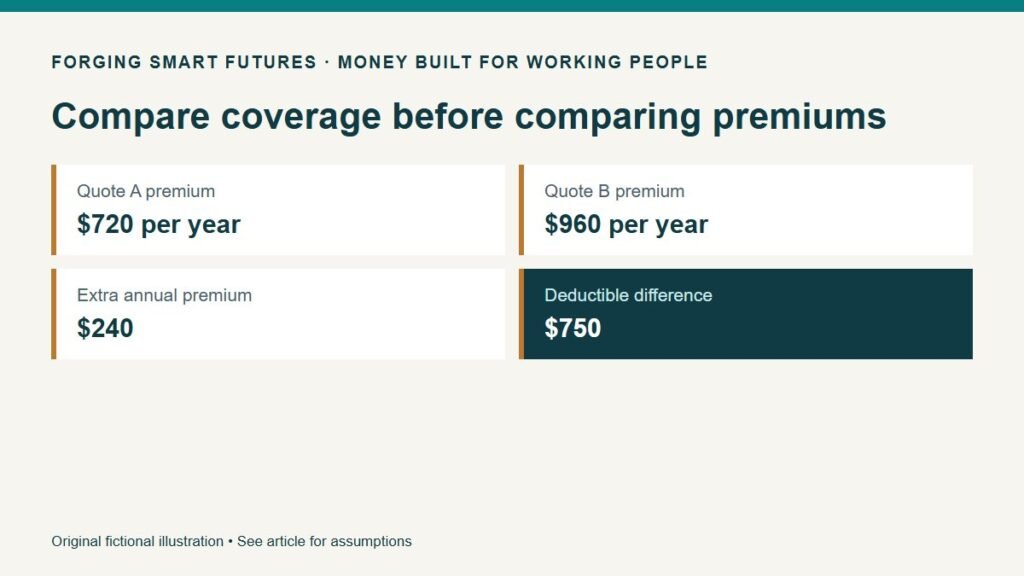
In a fictional comparison with otherwise equivalent assumptions, Quote A costs $720 annually with a $1,000 deductible. Quote B costs $960 with a $250 deductible. B costs $240 more per year; the deductible difference is $750.
That arithmetic does not make either policy automatically better. You still need to understand whether the hypothetical incident would be covered, how a deductible applies and whether multiple claims or policy limits change the result. An annual premium plus one deductible is not a forecast of total risk.
If you choose a higher deductible, ask whether the business could fund it without missing payroll, materials or household essentials. If the answer is no, the lower premium may be masking a cash problem. Add payment-plan charges before comparing monthly prices.
Check requirements without guessing
Licensing rules, state requirements, employees, contracts and job sites can create different obligations. Verify what applies to the actual business and location. Do not accept a generic statement that every small business needs the same package, or that a sole owner never needs particular protection.
Review coverage when activities, revenue, locations, equipment, vehicles or staffing change. Keep the contact process for reporting a potential claim with your business records so you are not searching during a stressful incident.
Your next action
Prepare a one-page activity description and use it for each quote request. Put the resulting premiums, fees and deductible funding needs into the FSF startup-cost plan. The Resources page lists existing planning materials by free or member access.
General education, not individualized insurance, legal, tax or financial advice. Prices and deductibles are fictional, not offers. No carrier ranking, coverage guarantee or affiliate relationship is presented.
Editorial attribution: Paul Foster
Published: September 10, 2026 Last reviewed: September 10, 2026
Sources & References
- https://www.sba.gov/counseling/launch-your-business/
Put this into practice
Test demand and cash needs before committing to recurring costs. Free Starting a Business checklist — no membership required.
Related decisions
- Before Hiring Your First Helper: Estimate the Full Cost and Responsibilities
- What Will It Cost to Start Your Service Business Before the First Customer?
- How to Compare Business Bank Accounts for a Small Service Business
Expanded member resource: First Service Business Planning Workbook. Guided exercises with local save, reopen and print controls. Worksheet answers are not automatically calculated. Compare free resources and FSF membership benefits.
Human-reviewed, AI-assisted content; how FSF creates articles.