
What Will It Cost to Start Your Service Business Before the First Customer?
The short answer
Start with a defined service, list the cash you must spend to deliver it, and separate one-time purchases from recurring costs. Add a reserve based on your chosen operating period, then compare that need with business funding actually available. Finally, put the payments on a calendar: a monthly average cannot pay an annual bill due on opening day.
The goal is to find the missing costs before they become a withdrawal from the money that pays your household bills.
Price one service before pricing an entire business
You may already have skills people will pay for. That does not mean you need to buy everything required for every possible job.
Write one sentence describing your first offer: the customer, the task, the area you serve and what the customer receives. Then write down what that offer excludes. A narrow offer makes the equipment list easier to challenge. A machine for a service you will not initially provide belongs in a later expansion scenario.
For example, a worker considering a weekend business might have three equipment lists: items already owned and available for business use, items needed to complete the first offered job, and upgrades that would save time once there is repeat demand. Only the second list creates immediate purchase needs in this first scenario. Existing equipment may still create maintenance or replacement costs; having it already does not make its future use costless.
Before treating workplace equipment, materials or customer information as business resources, confirm that you have permission to use them. Experience you bring home is different from property or information belonging to your employer.
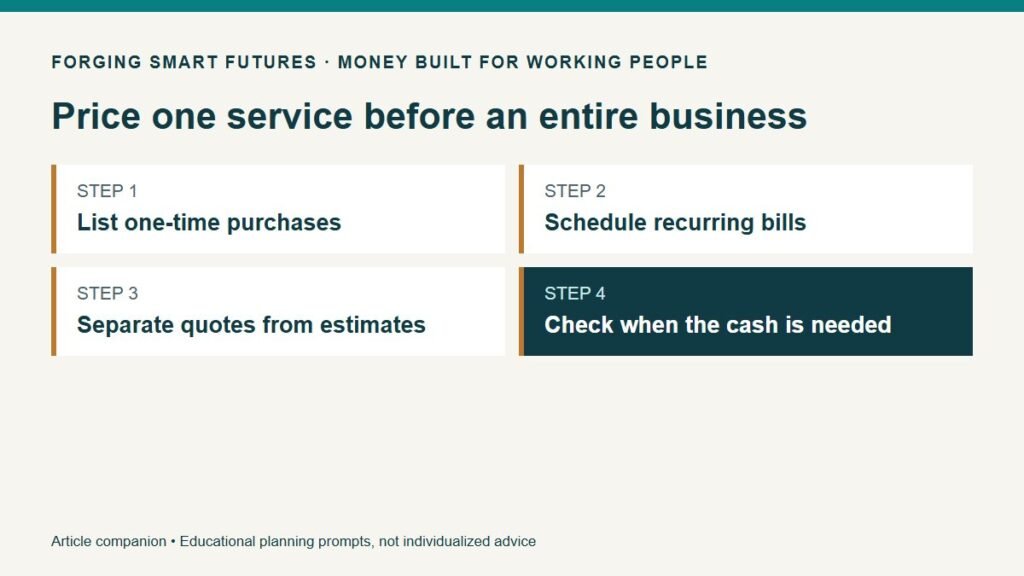
Make the cost list specific enough to obtain quotes
The SBA identifies equipment, supplies, insurance, licensing, professional help and marketing among possible startup costs. It recommends separating initial expenses from recurring expenses and researching amounts with providers. Which items apply depends on the business. SBA business-planning guidance.
Turn a vague entry such as “equipment” into something you can check. Record the item, the amount, what the price includes and when payment is required. A quoted price excluding delivery is an incomplete cash estimate if you need delivery to use it.
Use three questions for each row:
- Is this required for the first service, or would it simply be convenient?
- Is the amount supported by a current quote, or is it still an estimate?
- Will the cash leave once, monthly, every three months or annually?
Keep a note with the provider and quote date. Mark each amount as an estimate or an obtained quote, and keep the actual quote documents separately. An obtained quote can still expire or exclude something you need.
A fictional weekend-business scenario
The numbers below are deliberately simple planning assumptions, not typical market prices. They do not describe a real customer's business or establish that any particular service can be launched for this amount.
| Cash cost | Amount per occurrence | Frequency | Evidence in this example |
|---|---|---|---|
| Equipment purchase | $1,000 | One time | Quote obtained |
| Software | $30 | Monthly | Estimate |
| Recurring service | $300 | Every three months | Quote obtained |
| Insurance | $1,200 | Annually | Estimate |
The monthly equivalent of the recurring costs is:
$30 + ($300 ÷ 3) + ($1,200 ÷ 12) = $230.
Suppose the owner chooses three months as an initial reserve scenario. That creates a $690 recurring-cost reserve. Adding the $1,000 equipment purchase produces a $1,690 base. A chosen 10% contingency adds $169, making total modeled cash need $1,859.
With $2,000 available specifically for this business, the model shows $141 above the modeled need. Three months and 10% are assumptions for this example, not recommended targets. A different service, payment schedule or risk tolerance calls for different scenarios.
In this example, $390 of the base still rests on estimates: three months of software at $30, plus three months of the insurance equivalent at $100. That is a useful next-action list. Confirming those amounts is more productive than treating the final total as precise because it includes cents.
Now check whether the cash is needed sooner
The example contains an important trap. If the full $1,200 annual insurance payment and the $300 quarterly service payment are both due before the first job, the reserve approach understates the immediate cash requirement.
Equipment of $1,000, insurance of $1,200, the $300 service payment and the first $30 software payment would require $2,530 at that point, before contingency or other costs. Against $2,000, that is a $530 timing gap.
Both calculations can be mathematically correct while answering different questions. The first describes a reserve using monthly equivalents. The second describes payments due now. Use the actual due dates to decide whether a plan can be funded on time.
Enter those payments into a dated cash plan. Do not copy the monthly equivalents into every week and assume the actual bills have been covered. Likewise, avoid counting an annual payment upfront and then counting that same payment again inside the period's expenses.
Keep business funding separate from household survival
Write down the amount actually set aside for the venture. Avoid including an expected overtime check, an unapproved loan or a hoped-for customer payment as though it were already available cash.
If your plan depends on future funding, label the source, expected date and uncertainty separately. A customer inquiry is not a paid booking. An invoice is not a deposit. The next planning question is what happens if the expected money arrives later.
A useful household check is to write two balances beside each other: money reserved for personal bills and emergencies, and money committed to the business. If the same dollars appear in both, the plan is double-counting funding. Do not solve that by silently assuming more overtime; test the business plan against a lower-pay work month too.
Respond to a gap by changing the plan, then recalculating
An unfunded gap does not choose the solution for you. It tells you which version of the plan needs work.
| Possible change | What to recalculate |
|---|---|
| Offer fewer services initially | Remove purchases that the narrower offer genuinely does not need |
| Rent equipment for confirmed jobs | Replace the purchase with rental, transport and other actual charges |
| Delay an optional upgrade | Move its cash payment to a later scenario |
| Change a billing arrangement | Use the provider's actual price and payment dates, including additional charges |
| Wait and accumulate business cash | Revise the start date and verify quotes again |
Keep required safeguards and qualifications in the plan. Whether a permit, insurance policy or professional service is required for your specific activity needs separate verification; deleting the cost row does not remove the requirement.
If financing is part of a later scenario, distinguish the cash you pay from the asset's total price. Do not count the full financed purchase and all of its repayments as separate cash purchases. This startup exercise does not assess financing terms or approval.
Your next working session
Choose the first service, obtain the largest missing quotes and write the actual first payment dates beside them. Calculate an initial reserve scenario, then test the dated cash requirement. The difference between those two numbers can reveal the problem before you commit to a purchase.
You can reproduce the table and arithmetic in a notebook or spreadsheet. Use one sheet for the initial cost list and another for payments by date.
General financial education only, not individualized financial, investment, tax, legal or credit advice. This is a cash-planning illustration, not a recommendation to start, finance or purchase a business. Prepared with AI assistance by FSF Editorial Team. Owner editorial review completed September 9, 2026; no professional adviser review is claimed.
Editorial attribution: Paul Foster
Published: September 9, 2026
Sources & References
- https://www.sba.gov/counseling/plan-your-business/
Put this into practice
Test demand and cash needs before committing to recurring costs. Free Starting a Business checklist — no membership required.
Related decisions
- A Profitable Month Can Still Run Out of Cash: Understand Receivables
- Find Your First Service Customers Without Quitting Your Job
- How to Compare Business Bank Accounts for a Small Service Business
Expanded member resource: First Service Business Planning Workbook. Guided exercises with local save, reopen and print controls. Worksheet answers are not automatically calculated. Compare free resources and FSF membership benefits.
Human-reviewed, AI-assisted content; how FSF creates articles.