
Pay your essentials before you pay us
If buying something from Forging Smart Futures means coming up short on groceries, utilities, rent, medication or gas to get to work, do not buy it. Use our free resources instead. You do not need to become a member to start making a plan.
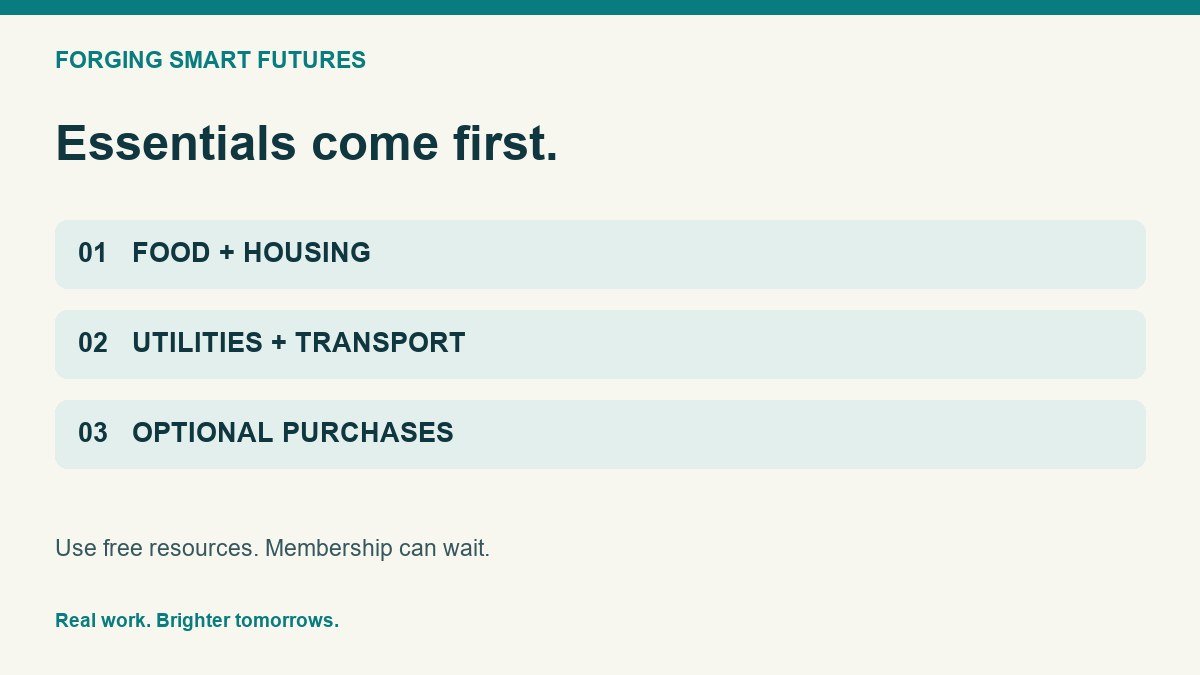
FSF is a collection of educational articles and planning tools. It is not a quick fix, an income opportunity or a promise that your next financial decision will work out. A spreadsheet can help you see a problem. It cannot put money in your account, negotiate with a creditor for you or create customers for a business.
That distinction matters most when money is tight. Feeling worried about the future should not become another reason to spend money today.
Give the next dollar a job before buying another tool
Before an optional purchase, look beyond the balance displayed in your banking app. Some of that money may already belong to a bill, a pending payment or the trip to work tomorrow.
Try this short check on paper:
- Write down cash you can actually access. Account for pending transactions without subtracting them twice.
- List essential costs due before your next reliable income arrives, including ordinary purchases such as food and transportation.
- Set aside money already committed to other obligations and a cushion appropriate to your situation.
- Ask whether an optional purchase would leave any of those needs uncovered. If it would, stop here.
Fictional example: Jordan has $180 available. Before payday, $70 is needed for groceries, $45 for transportation and $65 for an electricity payment. Those amounts total $180. There is no money left in this example for an FSF membership, another app or a course. Buying a planning product does not change that arithmetic.
This is an affordability check, not a universal ranking of every bill. When there is not enough money for everything, consequences and available arrangements matter. The CFPB provides a free prioritizing-bills worksheet and cash-flow tools to help organize that conversation. CFPB Your Money, Your Goals toolkit
Start with a free route that fits your problem
| What you need to understand | Free place to begin | What it cannot promise |
|---|---|---|
| What happens when overtime changes | Variable Pay Budget Planner | That future overtime will be available |
| What fewer hours could do to your cushion | Hours-Cut Cash Cushion Calculator | That you can predict every emergency |
| Whether a side job is worth its time and costs | True Hourly Side-Gig Calculator | That a quoted job becomes a paying customer |
Our Resources page also separates free interactive tools and checklists from free, read-only previews of member tools. A preview is an example of a paid tool, not the complete interactive version. You can use the free resources without deciding to join.
When a paid tool might make sense
A paid tool becomes worth considering when you can name the task it will help with, understand its limits, have time to use it and can afford the full charge without putting essentials at risk. Preview it first. Compare it with what you already have, including a notebook or spreadsheet.
FSF membership currently costs $39 per year plus applicable tax and automatically renews until canceled. That is an annual charge, not a monthly payment plan. Review the current membership details before deciding. A low price does not automatically make something affordable or necessary.
A useful first step costs nothing
Choose one question: What is due before payday? What changes if my hours fall? What does this side job actually cost? Write down the numbers you know and mark what you still need to confirm.
You do not have to fix everything in one sitting. Finding one gap early, asking one useful question or deciding against one purchase can be a worthwhile result. You are welcome here whether you ever buy anything or not.
General financial education, not individualized financial advice. Fictional example; no outcome is guaranteed.
For a first practical step, read how to budget when overtime changes.
AI-assisted content. Publication authorized by Paul Foster. How FSF creates articles.
Editorial attribution: Paul Foster
Published: September 30, 2026