
Compare Disability Coverage When Your Pay Depends on Physical Work
The short answer
Find out what the policy considers a covered disability, which earnings it uses, when payments can start and how much may actually reach the household. A percentage printed in a benefits brochure is not enough to know whether rent and groceries will be covered.
Texas Department of Insurance guidance explains that disability policies can replace part of income and differ in definitions, waiting periods and duration. The actual policy and your circumstances control; state-specific details may differ outside Texas. TDI disability insurance guide.
Identify the coverage you already have
Ask benefits staff for the short-term and long-term coverage documents, if offered, plus any employee-paid options. Record who pays the premium, the effective date, eligibility requirements and whether coverage continues if employment ends.
Keep this separate from workers' compensation, health insurance and government disability benefits. They address different questions and have different eligibility rules. Do not assume one automatically replaces the need to understand the others.
Check what counts as earnings
A policy may define covered earnings differently from your highest recent paycheck. Ask explicitly about overtime, bonuses, shift differentials and variable commissions where applicable. Read any cap on benefits and ask how other income or benefits affect the amount.
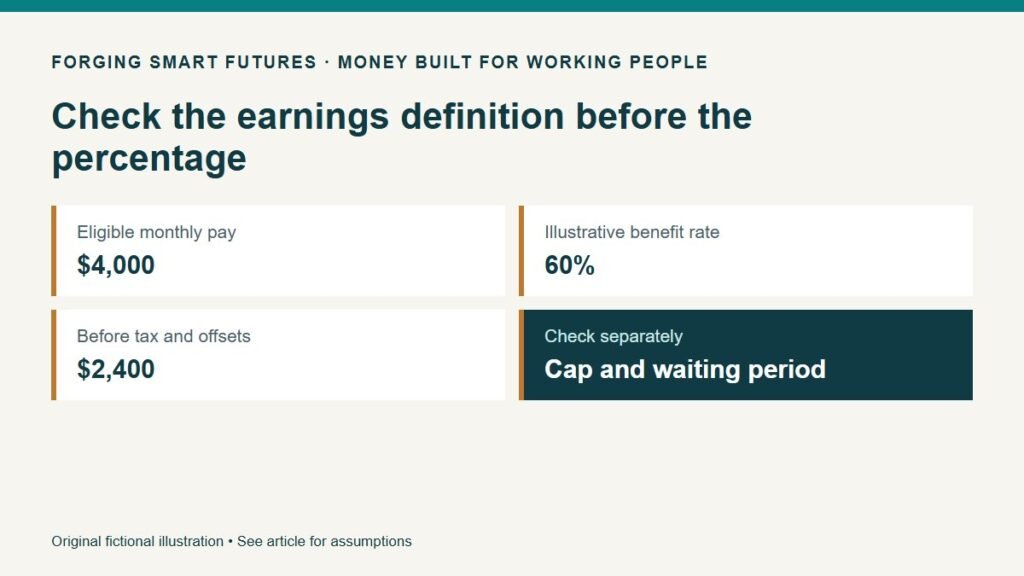
In a fictional policy, the benefit is 60% of eligible monthly earnings, capped at $2,500. If eligible earnings are $4,000, the calculated benefit is $2,400 before any tax or offsets. If your usual gross pay with overtime is $5,000 but overtime is excluded, it would be wrong to assume a $3,000 benefit.
If eligible earnings were $5,000 under another scenario, 60% would be $3,000, but the $2,500 cap would still limit the stated amount. These examples describe invented terms, not a typical policy or a coverage promise.
Map the waiting period to cash
Ask when the waiting period begins, which days count, what evidence is required and when payment is made after eligibility is established. The waiting period ending is not necessarily the same day money reaches your account.
For a simplified example, essential spending is $2,800 per month. A sixty-day waiting period represents roughly two months, or $5,600, before considering other income, paid leave or processing time. Actual calendar dates and policy terms matter; sixty days is not always exactly two monthly billing cycles.
Compare available cash and usable paid leave with that gap. Do not count a benefit twice if one source offsets another. Keep a separate question list for payroll and the insurer if the interaction is unclear.
Read the definition and limits
Ask how the policy defines inability to work, whether that definition changes over time, how partial work is handled and which exclusions or pre-existing-condition provisions apply. For physical work, the difference between being unable to perform your current duties and a broader definition can be material.
Record the maximum benefit duration, requirements for continuing proof and any rehabilitation or return-to-work provisions. Ask a licensed insurance professional to explain uncertain terms using the actual job duties rather than relying on a generic occupation label.
Compare available cash after all adjustments
Benefit taxation can depend on how premiums were paid and other facts. Ask for an explanation specific to the arrangement rather than assuming the gross benefit equals take-home income. Likewise, identify offsets and deductions before using the amount in a budget.
If the expected available benefit is below essential spending, list the gap and how it might be funded. The answer may involve reserves, different coverage or another household adjustment; this article does not select a policy for you.
Your next action
Request the policy summary and write the eligible-earnings formula, cap, waiting period and unresolved questions on one page. Use the FSF emergency-savings guide to consider the cash bridge. Existing free and member planning materials are listed on the Resources page.
General education, not individualized insurance, medical, legal or tax advice. All policy terms and amounts in examples are fictional. No coverage eligibility, claim outcome or affiliate relationship is promised.
Editorial attribution: Paul Foster
Published: September 10, 2026 Last reviewed: September 10, 2026
Sources & References
- https://www.tdi.texas.gov/tips/disability-insurance.html
Put this into practice
Compare the full commitment against a lower-income month. Free Major Financial Decisions checklist — no membership required.
Related decisions
- Can You Afford a Career Change Later in Life? Build a Transition Budget
- HSA or FSA at Open Enrollment: Compare Your Actual Plan Rules
- Paid Time Off, Sick Leave, and Unpaid Days: Build a Time-Off Budget
Expanded member resource: Big Purchase and Household Decision Workbook. Guided exercises with local save, reopen and print controls. Worksheet answers are not automatically calculated. Compare free resources and FSF membership benefits.
Human-reviewed, AI-assisted content; how FSF creates articles.