
What a Truck Really Costs Beyond the Monthly Payment
The short answer
Build two numbers: the cash needed to get the truck and the recurring cash needed to keep it working. Then test the recurring total against dependable take-home pay. A payment that fits by itself may stop fitting once insurance, fuel, tires and repairs are included.
The CFPB advises considering upfront charges and continuing ownership costs when deciding what to borrow. Its examples include taxes, fees, insurance, fuel and maintenance. CFPB vehicle affordability guidance.
Start with the job the vehicle must do
Write the actual requirements: commute distance, passenger needs, tools carried, towing requirements and where it will be parked. Distinguish current work from a side business you might start someday. A hypothetical future job cannot make this month's payment.
Obtain insurance quotes for the actual vehicle and intended use. Do not assume personal coverage handles paid deliveries or other business use. Ask the insurer what applies; a salesperson's estimate is not an insurance quote.
Keep upfront cash separate from monthly cash
List the down payment, taxes and fees paid at signing, inspection, immediate repairs and any equipment genuinely needed. If a cost is financed, include it in the amount borrowed rather than also treating it as cash paid at signing.
Keep a second list for the recurring budget. For a financed truck, use the actual loan payment, which already includes principal and interest. Do not add all of the purchase price again to that monthly cash-flow total.
Here is an original fictional monthly scenario:
| Cash commitment | Monthly amount |
|---|---|
| Loan payment | $510 |
| Insurance quote | $170 |
| Fuel estimate | $240 |
| Maintenance and tire reserve | $100 |
| Registration reserve | $15 |
| Total | $1,035 |
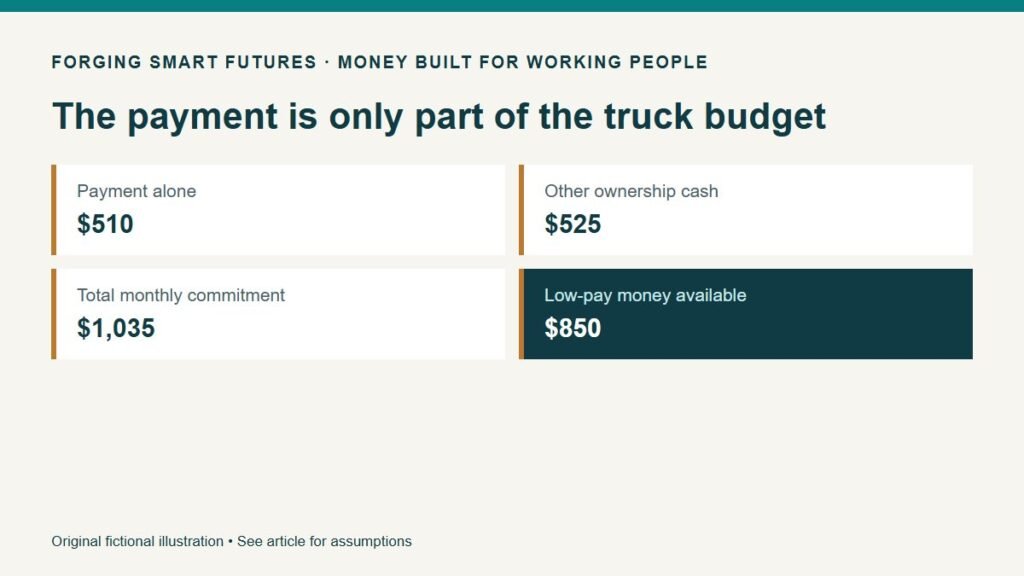
The cash commitment is $525 more than the payment alone. The reserves are planning amounts, not guarantees that repairs will cost exactly that much or arrive evenly.
Run the no-overtime test
Suppose dependable monthly take-home pay is $3,600 and nonvehicle essentials and required payments total $2,750. That leaves $850 before the truck. The $1,035 scenario is short by $185, even before other discretionary spending or goals.
A $500 overtime deposit would cover this month's difference. It would not make the baseline affordable. Compare a less costly vehicle, a larger delay before purchase, a different transportation arrangement or a changed expense plan using real numbers. Do not hide the gap by averaging in overtime you cannot count on.
If the truck replaces an existing vehicle, subtract only the costs that truly disappear. Insurance, fuel and loan payments may overlap during the transition. Check any trade-in loan balance separately; trade-in value is not the same as equity you can use.
Add an economic-cost view without double-counting
Monthly cash flow answers whether bills can be paid. Ownership cost over several years is a different comparison. It includes value lost between purchase and resale, financing costs and operating expenses. Do not add depreciation on top of principal payments and call the result a clean ownership-cost measure without accounting for the vehicle's remaining value.
For a straightforward comparison, write the cash paid to acquire and operate each vehicle over the same period, subtract its estimated sale proceeds and account for any loan balance still owed. Label resale estimates as uncertain. Do not present a guessed future sale price as guaranteed money.
Gather the missing numbers before signing
Use a written out-the-door price, financing disclosure, actual insurance quote, realistic mileage and a maintenance assessment. For a used vehicle, arrange an independent inspection where practical. Record which estimates are weak and test a higher-cost case.
The FSF cost-of-going-to-work guide helps connect transportation to the household budget. Free checklists and existing member planning tools are listed in Resources. Start with the total monthly commitment—not the number printed largest in the ad.
General financial education, not individualized financial, investment, tax, legal or credit advice. Examples and estimates are fictional. No affiliate relationship is included.
Editorial attribution: Paul Foster
Published: September 10, 2026 Last reviewed: September 10, 2026
Sources & References
- https://www.consumerfinance.gov/ask-cfpb/how-much-can-i-afford-to-borrow-for-a-car-or-auto-loan-en-751/
Put this into practice
Compare the full commitment against a lower-income month. Free Major Financial Decisions checklist — no membership required.
Related decisions
- Rent or Buy When Your Income Depends on Overtime?
- Helping Family Financially Without Missing Your Own Bills
- Cash, Payment Plan or Loan for an Urgent Home Repair?
Expanded member resource: Big Purchase and Household Decision Workbook. Guided exercises with local save, reopen and print controls. Worksheet answers are not automatically calculated. Compare free resources and FSF membership benefits.
Human-reviewed, AI-assisted content; how FSF creates articles.