
What Going to Work Really Costs Your Household
Start with what changes because you go to work
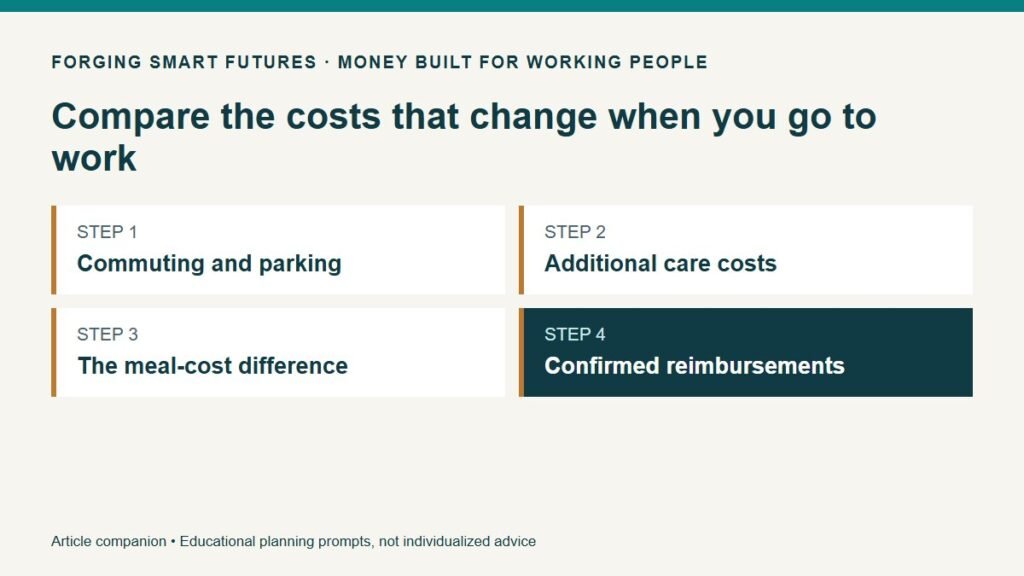
A larger paycheck does not automatically mean an equally large increase in money available for household goals. A different work location or schedule may change parking, transportation, meals and care arrangements. The useful question is how much additional take-home pay remains after the additional costs of that arrangement.
You can examine this with a notebook. List the workdays you expect, the costs those days create and the expenses that stay the same either way. Keep the assumptions visible. This is a household planning comparison, not a replacement for your employer's wage calculation or a tax return.
The CFPB recommends examining actual transactions and less frequent expenses before judging what a budget can support. Its guidance is written for homebuying; the work-cost exercise here is an original FSF application. CFPB: Assess your spending.
Give each expense one place
Use three groups: costs that change with each workday, costs that change with the overall arrangement, and household costs that continue regardless.
Workday costs might include a parking charge, a transit fare, additional fuel, an extra care session or the difference between a purchased meal and the meal you would otherwise eat. Arrangement costs could include a required monthly parking pass or a different care contract. Housing and a car payment may continue regardless of a particular extra shift.
The groups depend on the question. A car payment may not change when you accept one extra Saturday, but buying another vehicle could matter greatly when comparing two long-term work arrangements. Do not treat a cost as permanently fixed just because it does not change this week.
Record the amount, frequency, evidence and whether it changes in the alternative you are comparing. Mark uncertain entries as estimates instead of hiding them inside one precise-looking total.
Work through one ordinary month
Riley's fictional work arrangement involves 20 on-site days. The following amounts are illustrative; they are not typical costs for Houston or any occupation.
| Work-driven expense | Per on-site day | 20-day total |
|---|---|---|
| Additional commuting cash cost | $8 | $160 |
| Parking | $3 | $60 |
| Meal spending above the alternative meal cost | $5 | $100 |
| Additional care session | $18 | $360 |
| Total | $34 | $680 |
Riley starts by comparing the $680 with the household budget. If take-home deposits total $3,200, then $2,520 remains after these four categories alone. That is not disposable income: rent, groceries, debt payments and every other obligation still need their place.
The example also excludes long-term vehicle wear and any change in insurance or equipment needs. Riley should identify those separately before using the comparison for a lasting job decision. A short list of cash costs is useful only when its limits are clear.
Compare an extra shift using the expenses it actually changes
Suppose Riley estimates an extra shift would increase take-home pay by $170. Confirm that estimate against payroll information and a comparable statement when available; gross pay and additional take-home pay are different figures.
If all four example costs apply that day, the shift leaves $136 after those incremental costs: $170 minus $34. But suppose the usual care arrangement does not cover that day and the additional care cost is $55 instead of $18. The day's costs become $71, leaving $99.
Neither result says whether Riley should accept the shift. Rest, family responsibilities, safety, advancement and the reliability of future hours also matter. The calculation simply makes one part of the choice visible.
Keep one-time and recurring changes separate. A single shift cannot reasonably be expected to fund an ongoing bill every month unless the income is actually dependable.
Avoid the common double counts
If groceries already include food for packed lunches, do not subtract the full price of a purchased meal as an extra cost without considering the food it replaces. Use the difference for a comparison, or show both complete budgets consistently.
Do not count a monthly pass and the same covered trips again as separate fares. Do not subtract a paycheck deduction twice if the take-home amount already reflects it. If you move money into a reserve for future work gear, distinguish that transfer from a purchase paid out of the reserve later.
Reimbursements need two dates: when you pay and when repayment actually arrives. A reimbursed expense may have little eventual net cost but still leave you short before payday. Do not count an unconfirmed reimbursement as money already available. Check the actual employer policy; this exercise does not establish which expenses an employer must pay.
Build your comparison in ten minutes
Create this table for your present arrangement and the proposed alternative. Use actual schedules rather than assuming every month has the same number of workdays.
| Item | Current arrangement | Alternative | Evidence or open question |
|---|---|---|---|
| Expected take-home deposits | |||
| On-site workdays | |||
| Transportation and parking | |||
| Additional care | |||
| Meal difference | |||
| Other changed recurring costs | |||
| One-time transition costs | |||
| Confirmed reimbursements and timing |
Compare like periods. Keep a one-time deposit or purchase out of the recurring monthly total, while still making room for it in the first month's cash plan. For each uncertain amount, try a lower and higher case. A choice that works only with the cheapest estimate deserves another look.
Put the result back into your bill calendar
Costs matter on the day money leaves, not only as monthly averages. Enter transportation, care and other planned spending alongside your deposits and household bills. Check the lowest planned balance before allocating extra pay to a new goal.
Use the FSF Variable Pay Budget Planner for the monthly comparison, then read How to Budget When Overtime Changes Your Paycheck to separate dependable income from variable extras. The concise free tool accepts totals; keep this itemized working table with your records.
General financial education only, not individualized financial, investment, tax, employment, legal or credit advice. Riley and all figures are fictional. This article does not determine tax deductibility, employer reimbursement duties or the suitability of a job.
Editorial review: Owner reviewed and approved this article for release on September 9, 2026. Prepared with AI assistance by FSF Editorial Team; no professional adviser review is claimed.
Editorial attribution: Paul Foster
Published: September 9, 2026
Sources & References
- https://www.consumerfinance.gov/owning-a-home/prepare/assess-your-spending/
- https://forgingsmartfutures.com/variable-pay-budget-planner/
- https://forgingsmartfutures.com/budget-with-overtime-pay/
Put this into practice
Build a plan that still makes sense when overtime falls. Free Budgeting checklist — no membership required.
Related decisions
- Higher Hourly Pay or Better Benefits? Compare Two Job Offers
- Why Your Overtime Check Is Smaller Than the Number in Your Head
- Open Enrollment for Shift Workers: A Practical Comparison Checklist
Expanded member resource: Variable Pay Household Planning Workbook. Guided exercises with local save, reopen and print controls. Worksheet answers are not automatically calculated. Compare free resources and FSF membership benefits.
Human-reviewed, AI-assisted content; how FSF creates articles.