
Balance Transfer or Consolidation Loan? Compare the Whole Payoff Job
The short answer
Compare the cash needed to clear the debt, the deadline and the payment your regular income can support. A lower advertised rate or smaller minimum payment is not enough. A balance transfer may have a fee and a promotional deadline; a loan may reduce the monthly payment by extending repayment.
The CFPB identifies these costs and warns that moving debt does not fix an ongoing gap between income and spending. It also notes that existing creditors may offer arrangements worth asking about before taking on a replacement product. CFPB consolidation guidance.
Put three options on the same page
Include staying with current accounts and making a planned repayment—not just two new offers. For each option, record the starting balance, all fees, rate periods, payment schedule, total modeled repayment and assumptions about new borrowing.
Ask whether fees are paid upfront, deducted from loan proceeds or added to the balance. A loan described as $6,000 does not necessarily supply $6,000 to creditors after fees. Obtain the actual disclosure and check the amount delivered, APR and repayment schedule.
A fictional transfer with an affordable-looking minimum
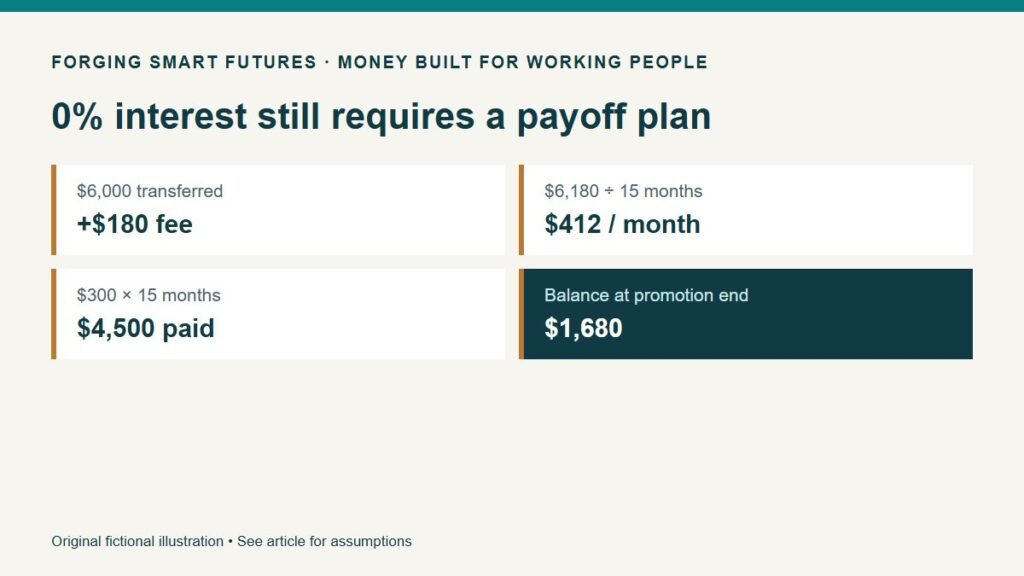
Assume $6,000 transfers to a card with a 3% fee added to the balance and 0% interest on that transferred balance for 15 months. Assume no other fees, no purchases and that the stated promotion remains in force.
The fee is $180. The repayment job is $6,180. Clearing it with 15 equal payments requires $412 a month. That is a planning payment, not the card's required minimum.
If the household can afford only $300 monthly, it pays $4,500 over the period and has $1,680 remaining when the promotion ends. The later rate and terms then matter. Hoping for another transfer offer is not the same as a funded payoff plan.
For a worker with uncertain overtime, test $412 against regular take-home pay. A few strong months could help, but do not use them as guaranteed income. Also allow enough processing time and check the actual promotional expiration date; “15 months” does not automatically mean fifteen payments will clear before interest changes.
Compare a loan without confusing rate and APR
Now assume a separate fictional loan supplies the full $6,000, has no fees, charges a fixed nominal annual rate of 12% with monthly interest and amortizes over 24 monthly payments. The modeled payment is about $282.44; total payments are about $6,778.58, including about $778.58 of interest. Real offers may differ, especially when fees make APR different from the stated interest rate.
This loan's payment is below the transfer's $412 payoff target, but it carries the balance longer and costs more under these assumptions. The comparison does not establish which is best for a particular borrower. It shows why payment, cost and finish date all need a place on the page.
Test what happens when the plan slips
For a transfer, write down the rate after the promotion and what happens after a missed payment. For a loan, check late fees, whether the rate changes, and any early-payment terms. For both, confirm what happens to the original accounts and scheduled payments after balances move.
Do not keep spending on the cleared cards without a replacement spending plan. Otherwise the household can end up with both the consolidation obligation and new card debt. Be especially cautious about converting unsecured balances into debt secured by a home: the consequences of nonpayment change.
Debt settlement is a different arrangement from a new loan or balance transfer. If a company tells you to stop paying creditors, pause and investigate the service, its fees and its risks rather than treating it as an ordinary rate comparison.
The decision sheet
Before applying, fill in: debt actually paid off; cash required upfront; required monthly payment; payment needed for your desired finish date; modeled total cost; lean-month affordability; and the result if overtime disappears. Leave unknowns marked unknown until the provider answers in writing.
Use the free Debt & Credit checklist in FSF Resources and the variable-pay budget guide. An offer that needs ideal working hours every month deserves another look before you sign.
General financial education, not individualized financial, investment, tax, legal or credit advice. Rates, terms and calculations above are fictional illustrations, not available offers. No affiliate relationship is included.
Editorial attribution: Paul Foster
Published: September 10, 2026 Last reviewed: September 10, 2026
Sources & References
- https://www.consumerfinance.gov/ask-cfpb/what-do-i-need-to-know-if-im-thinking-about-consolidating-my-credit-card-debt-en-1861/
Put this into practice
Put balances, dates and written terms in one usable plan. Free Debt & Credit checklist — no membership required.
Related decisions
- Should Your Next Overtime Check Go Toward Debt or Your 401(k)?
- Buy Now Pay Later for Tools and Work Gear: Add Up Every Due Date
- How to Use Overtime to Pay Down Debt Without Leaving Yourself Short
Expanded member resource: Debt Organization and Decision Workbook. Guided exercises with local save, reopen and print controls. Worksheet answers are not automatically calculated. Compare free resources and FSF membership benefits.
Human-reviewed, AI-assisted content; how FSF creates articles.