
Cash, Payment Plan or Loan for an Urgent Home Repair?
The short answer
Establish what must be repaired now, obtain a clear scope and compare the full cost and cash timing of each payment option. Using savings can avoid borrowing costs but leave too little for bills; financing can preserve cash but create a payment or collateral risk. Neither choice is automatically right.
Address immediate safety concerns through qualified help. A financial comparison is not permission to delay a hazardous electrical, structural or other urgent condition.
Separate the repair decision from the financing pitch
Ask what work stabilizes the immediate problem and what can reasonably be scheduled later. Get the scope, materials, timeline and price in writing. Compare equivalent work rather than a basic repair from one contractor with a full replacement from another.
The FTC recommends investigating contractors and comparing financing rather than automatically accepting the contractor's offer. It warns against pressure and problematic payment demands. FTC home-improvement guidance.
Verify licensing or registration requirements with the relevant local authority and ask about insurance. Requirements vary. A polished truck or online review does not establish that the contractor is qualified for the particular work.
Compare a fictional $2,400 repair
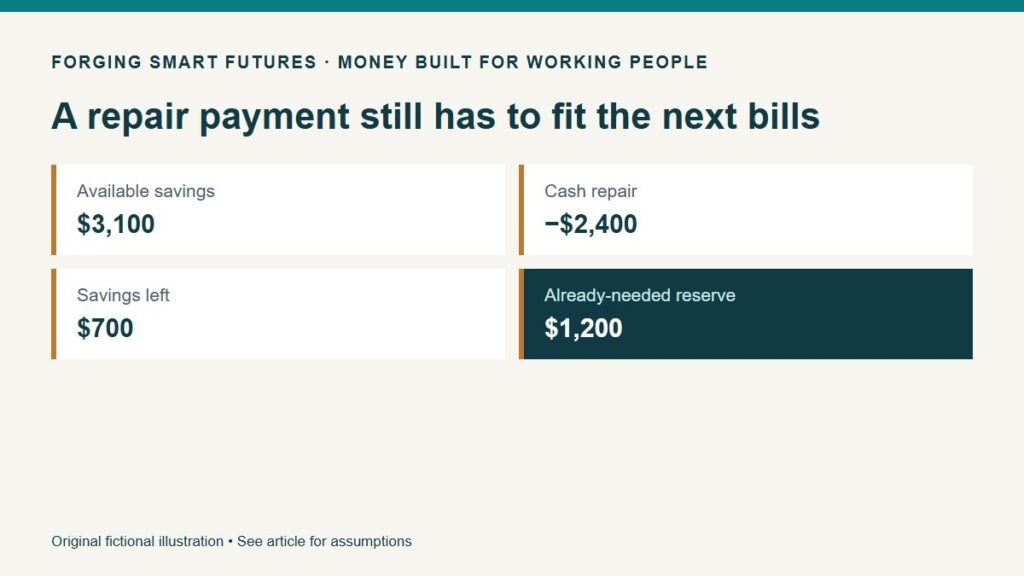
Assume the same completed work costs $2,400 and the household has $3,100 of savings. It has already identified $1,200 of near-term bills and reserves that the savings must support.
Paying all $2,400 in cash leaves $700, which is $500 below the amount already needed. “We have enough savings to buy it” and “we have enough left to run the household” are different tests.
Consider three invented alternatives, not actual offers:
| Arrangement | Upfront cash | Later obligation |
|---|---|---|
| Cash | $2,400 | None for this repair |
| No-fee installment agreement | $600 | Six monthly payments of $300 |
| Loan with a $120 fee paid separately | $120 | Principal and interest under its written schedule |
The installment example totals $2,400, but its $300 recurring payment still needs room in each month's budget. The loan cannot be judged without its APR, amount delivered, term and payment schedule. A missing number is a reason to ask, not to assume it is favorable.
Test the least comfortable month
Use take-home pay without assumed overtime. Subtract essentials, existing required payments and known irregular costs. Does the new obligation fit? If it leaves only a few dollars, add a plausible disruption such as a reduced shift or another transportation cost.
Do not use the same savings twice—once as the repair down payment and again as the reserve covering lean-month payments. Place each withdrawal on a calendar. The FSF variable-pay guide helps keep those assumptions visible.
Ask what happens if payment is delayed
For any financing, identify late charges, rate changes, promotional deadlines, fees and whether property secures the debt. Read the final documents, not only a payment example on a brochure. A home-secured obligation can have consequences beyond an unsecured bill.
Ask when payments become due relative to the work. Understand deposits, progress payments and completion requirements under the contract and local rules. Keep receipts and change orders. Do not sign a completion statement for work that remains unfinished.
If assistance, insurance or a warranty may cover part of the work, contact the relevant provider and confirm the process. Do not assume reimbursement or approval until it is established, and do not delay urgent safety action solely to finish a budgeting worksheet.
Decide with a one-page comparison
Record the confirmed repair scope, cash needed now, total financed amount, complete repayment schedule, total modeled cost, remaining reserve and unresolved questions. Choose only after the work and payment terms are understandable together.
Use the free Major Financial Decisions checklist in FSF Resources. A useful comparison should let you explain both how the home gets repaired and how the household pays its next bills.
General financial education, not individualized financial, investment, tax, legal or credit advice. Fictional terms are illustrations, not financing offers. No affiliate relationship is included.
Editorial attribution: Paul Foster
Published: September 10, 2026 Last reviewed: September 10, 2026
Sources & References
- https://consumer.ftc.gov/articles/how-avoid-home-improvement-scam
Put this into practice
Compare the full commitment against a lower-income month. Free Major Financial Decisions checklist — no membership required.
Related decisions
- Lease or Buy a Vehicle When Work Puts on Heavy Mileage?
- Term Life Insurance When Your Family Depends on Your Paycheck
- What a Truck Really Costs Beyond the Monthly Payment
Expanded member resource: Big Purchase and Household Decision Workbook. Guided exercises with local save, reopen and print controls. Worksheet answers are not automatically calculated. Compare free resources and FSF membership benefits.
Human-reviewed, AI-assisted content; how FSF creates articles.