
Per Diem and Reimbursements: Keep Work-Travel Money Separate
The short answer
Separate ordinary wages from travel money, record what the payment is intended to cover and track the expenses or reporting that follow. A large deposit that includes an advance is not automatically a larger amount available for household bills.
Tax treatment depends on the arrangement and whether its rules are met. IRS Publication 463 explains accountable-plan requirements, including business connection, substantiation and handling excess amounts. A label such as “per diem” alone does not settle the tax result. IRS travel and reimbursement guidance.
Find out how this trip is funded
Ask whether the employer pays vendors directly, advances money, reimburses actual approved expenses or uses a qualifying allowance arrangement. Identify what you must pay upfront, what documentation is required and when payment is expected.
Separate lodging, meals, travel and incidental categories according to the policy. Check personal extensions, family travel and upgrades before assuming they will be paid. The household should not discover after the trip that a charge it treated as reimbursable was outside policy.
Do not copy a government travel rate into a private-employer budget and assume it is automatically your entitlement or tax-free allowance. Confirm the employer's written terms and the applicable rules.
Show the advance as committed cash
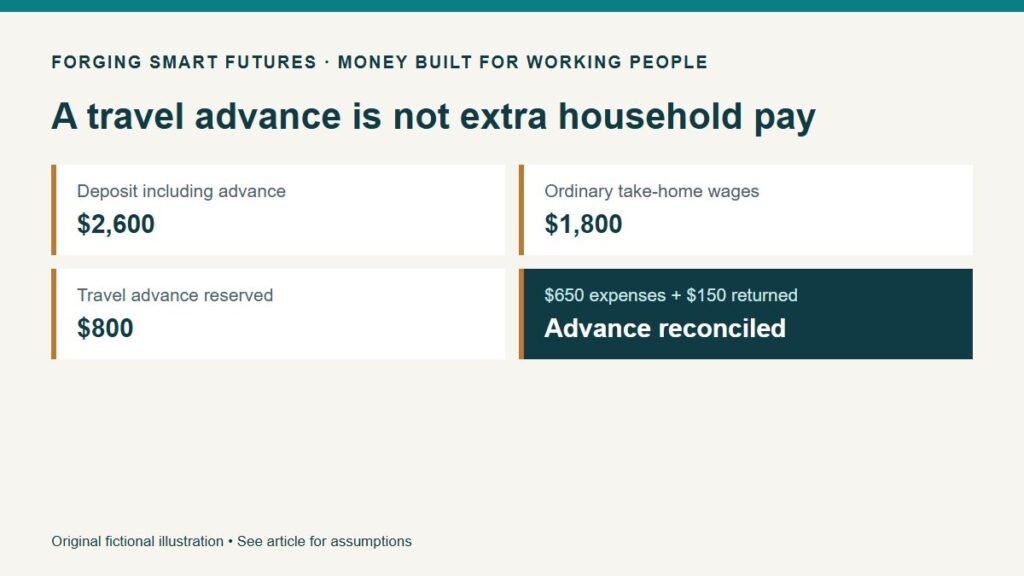
In a fictional example, a deposit includes $1,800 in ordinary take-home wages and an $800 actual-expense travel advance. The bank shows $2,600, but the advance has a job to do. The household wage budget starts with $1,800 rather than treating all $2,600 as spendable pay.
Approved documented expenses later total $650. Under this fictional actual-expense policy, the remaining $150 must be returned. The advance reconciliation is $800 received minus $650 supported expenses minus $150 returned equals zero outstanding.
This is not a statement that every per-diem arrangement requires returning every dollar below actual meal spending. Allowance rules can differ. Use the example to understand an actual-expense advance and ask how your particular policy handles unused or unsubstantiated amounts.
Plan the reimbursement delay
Suppose you instead pay a $900 hotel bill and expect reimbursement three weeks later. The expense may ultimately be reimbursed, but the household still has to fund the interval. Put the card due date or cash withdrawal on the calendar alongside the expected reimbursement date.
If payment is delayed, a card balance can create interest or a cash shortage. Ask about direct billing, advances or other employer arrangements before the trip rather than treating personal credit as a free bridge. Do not assume reimbursement will arrive before a statement deadline unless the timing is confirmed.
Keep the expected reimbursement visible as pending, not as cash already in the account. Follow up through the employer's process if it misses the expected date.
Keep a trip record that can be reconciled
Record trip dates, business purpose, advance received, expense date, supplier, amount, category, receipt location, submitted amount, approved amount and payment or return date. Note rejected or questioned items separately.
At the end, connect every payment to the trip rather than adding another unexplained deposit to household income. Keep the submitted report and approval evidence. A photograph of a receipt is useful only if it is readable and can be matched to the transaction later.
IRS guidance allows certain per-diem or car allowances to satisfy substantiation under specified conditions. That does not remove the need to follow the applicable process. Ask payroll about unclear tax reporting rather than deciding from the deposit description alone.
Your next action
Before the next trip, write down the payment method, documentation deadline and expected reimbursement date. Use the FSF bill-calendar guide to check the cash bridge and the cost-of-going-to-work article for costs the employer does not cover. Existing planning materials are labeled on the Resources page.
General education, not individualized tax, employment or financial advice. Examples are fictional and distinguish actual-expense advances from other allowance arrangements. No affiliate relationship is presented.
Editorial attribution: Paul Foster
Published: September 10, 2026 Last reviewed: September 10, 2026
Sources & References
- https://www.irs.gov/publications/p463
Put this into practice
Build a plan that still makes sense when overtime falls. Free Budgeting checklist — no membership required.
Related decisions
- How to Budget When Overtime Changes Your Paycheck Every Month
- Paid Every Two Weeks? Build a Bill Calendar That Fits
- Budget App or Spreadsheet for Variable Pay? Compare the Tradeoffs
Expanded member resource: Variable Pay Household Planning Workbook. Guided exercises with local save, reopen and print controls. Worksheet answers are not automatically calculated. Compare free resources and FSF membership benefits.
Human-reviewed, AI-assisted content; how FSF creates articles.