
Before Hiring Your First Helper: Estimate the Full Cost and Responsibilities
The short answer
Budget the full cost of bringing someone into the work, then determine the responsibilities that apply before the first shift. The hourly amount is only one input. Classification, payroll, insurance, safety, supervision and reliable customer cash all matter.
The IRS explains that the actual working relationship determines employee or independent-contractor status for federal tax purposes; a label in a contract is not enough. Other laws can use different tests. Get the classification right for the actual arrangement rather than choosing “contractor” to make a spreadsheet cheaper. IRS worker-classification guidance.
Define the work and the reason for help
Write the tasks, schedule, location, equipment, required skills and supervision. Identify whether the helper adds capacity, replaces your time or enables work you cannot do alone. Those are different business cases.
If demand is irregular, record the minimum and maximum hours you can reasonably support. Do not promise steady work based on one unusually busy month. Ask what happens if a customer cancels after you have committed to paying for time.
Build a full-cost worksheet
For an employee arrangement, investigate wages, paid nonbillable time, employer taxes, insurance, payroll administration, training, equipment and applicable leave or other requirements. The rates and rules depend on the work and location; this article does not prescribe a universal payroll percentage.
For an independent business providing services, compare the actual contract scope, price, insurance, scheduling and responsibilities. A different label does not erase safety or customer obligations, and misclassification can create consequences beyond the original budget.
Work through a fictional employee-cost example
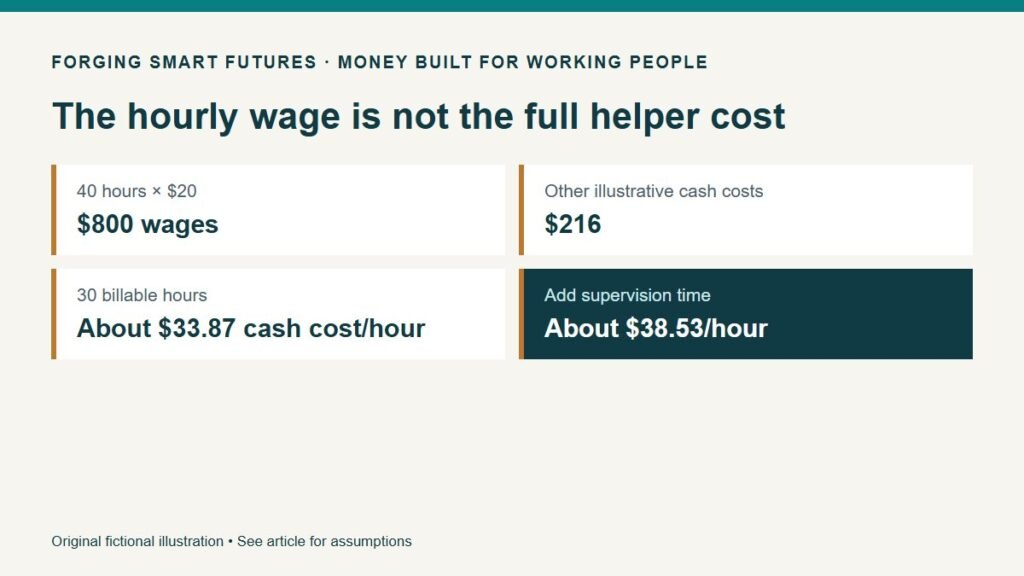
Suppose forty paid hours at $20 cost $800. For planning only, add $96 of estimated employer taxes and insurance, $40 of payroll administration and $80 of equipment or consumables allocated to the period. The cash-cost estimate is $1,016.
If only thirty of those forty hours can be billed to customers, the cost is about $33.87 per billable hour before your supervision and other business overhead. The $96 allowance is fictional, not a legally sufficient tax or insurance calculation. Replace every placeholder with verified costs before hiring.
Now add four hours of your supervision valued at a chosen $35 per hour for planning. The $140 time value brings the economic-cost estimate to $1,156, or about $38.53 per billable hour. That time value may not be a separate cash payment, but it prevents assuming supervision is free.
Compare contribution to cost
If thirty billable hours produce $1,500 in customer revenue, subtract the $1,016 cash estimate to leave $484 before your time and other overhead. Including the illustrative $140 supervision value leaves $344. A profit conclusion would require the rest of the business costs and actual tax treatment.
If customers pay after the payroll date, revenue on paper does not fund the paycheck. Put customer collection dates beside wage and supplier due dates. Keep enough working cash for the commitment rather than assuming an unpaid invoice is available money.
Finish the operational preparation
Confirm required registrations, payroll setup, employment documentation, insurance and safety responsibilities using current official sources and qualified help. Determine how time will be recorded, instructions given, work checked and incidents reported.
Provide an appropriate orientation for the actual work. Do not use an AI-generated checklist as the sole authority for hazardous tasks. If the job requires qualifications, verify them rather than assuming experience from an unrelated role is sufficient.
Your next action
Price one realistic month with paid hours separated from billable hours, then test a slower collection scenario. Review FSF's business cash-flow article and startup-cost planning. Existing free and member resources are identified on the Resources page.
General education, not individualized employment, legal, tax, safety or accounting advice. All costs and rates are fictional planning inputs. No classification, compliance outcome or affiliate relationship is guaranteed.
Editorial attribution: Paul Foster
Published: September 10, 2026 Last reviewed: September 10, 2026
Sources & References
- https://www.irs.gov/businesses/small-businesses-self-employed/independent-contractor-self-employed-or-employee
Put this into practice
Test demand and cash needs before committing to recurring costs. Free Starting a Business checklist — no membership required.
Related decisions
- What Will It Cost to Start Your Service Business Before the First Customer?
- How to Compare Business Bank Accounts for a Small Service Business
- Bookkeeping and Invoicing Software for Your First Service Business
Expanded member resource: First Service Business Planning Workbook. Guided exercises with local save, reopen and print controls. Worksheet answers are not automatically calculated. Compare free resources and FSF membership benefits.
Human-reviewed, AI-assisted content; how FSF creates articles.