
A Profitable Month Can Still Run Out of Cash: Understand Receivables
The short answer
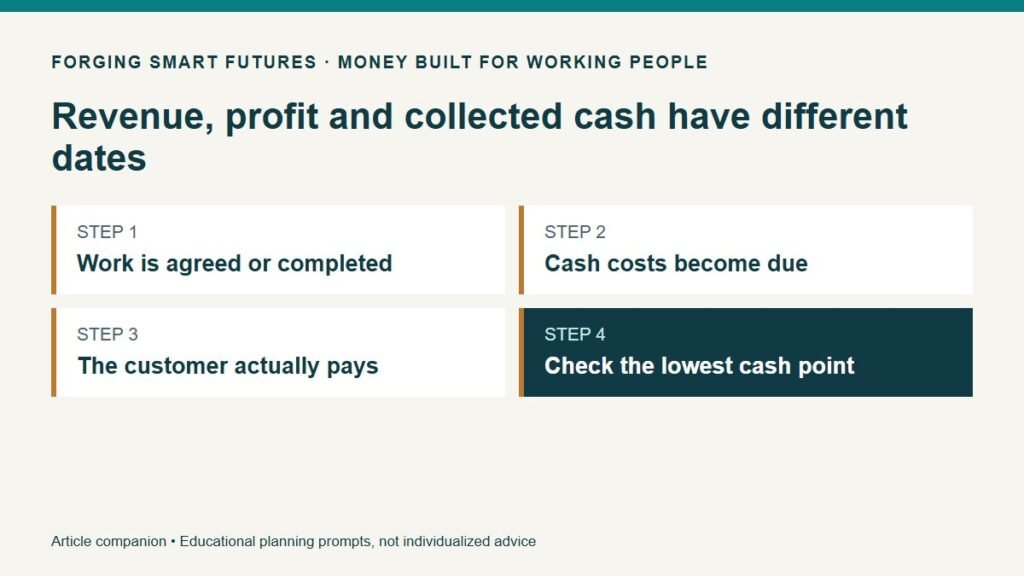
A job can bring in more than its costs while the business runs short of cash before the customer pays. Track the work, the invoice and the bank deposit separately. Then place collections and payments in the weeks when cash is expected to move, and test what happens if collections arrive late.
If you operate a side business after a full shift, the practical question is simple: will the next supplier payment come out of business cash, or will it collide with the household bills?
Three different milestones
Finishing a job means the work has reached a particular stage. Sending an invoice requests payment. Receiving the money increases cash available, subject to settlement, holds or other restrictions that may apply to the payment method. Those events do not necessarily happen together.
Accounts receivable is money owed by customers. It is useful to know what is owed, but an outstanding balance is not the same as spendable money in the bank. Bookkeeping methods also differ: the SBA explains that cash and accrual approaches can record a sale in different periods when payment follows the work. Your cash forecast is a planning view, not a decision about which accounting or tax method your business should use. SBA financial-management guidance.
Keep the distinction visible. A list headed “sales this month” may contain completed but unpaid jobs. A list headed “cash collected this month” should contain collections. Combining the two can make the same money appear twice.
A fictional job with a positive margin and a cash shortage
Imagine a small service business starts the month with $900 available. It completes and invoices a $2,400 job. Direct cash costs associated with that job total $1,400: $800 in materials and a $600 payment for work performed. The customer is expected to pay in week three.
The difference between the invoice and those two job costs is $1,000. That is a simplified job margin before overhead, taxes and other costs; it is not a complete calculation of net profit or owner take-home pay.
Here is the cash timeline with no other activity:
| Week | Starting cash | Customer cash received | Cash paid | Ending cash |
|---|---|---|---|---|
| 1: materials paid | $900 | $0 | $800 | $100 |
| 2: work payment due | $100 | $0 | $600 | −$500 |
| 3: customer pays | −$500 | $2,400 | $0 | $1,900 |
The negative $500 is an unfunded gap in the model, not permission to overdraw an account or evidence that a bank will cover it. Without another arrangement, the business cannot fund all the entered payments on time.
The eventual $1,900 ending cash reconciles to the $900 opening cash plus the $1,000 simplified margin. That reconciliation does not erase the week-two problem. If the customer pays in week four instead, the gap persists longer even though the job price has not changed.
Build the cash calendar from the bank outward
Start with cash actually available for business use. Identify money already committed or restricted so that it is not accidentally treated as available for the next job. Reconcile the starting point with your records rather than copying a remembered balance.
Next list the next several weeks of cash movement. Thirteen weeks is a useful working window for this exercise; it is not a guarantee that longer-term needs have been covered.
For each customer collection, record the amount, invoice or job reference, expected collection date and reason for that date. Separate a contractual due date from your current expectation if they differ. A date copied automatically from an invoice can give false confidence when the customer has already told you payment will be delayed.
For payments, include the actual timing of materials, services, recurring business bills, equipment cash payments and planned owner withdrawals. Include taxes, financing payments and payroll-related cash requirements where applicable, using your verified records and qualified guidance. This article does not calculate those obligations.
Use separate rows for customer collections and other cash entering the business. An owner contribution or borrowing can help explain a cash balance, but neither should masquerade as customer demand.
Test one late-payment scenario at a time
Keep your original timing as a base case. Make a second case that moves a relevant collection one or more weeks later while leaving the bills at their original dates. Compare the lowest balance and how long it remains below the cash you need.
Do not quietly delay your own bills along with the customer payment unless that arrangement actually exists. Otherwise the scenario hides the pressure it was meant to reveal.
In the fictional example, moving the $2,400 payment from week three to week four leaves the same eventual $1,900 balance but extends the funding gap. Moving it beyond the forecast window makes the window's ending cash lower. That does not automatically mean the receivable is lost; it means it has not arrived within the modeled dates. Whether a particular debt will be collected is a separate question.
In a spreadsheet, create a second copy of the schedule and shift customer collections by your chosen number of weeks. Keep other cash and payments in their original weeks and separately record collections pushed beyond the window. This is a sensitivity test, not a prediction of customer behavior.
A positive weekly ending balance can still hide a bad Tuesday
Suppose you start a week with $200, owe $700 on Tuesday and expect $1,000 on Friday. The week ends at $500, but Tuesday has a $500 funding gap if nothing else changes.
For a conservative within-week check, subtract all the week’s payments from opening cash before adding receipts. It deliberately asks a harder timing question. It is not an exact daily bank balance.
When the warning appears, inspect actual days. Sometimes money genuinely arrives before the payment. Sometimes the weekly forecast has exposed a real shortage. A weekly total alone cannot distinguish those situations.
Turn the warning into a specific action
| What the forecast shows | A useful next check |
|---|---|
| A large invoice is expected shortly before a major bill | Confirm invoice receipt, approval status and the customer's expected payment date |
| A planned purchase creates the low point | Check whether the purchase can wait without breaching an obligation or disrupting required work |
| Several jobs require materials before collections | Compare their combined funding needs, not just each job's margin |
| Owner withdrawals create the shortage | Compare business timing with the household plan before committing to the withdrawal |
| Cash stays negative even after expected collections | Revisit costs, pricing, scope and funding assumptions; payment timing may not be the only issue |
A deposit, milestone billing or different terms might change a future job's funding pattern, but do not assume you can impose new terms on an existing agreement. Confirm what the customer agreed to and obtain appropriate help with contract questions. Do not use a cash forecast as a substitute for that review.
Use a short weekly check-in
Choose a consistent time to replace estimates with actual receipts and payments, update the remaining dates, and add the next week to the view. Keep the prior version so you can see what changed. Record the largest timing difference and the action it requires.
You do not need to rewrite the whole business plan every week. You need an honest opening balance, a distinction between unpaid work and collected money, and a clear view of the next payment that could cause a problem.
Related reading: Build your service-business startup cash plan.
General financial education only, not individualized financial, investment, tax, legal or credit advice. Examples are fictional and omit costs specifically identified above. Prepared with AI assistance by FSF Editorial Team. Owner editorial review completed September 9, 2026; no professional adviser review is claimed.
Editorial attribution: Paul Foster
Published: September 9, 2026
Sources & References
- https://www.sba.gov/counseling/manage-your-business/
Put this into practice
Test demand and cash needs before committing to recurring costs. Free Starting a Business checklist — no membership required.
Related decisions
- What Will It Cost to Start Your Service Business Before the First Customer?
- How to Price a Weekend Job Without Forgetting Your Costs
- Business Insurance Quotes for a Small Service Company: Questions to Compare
Expanded member resource: First Service Business Planning Workbook. Guided exercises with local save, reopen and print controls. Worksheet answers are not automatically calculated. Compare free resources and FSF membership benefits.
Human-reviewed, AI-assisted content; how FSF creates articles.