
Term Life Insurance When Your Family Depends on Your Paycheck
The short answer
Start with the financial needs the household would face if your income or unpaid household work were lost. Then compare an appropriate coverage period, amount, premiums and policy terms. A multiple of salary can be a rough conversation starter, but it does not explain your family's actual gap.
Texas Department of Insurance explains that term life covers a stated period and differs from permanent coverage. Its consumer guide also addresses comparing policies and existing coverage. Actual terms and state rules matter. TDI life insurance guide.
List the needs before choosing a number
Identify ongoing household spending, reliable surviving income, childcare or other replacement services, debts and one-time needs. Include the economic role of a caregiver even if that person has no paycheck; replacing that work can cost money.
Separate essential obligations from goals you would like to fund. Record which needs end at a particular date and which may continue. Avoid counting the same mortgage both as a lump-sum payoff and as monthly payments throughout the income-replacement period unless you intentionally model both scenarios separately.
Build a transparent first estimate
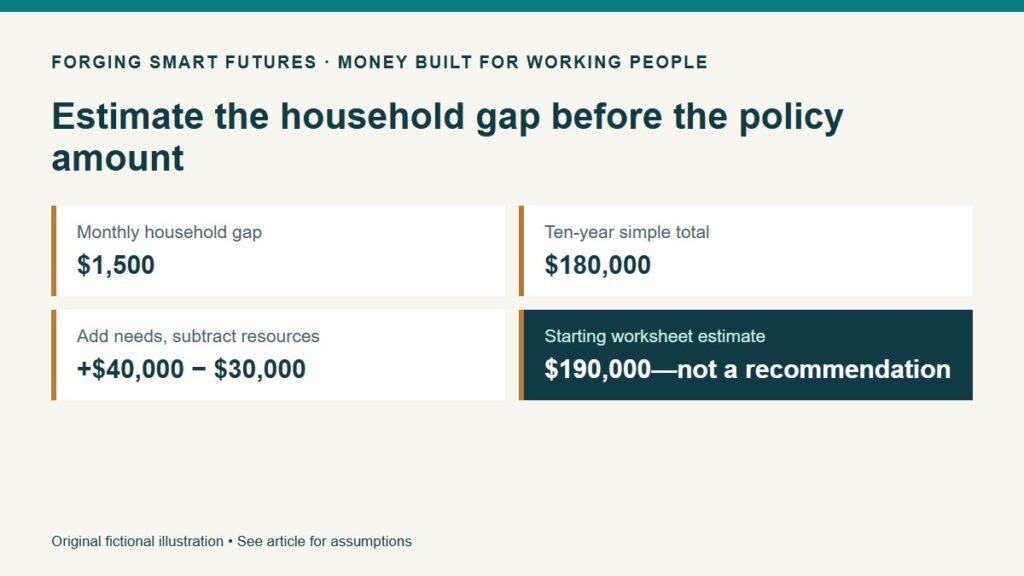
In a fictional household, essential spending would be $3,200 monthly and reliable surviving income $1,700. The $1,500 monthly gap is $18,000 annually. Multiplying by ten years gives $180,000 before considering inflation, investment returns, taxes or changing needs.
Add $40,000 of separate one-time needs and subtract $30,000 of resources genuinely available for this purpose. The simple planning estimate is $190,000. These figures are not a recommended coverage amount. They create a starting worksheet for a more complete discussion.
Do not subtract retirement savings or emergency cash automatically if doing so would undermine another essential household need. Likewise, a possible inheritance or uncertain employer benefit should not be treated as confirmed available money.
Match the period to the need
Ask how long dependents may rely on the income, when debts or care costs could decline and how retirement changes the picture. A shorter term may cost less but end before the need does. A longer term may cover more years but must still fit the budget.
Check whether premiums remain level for the period, what happens afterward and whether renewal or conversion options exist. Do not assume a later policy will be available at the same price or without a new health review.
Review employer coverage separately
Find the amount, eligibility conditions and what happens when you leave the job or reduce hours. Ask about portability or conversion rather than assuming the benefit follows you automatically. Record any deadlines and the cost of continuing it if available.
For workers whose hours and employers change, this job connection can be as important as the headline amount. Keep existing coverage in place while evaluating a replacement; do not cancel on the assumption that an application equals an issued, effective policy.
Compare quotes on the same basis
Use the same requested amount, term, health and work information. Review exclusions, riders, premium guarantees and the insurer's written terms. A preliminary online price may change after underwriting, so distinguish an estimate from an actual offer.
Answer application questions accurately. Ask a licensed insurance professional about unclear questions, beneficiary arrangements or a trust/minor-child situation rather than improvising legal instructions in an online form.
Keep the policy usable
Make sure the intended person can locate the insurer, policy number and claims contact without exposing sensitive information publicly. Review beneficiaries and contact details after relevant life changes, subject to any legal restrictions or obligations.
Include the premium in the normal-pay budget. A policy that repeatedly lapses because the payment depends on overtime may not provide the continuity you intended.
Your next action
Write the household income gap and a separate list of one-time needs, then discuss the assumptions with a qualified professional. Use the FSF variable-pay budget for affordability and the Resources page for existing planning materials.
General education, not individualized insurance, estate, tax or financial advice. All amounts and time periods are fictional. No policy, coverage amount or affiliate relationship is endorsed.
Editorial attribution: Paul Foster
Published: September 10, 2026 Last reviewed: September 10, 2026
Sources & References
- https://www.tdi.texas.gov/pubs/consumer/cb018.html
Put this into practice
Compare the full commitment against a lower-income month. Free Major Financial Decisions checklist — no membership required.
Related decisions
- What a Truck Really Costs Beyond the Monthly Payment
- Rent or Buy When Your Income Depends on Overtime?
- Helping Family Financially Without Missing Your Own Bills
Expanded member resource: Big Purchase and Household Decision Workbook. Guided exercises with local save, reopen and print controls. Worksheet answers are not automatically calculated. Compare free resources and FSF membership benefits.
Human-reviewed, AI-assisted content; how FSF creates articles.