
Rebuilding After Divorce: Organize the Accounts Before Making New Commitments
The short answer
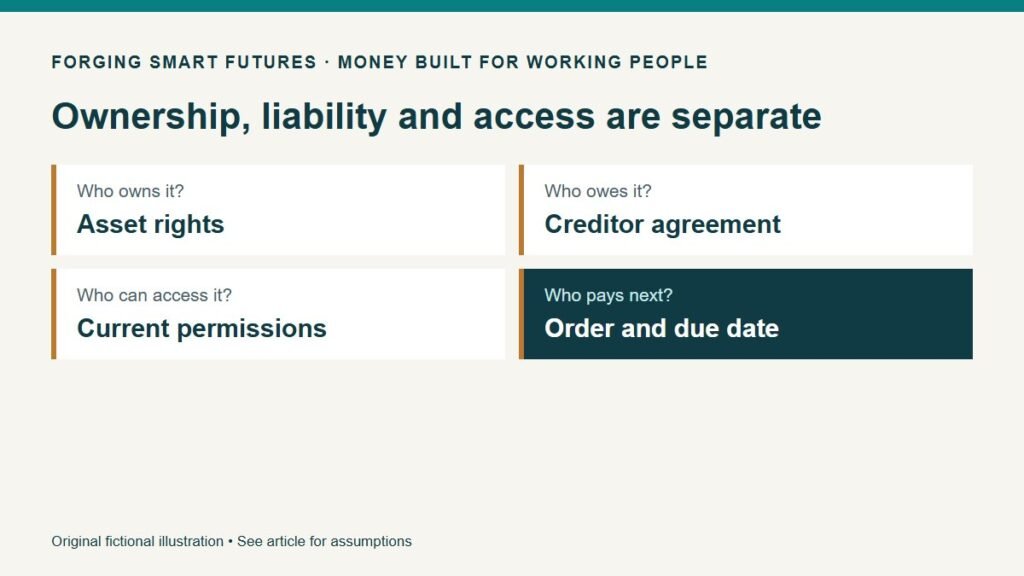
Create an account inventory that distinguishes who owns an asset, who owes a debt, who can access an account and who is expected to pay. Use the court orders, agreements and provider records to resolve differences with qualified help. A new household budget is more reliable once those obligations are clear.
The CFPB explains that a divorce decree assigning a joint debt does not automatically remove contractual responsibility to a creditor. Removing a name from property title also does not by itself remove the related loan obligation. CFPB debt after divorce.
Build the inventory without making unauthorized changes
List bank accounts, credit cards, loans, retirement plans, insurance, recurring bills and payment apps relevant to you. Record the institution, account type, ownership or liability status, current balance, due date and the document supporting the arrangement.
Use only records and accounts you are authorized to access. Do not move disputed money, close a joint account or change a beneficiary in conflict with an order or agreement. The inventory identifies questions; it does not authorize a transfer.
Keep full account numbers and sensitive documents in a secure location. A planning worksheet can use abbreviated references and a document-location note.
Separate four different questions
For each item, ask: who legally owns it, who is contractually liable, who currently has access and who must make the next payment under the applicable arrangement? Those answers may not all be the same person.
If the records conflict, flag the item for your attorney and provider. Do not assume an informal agreement or a copied decree changes the creditor's contract. Ask what specific action and confirmation would be required to change liability where possible.
For retirement assets or survivor rights, use the plan's process and qualified legal advice. A spreadsheet division does not itself implement a required order or transfer.
Map the first thirty days of cash
In a fictional new household, confirmed take-home pay is $2,900. Rent is $1,250, utilities $220, food $400, transport $380, insurance $180 and debt minimums $250. The listed commitments total $2,680, leaving $220 before other costs or reserves.
If a $300 temporary obligation is also due that month, the result becomes an $80 gap. Leaving it off because it feels temporary does not make the payment disappear. Record expected support or reimbursements separately and distinguish confirmed timing from amounts still uncertain.
Use current statements rather than dividing the old household's spending in half. Housing, insurance and transport do not necessarily split evenly, and some shared discounts or arrangements may end.
Review access and recurring payments carefully
Update your own authorized contact and security settings where appropriate. Review automatic payments so essential bills are not accidentally interrupted. Coordinate changes affecting joint obligations through the proper process, and retain written confirmation.
Check coverage and beneficiary arrangements with legal and plan guidance before changing them. A life change can require attention, but not every desired change is immediately permitted.
If privacy or safety is a concern, use a safe device and appropriate support when obtaining records or communicating. Do not share the inventory through an account another person can access without considering the consequences.
Prioritize unresolved items by consequence
Separate urgent payment or coverage deadlines from longer-term decisions about housing, investing or new borrowing. For each question, record the responsible professional or institution, requested document and next follow-up date.
Avoid taking on a new large commitment merely to make the transition feel finished. First confirm the obligations and cash flow that will continue after the immediate move or settlement period.
Your next action
Complete the four-question inventory for the largest accounts and the next bills due. Use the FSF bill-calendar guide to plan payments and the Resources page for existing free and member worksheets.
General education, not individualized divorce, legal, tax, credit or financial advice. The budget is fictional. FSF does not interpret court orders or endorse an affiliate relationship.
Editorial attribution: Paul Foster
Published: September 10, 2026 Last reviewed: September 10, 2026
Sources & References
- https://www.consumerfinance.gov/ask-cfpb/can-a-debt-collector-contact-me-about-a-debt-after-a-divorce-en-1413/
Put this into practice
Make the next few weeks manageable before rebuilding the long term. Free Starting Over / Late-Starters checklist — no membership required.
Related decisions
- Returning to Work After Caregiving: Budget the Gap Before the First Paycheck
- Catch-Up Saving Without Catch-Up Scams: Evaluate Big-Promise Offers
- Starting Over Financially: A First-30-Days Plan for Working Adults
Expanded member resource: Financial Restart Organizer. Guided exercises with local save, reopen and print controls. Worksheet answers are not automatically calculated. Compare free resources and FSF membership benefits.
Human-reviewed, AI-assisted content; how FSF creates articles.