
Paid Every Two Weeks? Build a Bill Calendar That Fits
A monthly total cannot tell you whether Friday's bill is covered
You can earn enough to cover the month's bills and still be short on the day rent is due. For someone paid every two weeks, the problem may be timing rather than an unexplained spending habit.
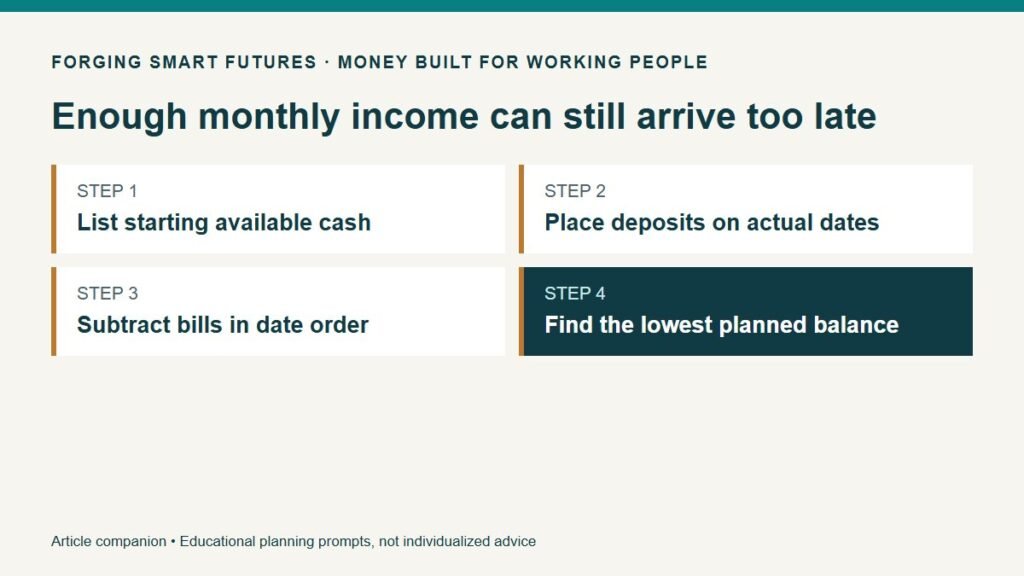
Start with money available now. Add deposits on the dates you reasonably expect them to become available. Subtract bills, groceries, transport and other planned spending on the dates the money will leave. The running balance shows where the plan needs attention.
The CFPB's bill-calendar and cash-flow tools support putting income and bills on a timeline. The example below is an original FSF illustration, not a recommended spending plan. CFPB Your Money, Your Goals toolkit.
First, distinguish every two weeks from twice a month
Every two weeks means an interval of fourteen days. Twice a month means two scheduled pay dates in each month, such as the fifteenth and the last day. They create different calendars.
Do not put two monthly events into a planner if your employer actually pays every other Friday. In a particular month, three scheduled biweekly paydays may fall inside the month. That does not make the third payment completely unassigned: it may need to carry the household into the next bill cycle.
Use the employer's actual payroll calendar to check weekends, holidays and the next available deposit. A planning app's repeating date is an estimate until you verify it. Neither a reminder nor a predicted direct-deposit date guarantees money will be available.
A fictional month with enough income but a timing shortage
Morgan starts a September scenario with $500 available for this plan. Take-home deposits of $1,600 are expected on September 4 and September 18. Overtime is uncertain, so Morgan leaves it out of the baseline.
The following are selected planned transactions, not a complete household budget:
| Date | Transaction | Change | Planned balance |
|---|---|---|---|
| Start | Available cash | — | $500 |
| September 1 | Housing payment | −$900 | −$400 |
| September 4 | Take-home deposit | +$1,600 | $1,200 |
| September 7 | Groceries and transport | −$250 | $950 |
| September 10 | Utilities and phone | −$300 | $650 |
| September 14 | Groceries and transport | −$250 | $400 |
| September 18 | Take-home deposit | +$1,600 | $2,000 |
| September 21 | Insurance and debt minimums | −$450 | $1,550 |
| September 28 | Groceries and transport | −$250 | $1,300 |
Income is $3,200, listed outflows total $2,400, and the arithmetic ends at $1,300 after including the starting $500. Yet the plan falls $400 below zero on September 1.
That negative number is a warning. It does not mean the bank will allow the payment or that borrowing $400 solves the full problem. Morgan needs to address the September 1 gap before treating the ending balance as money available for another goal.
The $1,300 ending balance also needs a second check: what must it cover before the next deposit? A calendar that ends at midnight on the last day can hide next month's housing obligation.
Give the next deposit a job before it arrives
For each paycheck, identify spending through the following realistic payday. Include costs that do not arrive as formal bills: getting to work, food, laundry, required supplies and household needs. Then account for known future bills whose reserve must grow during this pay period.
Keep three labels beside a planned amount: confirmed, estimated or uncertain. A bill statement can establish an amount and deadline. A recent grocery total is an estimate. A shift someone hopes to pick up is uncertain income. Showing all three as equally dependable makes the calendar less useful.
When a confirmed deposit differs from the estimate, update it. Do not keep the higher estimate merely because the original plan balanced.
Explore a timing change without assuming it is available
If a due date creates a recurring gap, ask the provider whether another date or payment arrangement is available. Confirm any fees, interest, transition payment and effective date before changing the calendar. A request is not approval, and an account's grace period is not automatically permission to ignore its due date.
Another possibility is gradually building a bill buffer. In Morgan's illustration, an additional $400 available at the beginning would bring the lowest modeled balance to zero. It would not cover omitted expenses or provide an emergency cushion. Label exactly what the $400 is solving.
If there is no money to build a buffer, focus first on the immediate dates and available options. An elegant calendar cannot create a missing deposit. Use the evidence it produces to identify which providers to contact and which decisions need attention now.
Use reminders as a prompt to check, not a command to pay
A reminder three days before a bill can be useful for checking the amount and the account balance. It is not the payment itself. Autopay, a bank transfer and an imported calendar event are separate things.
For calendar exports, use a separate calendar with generic event names if other people can see it. Check the first several dates and alerts after importing. Calendar applications may handle reminders differently. A downloaded calendar file is a snapshot; changing the planner does not update previously imported events.
Avoid exporting a year's estimated overtime as if it were confirmed income. The longer the schedule, the more assumptions it contains.
A practical fifteen-minute start
Write the next two verified paydays and the bills due before each. Add necessary between-bill spending. Enter the starting amount that is actually available for this plan, excluding money already reserved elsewhere. Calculate the running balance and circle its lowest point.
Then choose one action: correct a missing transaction, verify a deposit date, ask about a due-date option, or reserve part of a future deposit. Recheck after the next actual payday.
For the monthly starting point, use the FSF Variable Pay Budget Planner. For the broader budgeting method, read How to Budget When Overtime Changes Your Paycheck. For itemized income, bills and calendar exports, the Working Paycheck Planner is included in FSF membership. Membership is $39/year plus applicable tax and renews automatically until canceled.
Financial-education disclaimer: General education only, not individualized financial, investment, tax, legal or credit advice. Morgan's figures are fictional and omit some household costs. Confirm actual payment terms and deposit availability.
Source checked September 8, 2026: CFPB toolkit linked above. Calendar arithmetic, examples and workflow are original FSF illustrations.
Editorial review: Owner reviewed and approved this article for release on September 9, 2026. Prepared with AI assistance by FSF Editorial Team; no professional adviser review is claimed.
Editorial attribution: Paul Foster
Published: September 9, 2026
Sources & References
- https://www.consumerfinance.gov/consumer-tools/educator-tools/your-money-your-goals/toolkit/
- https://forgingsmartfutures.com/variable-pay-budget-planner/
- https://forgingsmartfutures.com/budget-with-overtime-pay/
Put this into practice
Build a plan that still makes sense when overtime falls. Free Budgeting checklist — no membership required.
Related decisions
- When a Five-Week Month Breaks Your Grocery and Fuel Budget
- How to Automate Saving Without Overdrawing a Small Paycheck
- Budget App or Spreadsheet for Variable Pay? Compare the Tradeoffs
Expanded member resource: Variable Pay Household Planning Workbook. Guided exercises with local save, reopen and print controls. Worksheet answers are not automatically calculated. Compare free resources and FSF membership benefits.
Human-reviewed, AI-assisted content; how FSF creates articles.