
A 20-Minute Money Meeting for Couples on Different Shifts
Make the next seven days easier to manage
When one person leaves before the other wakes up, managing household money can become a series of hurried messages: Did that payment clear? Are you counting on my overtime? Who is covering the care bill?
A short money meeting can give both people the same current picture. Its purpose is to agree on the next few actions and record them clearly. Twenty minutes is a suggested format, not a deadline or a promise that every disagreement can be resolved that quickly.
The planning foundation is ordinary recordkeeping. The CFPB recommends comparing a realistic spending picture with take-home pay and checking it against actual statements. The meeting structure below is an original FSF exercise. CFPB: Assess your spending.
Prepare a handoff instead of a presentation
Each person brings the deposits they expect, upcoming bills they know about and any change since the previous check-in. Use the same planning window. A seven-day view is useful for the immediate handoff, with a glance at larger bills coming later in the month.
Agree which money is available for shared obligations. A household with separate accounts can coordinate shared bills without treating every personal purchase as a joint decision. Do not assume that a balance visible in one account is entirely available; some may already be assigned to a payment that has not cleared.
You do not need to exchange banking passwords. Use a shared summary or review the relevant figures together through each person's normal account access. Choose a record both people can retrieve, and keep financial details out of public or workplace messages.
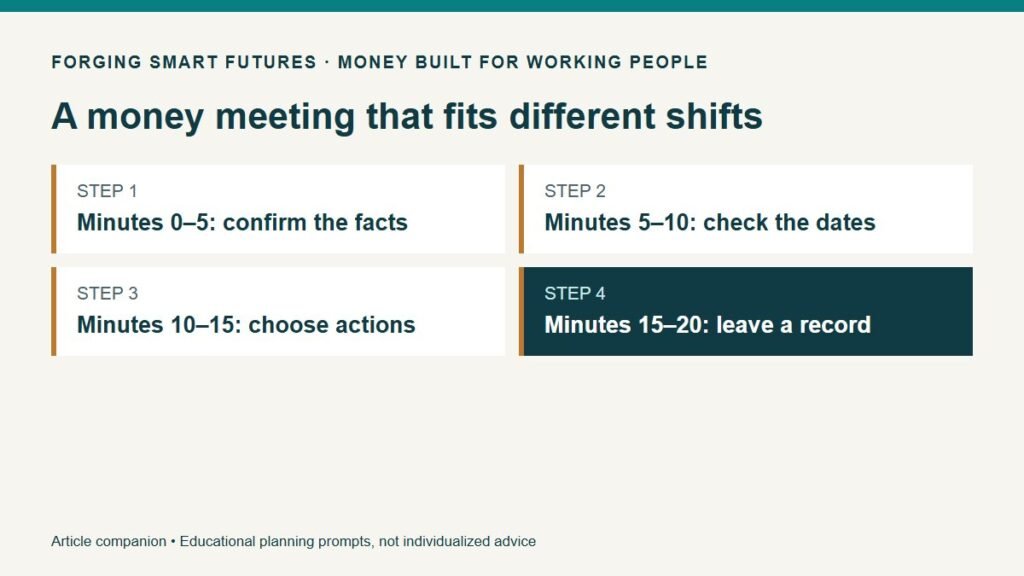
Minutes zero through five: establish what is known
Write down the date and time of the check-in, starting money available for the plan, and deposits expected before the next meeting. Separate confirmed pay information from an estimate based on possible hours.
Then ask what changed. A canceled shift, an unexpected repair or a care arrangement that ends early may matter more than a small difference in last week's groceries.
Use neutral descriptions that someone else can verify: payment due Friday, amount not yet confirmed, overtime not approved. Avoid turning uncertainty into a fact simply because it was mentioned at the previous meeting.
Minutes five through ten: walk through the dates
Put expected inflows and outflows in order. Include ordinary groceries and transport, not just bills with formal due dates. Check whether money could run short before the next deposit even if the week ends positive.
Jordan and Sam are fictional shift workers. They agree that $420 is currently available for their shared seven-day plan. A $1,100 deposit is expected Thursday. Before that deposit, they expect a $280 utility payment and $90 for transport and groceries. Friday brings a $600 housing payment, and they allow $180 for weekend groceries and care.
Their planned balances are:
| Event | Planned balance |
|---|---|
| Starting available money | $420 |
| Utility payment, minus $280 | $140 |
| Early-week transport and groceries, minus $90 | $50 |
| Expected Thursday deposit, plus $1,100 | $1,150 |
| Housing payment, minus $600 | $550 |
| Weekend allowance, minus $180 | $370 |
The week ends at $370 in this example, but the earlier low point is $50. That difference is the reason to discuss timing before assigning the apparent surplus to another goal. If the deposit changes or another payment appears, they need to update the plan.
Minutes ten through fifteen: make a small number of decisions
Pick the decisions that must happen before the next meeting. For each, record the action, the person taking it and the deadline. Assignment is about avoiding duplication or missed work; it does not give one person unlimited control over the other's money.
In the example, Jordan checks whether the utility amount is final by Tuesday. Sam verifies the Thursday deposit information. They agree to leave the $370 unassigned until those checks and the planned payments are reflected in the record.
If they disagree about a larger purchase, they can record that it is unresolved and set a separate time to discuss it. A short meeting does not require forcing agreement on every long-term goal.
Decide what change calls for a message before the next scheduled check-in. Examples include a missing deposit, a new essential expense or a planned payment being substantially different. Choose thresholds together rather than presenting a universal dollar rule.
Minutes fifteen through twenty: leave a usable record
A useful handoff can fit on one page:
| Field | What to record |
|---|---|
| Planning period | Start date and next meeting date |
| Starting available money | Amount, account scope and time checked |
| Expected deposits | Amount, date and confirmed or estimated |
| Upcoming spending | Amount, date and any uncertainty |
| Lowest planned balance | Amount and date |
| Agreed actions | Person, action and deadline |
| Unresolved decisions | What information is missing |
| Next check-in | When and how you will connect |
Read the actions back before ending. A note saying someone will investigate a payment is different from a note saying it has been paid. After an action is complete, mark the result and date so the other person does not repeat it.
When your schedules never overlap
Use an asynchronous version. One person updates the shared record, then the other reviews it before a mutually agreed time. Flag changed numbers clearly. Treat a proposed action as pending until the person who must agree has responded; silence is not agreement.
If information is urgent, use the communication method you both agreed for urgent household issues. A message buried among work notifications may not be seen in time. Keep the plan simple enough to understand when tired, and save difficult discussions for a time when both can participate.
Review the process after two weeks
Ask whether the record helped prevent a missed bill, duplicated payment or surprise. Identify which entries were hard to keep current. Remove unnecessary detail and keep the fields that actually supported decisions.
The goal is a shared, accurate picture that respects both people's role in the household. If the figures do not reconcile, trace the transactions before blaming the other person. The plan may have omitted an expense, counted money twice or relied on a deposit that changed.
Use the FSF Variable Pay Budget Planner to agree on your monthly totals. If overtime varies, FSF's overtime budgeting article explains why it helps to distinguish dependable pay from extras. Keep the dated handoff alongside that monthly picture.
General financial education only, not individualized financial, investment, tax, legal, credit or relationship advice. Jordan, Sam and all amounts are fictional. This exercise does not require joint accounts or shared credentials.
Editorial review: Owner reviewed and approved this article for release on September 9, 2026. Prepared with AI assistance by FSF Editorial Team; no professional adviser review is claimed.
Editorial attribution: Paul Foster
Published: September 9, 2026
Sources & References
- https://www.consumerfinance.gov/owning-a-home/prepare/assess-your-spending/
- https://forgingsmartfutures.com/variable-pay-budget-planner/
- https://forgingsmartfutures.com/budget-with-overtime-pay/
Put this into practice
Build a plan that still makes sense when overtime falls. Free Budgeting checklist — no membership required.
Related decisions
- Paid Every Two Weeks? Build a Bill Calendar That Fits
- Use AI to Organize Household Paperwork Without Uploading Your Private Records
- When a Five-Week Month Breaks Your Grocery and Fuel Budget
Expanded member resource: Variable Pay Household Planning Workbook. Guided exercises with local save, reopen and print controls. Worksheet answers are not automatically calculated. Compare free resources and FSF membership benefits.
Human-reviewed, AI-assisted content; how FSF creates articles.