
How to Compare Savings Accounts for Your Emergency Fund
An emergency account has two jobs
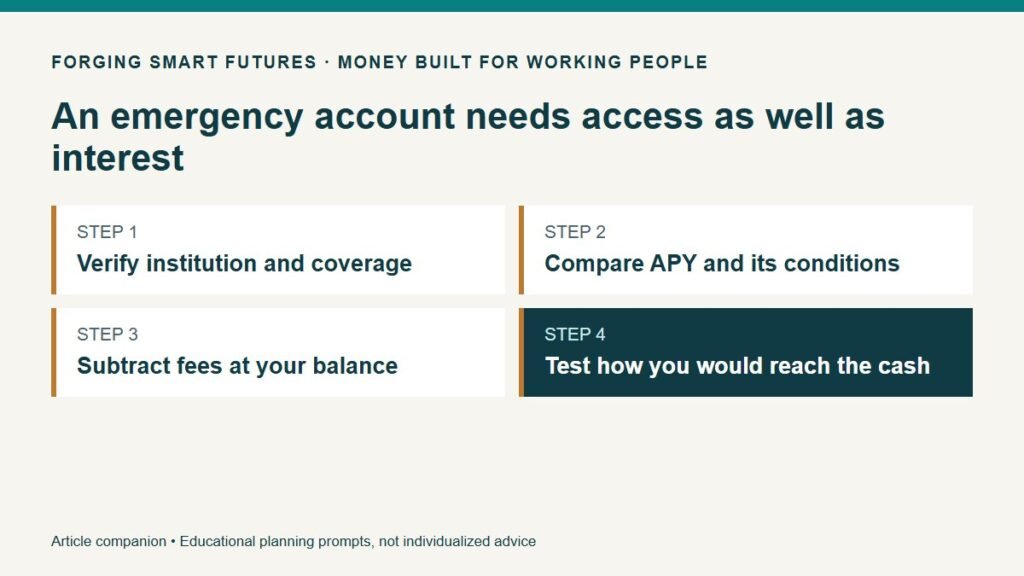
It holds money for a disruption, and it lets you reach that money when the disruption arrives. A higher advertised yield is useful information, but it does not answer whether a transfer will arrive before the repair shop closes or whether a fee appears when your hours are cut.
For a working household, compare accounts using the balance you can realistically maintain and the way you expect to move money. Write down access limits, fees, conditions and the institution holding the deposit before deciding that one offer is better.
This article provides a comparison method. It does not rank current accounts or claim that FSF opened and tested any institution's product.
Check the institution and account type first
Identify the actual bank or credit union and the exact account. An app name alone is not enough information to establish where money is held or what protections apply. Read the account documents and verify the institution through the relevant federal agency's official resources.
The FDIC states that its standard coverage is $250,000 per depositor, per insured bank, for each account ownership category. That is not a separate allowance for every savings account at the same bank. FDIC understanding deposit insurance.
For federally insured credit unions, the NCUA describes standard share insurance of $250,000 per share owner, per insured credit union, for each account ownership category. Verify that the credit union is federally insured and check how your ownership arrangement is treated. NCUA account insurance guidance.
A logo or familiar financial brand is not a substitute for checking the actual product. If you cannot clearly identify the institution, account type and applicable coverage, leave that row unresolved before moving money. This article does not calculate your particular insurance coverage.
Compare APY with APY
Annual percentage yield, or APY, expresses interest on an annualized basis and incorporates compounding under the applicable assumptions. It is different from merely quoting an interest rate. For a variable-rate account, the rate can change; the displayed APY is not a promise that your next twelve months will earn that exact amount. CFPB APY calculation rules.
Record the date checked and whether the advertised figure depends on a balance tier, direct deposit, promotional period or another condition. Ask what happens when you do not meet the condition. A requirement that is easy during heavy overtime may be harder during a reduced-hours month.
Keep bonuses separate from interest. If a promotion involves maintaining a balance or routing deposits for a period, copy the conditions and deadline into your comparison. Do not treat a possible bonus as money available for the next emergency.
Put fees next to the balance you actually expect
Consider two fictional accounts. Both examples assume a $1,000 starting balance held for a year, no deposits or withdrawals affecting interest, and an unchanged APY. Fees are counted separately to make the screening arithmetic easy to see. Real account earnings depend on actual balances, rate changes, fee timing and the account's terms.
| Fictional comparison | Account A | Account B |
|---|---|---|
| Assumed APY | 3.5% | 4.0% |
| Illustrative annual interest before fees | $35 | $40 |
| Monthly fee incurred in this example | $0 | $5 |
| Twelve months of fees | $0 | $60 |
| Interest less those fees, before taxes | $35 | -$20 |
The higher yield adds $5 of illustrated interest. The fee costs $60 over the same period. If fees are withdrawn from the savings balance, they can also reduce the balance earning interest, so the table is a comparison screen rather than an exact account projection.
A fee waiver might change the result, but only if you can actually meet it. Model both an ordinary month and a lower-balance month after a repair. The CFPB similarly cautions that account fees can exceed interest and recommends comparing terms against how you bank. Its linked discussion concerns checking accounts; the fictional savings comparison here is FSF's own illustration. CFPB: Compare fees and interest.
Start with the tasks you actually perform
List direct deposits, cash deposits, check deposits, transfers, ATM withdrawals and any occasional needs such as a cashier's check. Next to each, write how often you use it and how quickly you need the result. An online account may fit a direct-deposit household differently from someone paid partly in cash.
| Arrangement | What may make it useful | What to check |
|---|---|---|
| Primarily online | Remote access and a suitable account offer | Deposit methods, support hours, limits and access during an outage |
| Local bank or credit union | Branch tasks or an in-person service you actually use | Fees, branch hours, ATM network and account conditions |
| Hybrid | Local payment access plus a separate savings account | Transfer timing, extra account requirements and recordkeeping |
These are questions to investigate, not benefits every institution provides. A nearby branch that is closed whenever you are off shift may be less useful than its location suggests.
Confirm who holds the money
An online bank and a nonbank financial app are different things. The FDIC explains that a nonbank company is not itself FDIC-insured, and that pass-through coverage arrangements have conditions. Deposit insurance does not protect against a nonbank company's own failure. Identify the actual institution and product rather than relying on a logo. FDIC on third-party banking apps
Use FDIC BankFind to check a bank. For credit unions, use the applicable NCUA insurance resources. Coverage depends on the account and ownership arrangement; an investment offered by a financial brand is not automatically an insured deposit.
Walk through a Friday repair before you choose
Imagine you need to pay a $700 repair bill on Friday afternoon. This is a planning exercise, not a claim about a bank's transfer speed.
Ask how the money would get from the proposed account to the place you pay the bill. Can you pay directly, transfer to checking or withdraw cash? What are the cutoff times, business-day assumptions, limits and possible holds? Is your checking account already linked and verified? What help is available when you are off shift?
Record the institution's answer with its source and date. Do not replace it with a general assumption that all transfers are instant or that every advertised timing applies to a newly opened account.
Once you have independently decided to open an account, an optional small transfer you can afford to leave temporarily unavailable can help you learn the process. One successful test does not guarantee every later transfer's timing. Keep enough accessible money for obligations already due while the setup is being confirmed.
Use one comparison sheet
Complete the same fields for each candidate. Write unknown where the terms are unclear rather than awarding a point to the more attractive advertisement.
| Question | Candidate A | Candidate B | Source and date checked |
|---|---|---|---|
| Institution and exact account name | |||
| Applicable insurance and ownership treatment checked | |||
| Current APY and conditions | |||
| Minimum to open versus minimum to avoid fees | |||
| Monthly and relevant transaction fees | |||
| What changes after a promotional period | |||
| How money reaches the account used for bills | |||
| Limits, holds and cutoff times | |||
| Help available around your schedule | |||
| Lower-balance month consequences |
Do not collapse every answer into one score unless you are comfortable with the tradeoffs hidden by that score. An account that fails your essential access requirement may be unsuitable for that purpose even if several other features look good.
Keep the comparison proportional to the benefit
For an early cash cushion, avoiding unnecessary fees and understanding access may be more useful than repeatedly switching accounts for a small yield difference. Calculate the approximate dollars at your own expected balance before spending hours on another application or moving bill-payment arrangements.
For example, a half-percentage-point difference on $1,000 is $5 over a full year under a constant-balance, constant-yield comparison. It becomes $50 on $10,000 under the same assumptions. Neither number includes fees, taxes or future rate changes. The point is to compare actual scale rather than reacting to the percentage alone.
Revisit the account after a fee notice, a material rate or condition change, a change in household needs or a problem accessing funds. Keep the comparison dated so an old screenshot does not become a current recommendation.
Use the FSF Hours-Cut Cash Cushion Calculator to explore an illustrative savings target. Then read Emergency Savings When Your Hours Can Be Cut to connect the target with your household's actual obligations.
General financial education only, not individualized financial, investment, tax, legal or credit advice. All account rates, fees and dollar examples are fictional and are not current offers. No institution is recommended and no product use has been claimed.
Editorial review: Owner reviewed and approved this article for release on September 9, 2026. Prepared with AI assistance by FSF Editorial Team; no professional adviser review is claimed.
Editorial attribution: Paul Foster
Published: September 9, 2026 Last reviewed: September 18, 2026
Sources & References
- https://www.fdic.gov/resources/deposit-insurance/understanding-deposit-insurance
- https://mycreditunion.gov/brochure-publications/brochure/how-your-accounts-are-federally-insured
- https://www.consumerfinance.gov/rules-policy/regulations/1030/a/
- https://www.consumerfinance.gov/ask-cfpb/should-i-get-a-checking-account-that-pays-interest-en-925/
- https://forgingsmartfutures.com/hours-cut-cash-cushion-calculator/
- https://forgingsmartfutures.com/emergency-savings-hours-cut/
Put this into practice
Separate true surprises from bills you can see coming. Free Saving checklist — no membership required.
Related decisions
- How Much Emergency Savings Do You Need When Your Hours Can Be Cut?
- How to Automate Saving Without Overdrawing a Small Paycheck
- Build a Cash Plan Before a Seasonal Shutdown
Expanded member resource: Cash Cushion and Planned Expenses Workbook. Guided exercises with local save, reopen and print controls. Worksheet answers are not automatically calculated. Compare free resources and FSF membership benefits.
Human-reviewed, AI-assisted content; how FSF creates articles.