
Why Your Overtime Check Is Smaller Than the Number in Your Head
Start with the deposit, then explain the difference
Eight extra hours at a $24 hourly rate can look like $288 of spending money when you multiply by time-and-a-half. That calculation may correctly describe additional gross wages in a simple case. It does not tell you what will arrive in your bank account.
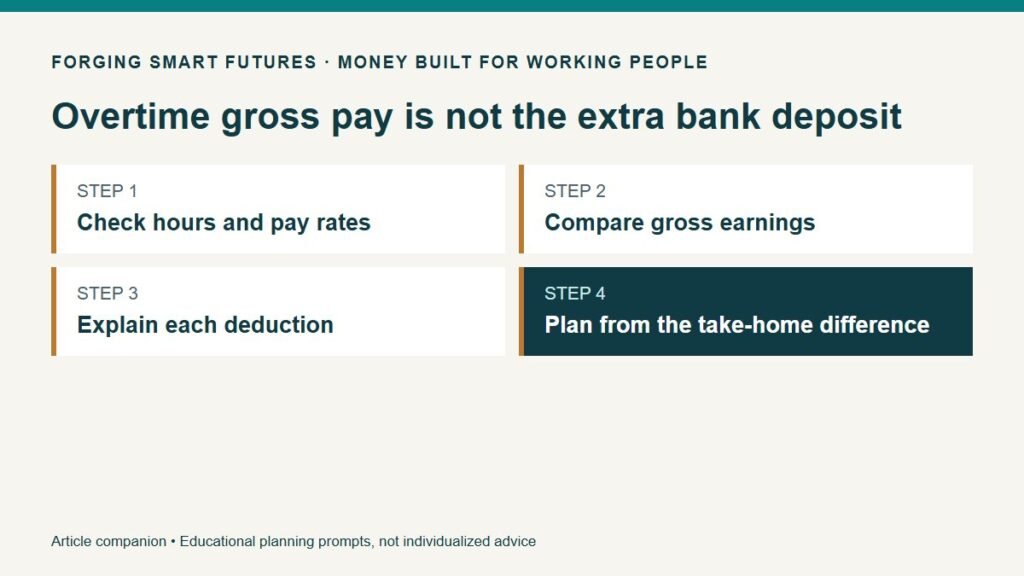
Your useful planning number is the change in take-home pay after deductions. To find it, separate three questions: Were your hours and gross earnings calculated correctly? What was withheld or deducted? How much of the deposit is available after bills already assigned to it?
A smaller-than-expected deposit does not, by itself, prove that payroll made an error. It also does not prove the paycheck is correct. Read the earnings and deduction lines before making either assumption.
What the federal overtime rule actually compares
For covered, nonexempt employees, the federal Fair Labor Standards Act generally requires at least one-and-a-half times the regular rate for hours worked beyond 40 in a workweek. A workweek is the relevant unit; averaging a busy week and a quiet week together is not the same calculation. Exemptions and different rules can apply, and state law can provide additional protections. The regular rate may include more than the posted hourly base rate, depending on the compensation involved. A nondiscretionary bonus or other pay component may require closer review.
That is why a simple calculator should explain its assumptions instead of announcing that every extra hour earns the same premium. Check the actual pay arrangement, workweek, applicable rules and earnings statement. Department of Labor overtime fact sheet, regular-rate guidance.
A fictional two-paycheck comparison
Suppose a fictional worker, Avery, earns $24 an hour and is paid weekly. For this illustration only, assume the regular rate equals the hourly rate, there are no other earnings, and eight hours qualify for time-and-a-half overtime.
| Earnings | Regular week | Week with eight overtime hours |
|---|---|---|
| First 40 hours | $960 | $960 |
| Eight overtime hours at $36 | $0 | $288 |
| Gross pay | $960 | $1,248 |
| All deductions, assumed for this example | $210 | $300 |
| Take-home pay | $750 | $948 |
The gross increase is $288. The deposit increase is $198: $948 minus $750. The assumed $90 increase in deductions is not a tax-rate prediction. These invented deduction totals are chosen to demonstrate reconciliation; they do not calculate Avery's federal, state or payroll tax liability.
This is still useful. Avery can compare the actual earnings statement with the expected $288 additional gross pay and then explain each deduction that changed. Avery should not set up a $288 automatic savings transfer merely because the gross calculation produced that number.
For your own comparison, use two actual statements covering comparable periods. Identify differences in benefit premiums, reimbursements, bonuses, unpaid time, retirement contributions and other deductions. A reimbursement can increase a deposit while merely repaying money you already spent for work. An annual premium adjustment can decrease a deposit for a reason unrelated to overtime.
Withholding is not the same as the final tax calculation
The payroll statement reports what was withheld from that payment. Your eventual tax return uses annual information and applicable rules. Do not conclude from one unusually large withholding line that every overtime dollar faces a unique permanent tax rate.
The current federal deduction for qualified overtime compensation adds another distinction. It does not turn the entire overtime line into tax-free take-home pay. Eligibility and the qualifying premium matter. IRS guidance says overtime compensation remains generally subject to Social Security and Medicare taxes; its August 2026 update also addresses income-tax withholding procedures. For 2026 and later years, payers must separately report qualified overtime compensation. Check current IRS instructions and your own records rather than applying a headline to your whole paycheck. IRS qualified-overtime questions and answers, 2026 employer tax guide.
Do not change withholding blindly to make the next deposit look larger. If a paycheck or deduction is unclear, ask payroll for the calculation and consult a qualified tax professional when you need help applying the rules to your return. A budgeting tool should not pretend to perform that individualized analysis.
Five lines to check before contacting payroll
Write down the pay-period dates and the workweek involved. Compare the recorded hours with your own permitted time records. Identify the base rate and any separate overtime or premium line. Compare the deductions with a similar earlier statement. Finally, reconcile gross earnings minus deductions to the reported net amount, allowing for the statement's treatment of reimbursements or other items.
Keep the question specific. “My record shows 48 hours for this workweek, but the statement lists 46; can you explain the difference?” gives payroll something concrete to investigate. “Overtime is never worth it” does not identify a potential error.
Keep a copy of the statement and the explanation in a secure place. Avoid posting a full pay stub in a social group or uploading it to an unfamiliar AI service. Redacting a name alone may leave employee numbers, addresses, benefit details and bank information visible.
Decide what the extra deposit can actually do
Return to Avery's fictional $198 deposit increase. Suppose Avery already expects $45 of additional childcare and commuting costs associated with those shifts. That leaves $153 before any other commitments. The figures are an illustration, not a suggestion that your costs will be the same.
The next question is timing. If a $120 bill is due before the next regular payday and has no money assigned to it, only $33 of this example's remaining amount is unassigned. Calling all $198 “extra” would hide both the work-related cost and the near-term bill.
You can make this comparison without judging every overtime shift only by immediate cash. Schedule, rest, health, family responsibilities, benefits and career opportunities may matter too. Record those considerations separately so they do not disappear inside a single hourly number.
Use this four-line check:
- Additional take-home pay compared with a comparable regular period.
- Less additional costs of working those hours.
- Less obligations already assigned to that money.
- Equals the amount available for a new goal in this scenario.
Review this after a pay change, benefit election or recurring schedule change. An old rule such as “I always keep about two-thirds” may stop fitting. Actual statements are more useful than a remembered estimate.
Your next step
Use one recent overtime statement and one comparable regular statement to build your own reconciliation. Mark any unexplained line for payroll. Then place the expected deposit and upcoming bills on your payday calendar before assigning money to debt, savings or another goal.
Use the FSF Variable Pay Budget Planner to compare your take-home pay with planned spending.
General financial education, not individualized financial, investment, tax, legal or credit advice. Avery and all paycheck amounts are fictional. No tax liability, withholding rate or worker exemption is determined by this article.
Editorial review: Owner reviewed and approved this article for release on September 9, 2026. Prepared with AI assistance by FSF Editorial Team; no professional adviser review is claimed.
Editorial attribution: Paul Foster
Published: September 9, 2026
Sources & References
- https://www.dol.gov/agencies/whd/fact-sheets/23-flsa-overtime-pay
- https://www.dol.gov/agencies/whd/fact-sheets/regular-rate
- https://www.irs.gov/pub/taxpros/fs-2026-13.pdf
- https://www.irs.gov/publications/p15
- https://forgingsmartfutures.com/variable-pay-budget-planner/
Put this into practice
Compare written pay, time and benefit terms on the same basis. Free Work & Compensation checklist — no membership required.
Related decisions
- How to Read Your 401(k) Match When Your Pay Includes Overtime
- What Going to Work Really Costs Your Household
- Higher Hourly Pay or Better Benefits? Compare Two Job Offers
Expanded member resource: Total Compensation Decision Workbook. Guided exercises with local save, reopen and print controls. Worksheet answers are not automatically calculated. Compare free resources and FSF membership benefits.
Human-reviewed, AI-assisted content; how FSF creates articles.