
How to Price a Weekend Job Without Forgetting Your Costs
The short answer
Define the work, estimate all the time and cash required, and distinguish what remains for your labor from what remains for business risk and overhead. Compare the result with what customers will pay, then revise the offer if the economics do not work. A price that covers materials is not necessarily a price that pays you.
This is a planning method for an illustrative service job, not a market-rate recommendation or a tax calculation.
Quote a defined job
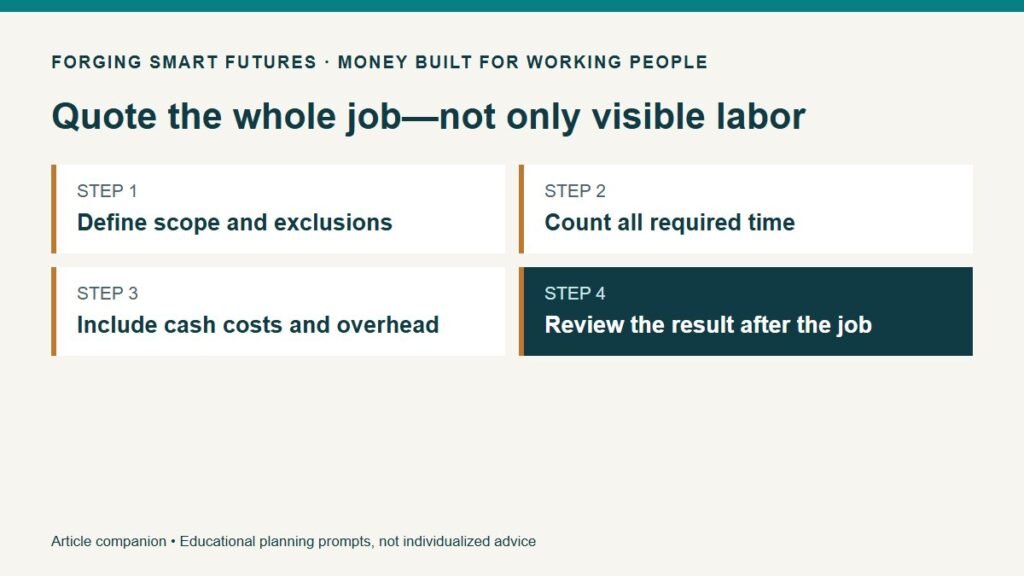
Before calculating a price, write what is included: the task, location, quantity, customer responsibilities and the completion standard you can reasonably commit to. List the exclusions and what would require a revised agreement.
“A few hours of work” can expand when travel, access problems, cleanup or an extra trip are omitted. A clear scope helps both sides understand the price. It does not replace appropriate contract terms or any qualification required for the work.
Ask enough questions to estimate the job. If important conditions are unknown, make the uncertainty visible and explain the next step before giving a firm commitment. Do not silently assume the easiest possible conditions just to produce an attractive number.
Count the hours outside the customer's view
Include the estimate visit, messages, purchasing, travel, setup, work, cleanup and billing. Some tasks can be shared across multiple jobs; allocate them consistently rather than assigning all the cost to one job or none of it anywhere.
A fictional job might take four hours on site but six hours altogether. If the price is $300 and direct cash costs are $90, the remaining $210 divided by six hours is $35 per hour, before overhead, taxes and other omitted costs. Dividing by four would show $52.50 and ignore two hours of your time.
Neither figure is an employee wage. A business owner may still have expenses, risk and unpaid activity outside this one job.
Build a price from explicit assumptions
| Fictional planning component | Calculation | Amount |
|---|---|---|
| Direct cash costs | Materials and other job-specific cash | $90 |
| Allocation for overhead | Chosen share of ongoing costs | $30 |
| Amount assigned to your time | 6 hours × $30 | $180 |
| Remainder for business risk/profit | Chosen amount | $30 |
| Proposed price | Sum of the above | $330 |
The $30 hourly target and allocations are invented planning choices. They do not establish a fair local price or guarantee profit. Taxes collected from a customer, if required, and your own tax obligations require a separate review; do not treat collected tax as extra earnings.
At a $330 price, direct costs and allocated overhead leave $210. Assigning $180 to your six hours leaves $30. If the job takes eight hours instead, the same $210 leaves only $26.25 per hour before reserving anything further for business risk or profit.
That sensitivity matters when deciding whether the scope is too uncertain for the proposed price.
Check the market without abandoning the math
The SBA's planning guidance treats customer demand, competing offerings and pricing as useful market-research questions. SBA business-planning guidance.
Compare equivalent work. Another provider's lower price may cover a narrower task, a shorter trip or different terms. It may also be an unsustainable price. You cannot learn which simply by copying it.
If your needed price is above what likely customers will pay, examine the offer. Could you reduce travel by serving a smaller area, define a more repeatable scope or remove an optional component? Do not pretend required costs disappear. A job that cannot support its costs may be one to decline or redesign.
Keep cash timing beside the quote
Materials may need payment before the customer pays you. A profitable-looking job can therefore require funding before it produces cash. Identify the amount and date of that need rather than treating the full quoted price as money available today.
Any deposit or staged billing needs an appropriate agreement and compliance with applicable rules. Do not assume a payment arrangement merely because it would help your cash flow. The FSF cash-timing article shows why the timing can matter even when the job margin is positive.
Review the job after it is finished
Compare estimated and actual hours, cash costs, extra trips and collected payment. Write down one change to the next quote. If travel consistently takes longer, update the travel assumption. If the same extra request appears repeatedly, decide whether it belongs in the standard offer or a separate priced option.
Keep the record honest. A low-cost first job for a friend may teach you something, but it does not prove the same price works for ordinary customers. Separate deliberate introductory discounts from the standard economics.
Use the FSF True Hourly Side-Gig Calculator to check the time-and-cost picture. The objective is a repeatable price you understand, not a busy weekend whose earnings disappear when you finally count everything.
General education only, not individualized financial, investment, tax, legal or credit advice. Examples are fictional and depend on the stated assumptions. Prepared with AI assistance by FSF Editorial Team; reviewed for publication by the FSF publisher.
Editorial attribution: Paul Foster
Published: September 10, 2026 Last reviewed: September 10, 2026
Sources & References
Put this into practice
Find out what a job earns after costs and all your time. Free Side Income checklist — no membership required.
Related decisions
- What Does Your Side Gig Really Pay After Expenses and Unpaid Time?
- AI for Service-Business Quotes: Draft the Scope, Then Check the Numbers
- App-Based Gigs or Your Own Customers? Compare the Tradeoffs
Expanded member resource: Side-Gig Profit and Pricing Workbook. Guided exercises with local save, reopen and print controls. Worksheet answers are not automatically calculated. Compare free resources and FSF membership benefits.
Human-reviewed, AI-assisted content; how FSF creates articles.