
App-Based Gigs or Your Own Customers? Compare the Tradeoffs
The short answer
Compare what you keep for every hour the work consumes, how dependable the opportunities are and what responsibilities you take on. An app can provide a route to customers under its terms. Serving your own customers gives you more decisions to make about marketing, scope, payment and follow-up. Neither automatically produces better earnings.
This is a comparison framework, not a ranking of platforms. Fees, worker terms, insurance arrangements and availability must be checked in the actual offer for your location and type of work.
Use the same clock for both choices
Count waiting, travel, searching for work, quoting, scheduling, collecting payment and resolving problems. A direct service may have fewer paid appointments but longer administrative time. An app session may contain long gaps between paid tasks.
Compare equivalent periods: a normal week against a normal week, not a holiday surge against a quiet Tuesday. Keep two measures: earnings per total work hour and total cash available from the hours your schedule actually permits. A higher hourly figure on only one available job may not meet a weekly cash need.
Work through a fictional comparison
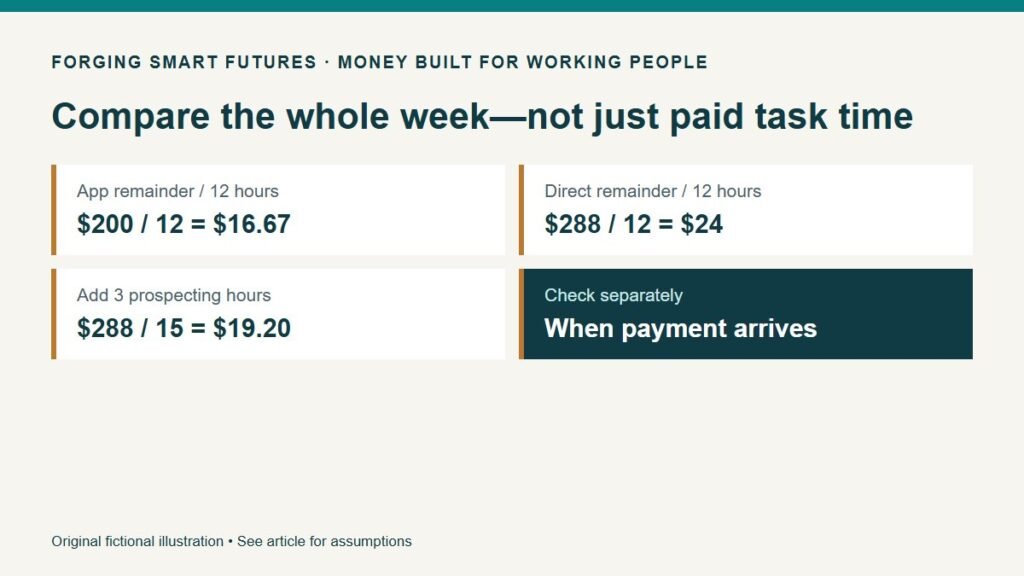
Suppose app work produces $300 in receipts over twelve total hours. Platform charges are $45 and other operating cash costs are $55. The $200 remainder is about $16.67 per hour before fixed costs and taxes.
A direct-customer alternative produces $360 in receipts. Supplies, travel and processing total $72. Its $288 remainder divided by twelve total hours is $24 per hour before fixed costs and taxes. That looks better, but it assumes the customer pays and the twelve hours include finding that customer.
If direct work also requires three extra prospecting hours that week, $288 divided by fifteen is $19.20. If the customer pays next month, this week's receipts are not the same as this week's completed sales. The comparison needs both an earnings column and a cash-arrival column.
Do not subtract a platform fee twice when the displayed payout is already net of that fee. Preserve the statement that connects gross charges, fees, refunds and the deposit.
Compare responsibilities alongside dollars
| Question | What to verify |
|---|---|
| Who finds the customer? | Your prospecting time, advertising cost or platform access terms |
| Who sets the scope? | Included work, changes and customer expectations |
| When is money available? | Payout schedule, holds, refunds and direct invoice terms |
| What happens after a complaint? | Dispute process, return visits and possible chargebacks |
| Who covers the risk? | Written insurance terms for the actual activity |
| Can you stop for a busy workweek? | Existing commitments, cancellation rules and customer continuity |
Do not assume a personal vehicle or home policy covers business activity. Ask the insurer about the actual use. Likewise, an app's description of protection should be read for conditions and exclusions rather than treated as a substitute for checking your own situation.
Keep the employer and household boundaries
Check your employer's conflict rules and your realistic capacity after a shift. A gig that consistently consumes the time you need for sleep or existing obligations can be a poor fit even with attractive gross receipts. This is a schedule constraint, not a claim that everyone can safely work a particular number of extra hours.
Direct customers may want weekday calls while you are on the job. Set a response window you can honor. For app work, check whether the hours available to you actually produce enough tasks; do not build the household budget around an advertised peak-hour figure you have not experienced.
Keep records regardless of the route
The IRS explains that gig income can be reportable even when no information form arrives. A platform summary is useful evidence, but it does not replace your record of other receipts and expenses. IRS gig economy tax center.
Run a short comparison log with date, total time, gross receipts, fees, other costs and cash received. Label unusual bonuses separately so you can see whether ordinary work supports the result.
Your next action
Compare one realistic week for each option with the FSF true hourly earnings guide. If direct work looks promising, review service-business startup costs before committing money. Existing worksheets and tools are listed by access level on the Resources page.
General education, not individualized business, tax, insurance or financial advice. Examples are fictional; they are not platform earnings claims or actual offers. No affiliate relationship is presented.
Editorial attribution: Paul Foster
Published: September 10, 2026 Last reviewed: September 10, 2026
Sources & References
- https://www.irs.gov/businesses/gig-economy-tax-center
Put this into practice
Find out what a job earns after costs and all your time. Free Side Income checklist — no membership required.
Related decisions
- Your First Side-Income Recordkeeping System While Working Full Time
- Your First Repeat Customer: Turn a Weekend Job Into a Simple Service Package
- Tool Rental or Purchase for a Side Job? Compare the Break-Even Point
Expanded member resource: Side-Gig Profit and Pricing Workbook. Guided exercises with local save, reopen and print controls. Worksheet answers are not automatically calculated. Compare free resources and FSF membership benefits.
Human-reviewed, AI-assisted content; how FSF creates articles.