
Separate Side-Gig Money From Household Bills Without Building a Complicated System
The short answer
Let side-job receipts arrive in an appropriate business account, record the activity, reserve money for upcoming business obligations and make a deliberate transfer for household use. Avoid treating every customer deposit as an immediate raise in take-home pay.
The IRS recommends separating business and personal accounts to make recordkeeping easier. The way an owner is paid and the tax treatment depend on the business structure and circumstances; an informal transfer label does not settle those questions. IRS income and expense guidance.
Start with one clear boundary
You do not need a dozen accounts to understand the money. You do need a reliable way to distinguish customer receipts, business expenses, owner contributions, transfers and household spending. Use an account suitable for the activity and a simple record that explains each movement.
If a business cost is accidentally paid personally, record it and keep the evidence. Do not hide the transaction because it crossed the boundary. Ask your bookkeeper or tax professional how to treat it correctly for your situation.
The same applies in reverse: a household purchase on the business card should not disappear into “supplies.” Correct the record rather than assuming the payment method determines deductibility.
Use a cash allocation before transferring money home
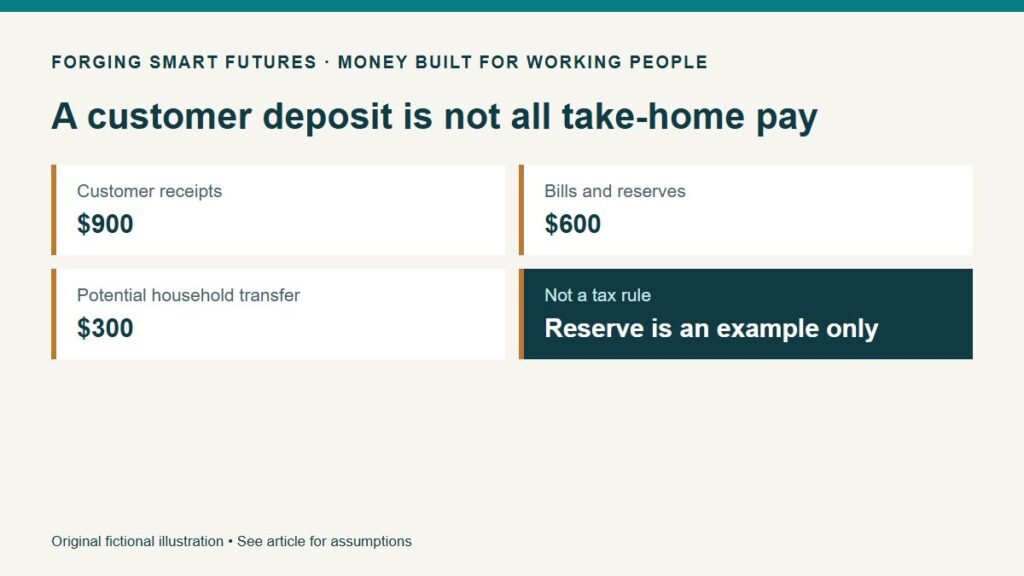
In a fictional week, customers pay $900. Upcoming business bills require $240. You set aside $90 for a known equipment replacement, a provisional $150 tax reserve and $120 to keep the next job funded. That leaves $300 potentially available for a household transfer.
The calculation is $900 minus $240 minus $90 minus $150 minus $120 equals $300. These are planning allocations, not a profit calculation or a recommended tax percentage. The tax reserve is an invented example amount; your actual payments should follow current rules and qualified guidance.
If the next week's customer payment is uncertain, test whether keeping some of the $300 in the business is necessary. An account balance can include money already needed for a supplier, customer refund or other commitment.
Do not count transfers as new earnings
Moving $300 from the business account to the household account changes where the cash sits. It does not create another $300 of customer revenue. Likewise, moving reserve money to a second business savings account is not automatically a deductible expense.
Use a clear transfer reference in both records and reconcile the amounts. Where ownership, payroll or distribution rules apply, follow the appropriate process rather than treating this example as permission to use informal draws in every entity.
Keep the household baseline conservative
Suppose side work produces household transfers of $300, $0, $180 and $420 over four weeks. The total is $900, averaging $225 per week, but the second week provides nothing. A bill due in that week cannot be paid with an average unless cash was carried forward.
Use actual timing in the household bill plan. Consider treating uncertain side income as money for goals or buffers until you have enough history to judge its reliability. That is a planning option, not a rule that every household must ignore all side earnings.
The FSF biweekly bill-calendar guide helps put cash arrivals beside bill dates. Keep business commitments out of the household “available to spend” number.
Review the boundary on a repeating schedule
At each review, reconcile the business account, list the next obligations, update reserve estimates and decide whether a household transfer is affordable. Keep a note explaining unusual transfers or owner contributions so they are not mistaken for sales later.
Gig income can be reportable even without an information form. Do not use “no form arrived” as a reason to omit receipts from your records. IRS gig economy tax center.
Your next action
Take the latest side-job deposit and write its allocation before moving money. Then read why profit and available cash differ. The Resources page identifies free tools and expanded member planners; neither replaces bookkeeping or a tax determination.
General education, not individualized accounting, tax, legal or financial advice. Numerical examples are fictional. No affiliate relationship is presented.
Editorial attribution: Paul Foster
Published: September 10, 2026 Last reviewed: September 10, 2026
Sources & References
- https://www.irs.gov/faqs/small-business-self-employed-other-business/income-expenses
- https://www.irs.gov/businesses/gig-economy-tax-center
Put this into practice
Find out what a job earns after costs and all your time. Free Side Income checklist — no membership required.
Related decisions
- Side Businesses You Can Build From Skills You Already Use at Work
- What Does Your Side Gig Really Pay After Expenses and Unpaid Time?
- How to Price a Weekend Job Without Forgetting Your Costs
Expanded member resource: Side-Gig Profit and Pricing Workbook. Guided exercises with local save, reopen and print controls. Worksheet answers are not automatically calculated. Compare free resources and FSF membership benefits.
Human-reviewed, AI-assisted content; how FSF creates articles.