
Find Your First Service Customers Without Quitting Your Job
The short answer
Test a specific service with a small number of suitable customers, within a schedule you can actually deliver. Track inquiries, quotes, completed jobs and collected money separately. Use what the first jobs teach you before buying more equipment or depending on the income for household bills.
You are testing whether an offer works repeatedly, not proving that a business is ready to replace a paycheck after one good weekend.
Define who the service is for
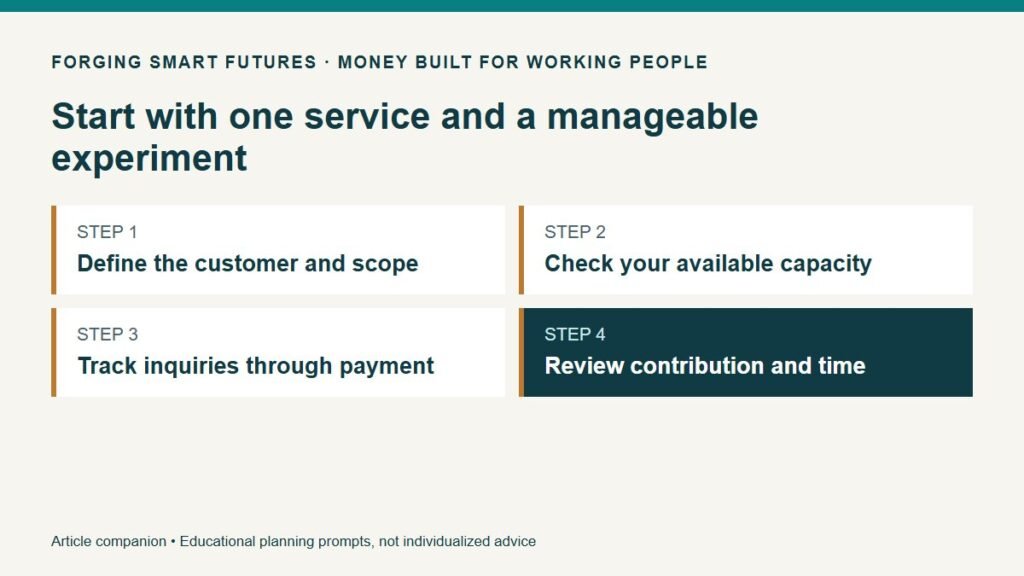
Write down the customer, the problem, the service area and the job you can complete competently with your current resources. “I can do lots of things” is harder for a customer to act on than a clear offer with boundaries.
Before accepting work, verify any qualifications, permission, insurance or other requirements relevant to the activity. Check your existing employment obligations and keep employer resources and customer information out of the experiment unless authorized. This article does not determine which business activities are permitted for you.
The SBA recommends investigating demand, location, competition and pricing when planning a business. Those questions provide a starting point; your actual test must match your local offer. SBA market-research guidance.
Put capacity ahead of promotion
Suppose you can reliably devote eight hours a week to the venture without assuming extra time appears. A typical job requires two hours on site plus one hour for travel, communication and cleanup. Two jobs consume six hours, leaving two for quotes, administration or problems. Three jobs would already exceed the eight-hour allowance before those remaining tasks.
These are fictional planning figures. Replace them with your real estimates and update them after each job. Leave room for the work you do not yet know how to estimate accurately.
Offer appointment windows you can honor. Do not promise immediate responses while you are on a shift where you cannot use your phone. A clear response window can be more useful than creating expectations that your day job makes impossible to meet.
Run one small outreach experiment
Choose one appropriate channel where the intended customer can encounter the offer: a permitted community listing, an existing personal introduction or a business contact you are entitled to approach. Follow that channel's rules and avoid unsolicited bulk messaging.
Describe the service, area, availability and how to ask for an estimate. Use accurate descriptions and images you have rights and permission to use. Do not imply qualifications, reviews or completed work that you do not have.
The test question is specific: “Will suitable customers request this service at a price and schedule I can support?” It is not simply “Can I get attention?” A popular post that produces requests outside your area may not help the business you are trying to build.
Track the path from interest to collected money
| Stage | What to record | What it does not prove |
|---|---|---|
| Inquiry | Requested task, location and timing | That the person will accept a quote |
| Suitable opportunity | Fit with your scope and capacity | That the job will be profitable |
| Quote | Scope, price and conditions | That payment will arrive |
| Completed job | Actual work, hours and issues | That the invoice is collected |
| Collected payment | Amount and date received | That the model works at larger scale |
For a fictional test, ten inquiries lead to six suitable opportunities, four quotes and two completed, paid jobs. That is a 20% inquiry-to-paid-job result for this tiny sample. It is not a reliable forecast for the next hundred inquiries. Read the reasons for the losses: wrong location, unsuitable scope, timing or price may call for different changes.
Look at contribution and time together
Suppose those two jobs collect $500 and require $180 in direct cash costs. That leaves $320 before overhead, taxes and other costs. If all work, travel and administration took ten hours, the simplified amount is $32 per hour before those remaining costs.
Now compare the ten hours with the eight-hour schedule you planned. The price may look encouraging while capacity needs correction. Scaling that result without changing the schedule could create missed commitments or strain your primary work and household.
Keep marketing costs in the record too. An unpaid introduction and paid advertising are different experiments. Do not assume a paid campaign will reproduce results from people who already know you.
Decide what the next test should change
Change one major variable when possible: a clearer scope, smaller service area, different appointment window or revised price. Keep enough of the prior setup consistent to learn from the result.
Do not treat praise alone as evidence of repeat demand. A second paid booking under workable terms is stronger evidence than “you should start a business.” Still, a few bookings do not establish that income is stable enough to replace employment.
Use the FSF startup-cost guide before expanding equipment or fixed commitments. Your first customers should help you learn what to build next, while your regular paycheck and household plan remain visible in the decision.
General education only, not individualized financial, investment, tax, legal or credit advice. Examples are fictional and depend on the stated assumptions. Prepared with AI assistance by FSF Editorial Team; reviewed for publication by the FSF publisher.
Editorial attribution: Paul Foster
Published: September 10, 2026 Last reviewed: September 10, 2026
Sources & References
Put this into practice
Test demand and cash needs before committing to recurring costs. Free Starting a Business checklist — no membership required.
Related decisions
- What Will It Cost to Start Your Service Business Before the First Customer?
- How to Price a Weekend Job Without Forgetting Your Costs
- A Profitable Month Can Still Run Out of Cash: Understand Receivables
Expanded member resource: First Service Business Planning Workbook. Guided exercises with local save, reopen and print controls. Worksheet answers are not automatically calculated. Compare free resources and FSF membership benefits.
Human-reviewed, AI-assisted content; how FSF creates articles.