
Social Security at 62 or Later: Questions for Workers in Physical Jobs
The short answer
Stopping a physically demanding job and starting Social Security are separate decisions. Compare your own estimates, the income needed between those dates, health coverage, household benefits and realistic work capacity. There is no single claiming age that fits every worker.
SSA explains that retirement benefits can generally start as early as 62 for eligible workers and that delaying increases the monthly amount up to age 70. Use your own record and eligibility information; do not plan from the maximum benefit shown in a headline. SSA retirement planning.
Verify the earnings assumption
Check the earnings record and whether estimates assume you keep working. SSA bases retirement benefits on the highest thirty-five years of earnings and the age benefits begin. Stopping earlier can affect the result, especially if it leaves years without earnings or prevents lower years from being replaced. SSA on work and claiming dates.
Compare estimates using the same work-stop assumption. An age-62 estimate with no future work and an age-70 estimate assuming eight more years of earnings do not isolate the effect of claiming later.
If an earnings entry appears wrong, follow SSA's correction process and retain supporting records. Resolve major uncertainty before treating an estimate as the foundation of the budget.
Price the bridge before deciding to wait
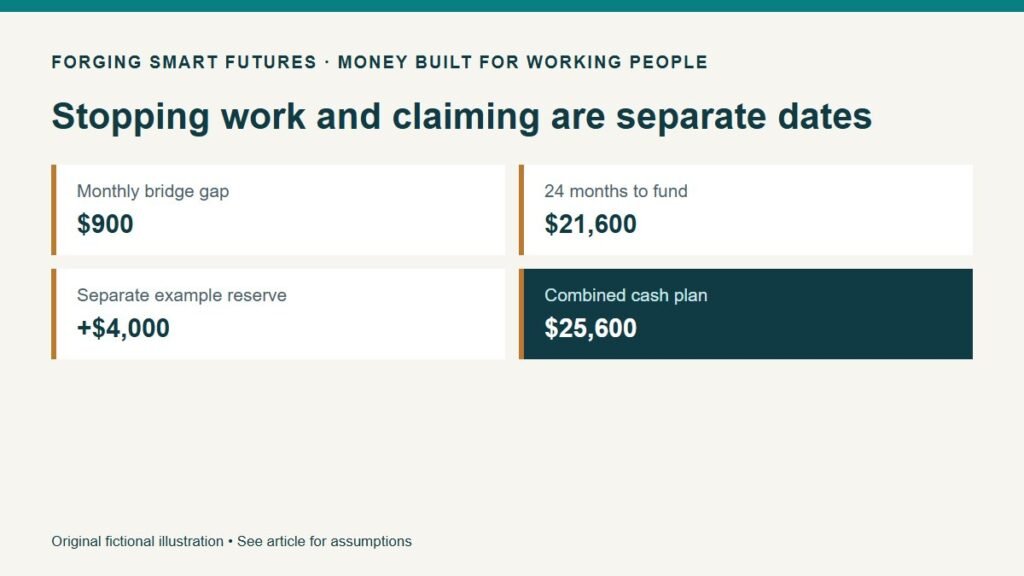
In a fictional household, spending after leaving work is $2,700 per month. Other reliable income is $1,800, leaving $900 to fund while delaying Social Security. A twenty-four-month bridge requires $21,600 at unchanged amounts, before inflation, taxes on withdrawals or unexpected costs.
If the household also needs a separate $4,000 reserve, the combined planning requirement is $25,600. That does not mean everyone needs that reserve or that two years is the right delay. It makes the cash requirement visible.
A plan that works only if you keep performing heavy work despite an uncertain ability to do so needs another scenario. Explore realistic lighter work or fewer hours without assuming such a job is guaranteed. If a health condition may qualify for a different benefit, ask SSA about eligibility rather than treating early retirement as the only possible route.
Treat break-even math as one lens
Suppose fictional estimates show $1,600 per month starting now or $1,900 starting twenty-four months later. Waiting forgoes $38,400 during those two years. The later amount is $300 more per month, so simple division reaches 128 months after the later start, about ten years and eight months.
That is not a recommendation or a complete lifetime-benefit analysis. It ignores cost-of-living changes, taxes, investment results, survival, family benefits and the precise claiming rules. It also assumes the estimates truly reflect the same work history. A spreadsheet crossover cannot answer how to pay next year's bills or protect a surviving spouse.
Include work, family and healthcare effects
Before full retirement age, earnings above applicable limits can cause benefits to be withheld. SSA later adjusts benefits to account for months withheld under those rules. Check the current threshold and how your expected wages or self-employment earnings are treated instead of assuming all income has the same effect. SSA retirement planning.
Ask about spouse, former-spouse or survivor benefits when relevant. Their rules are not interchangeable with your own retirement benefit. Coordinate the household decision with accurate information rather than selecting the largest individual estimate in isolation.
Plan health coverage separately. A Social Security start date does not by itself supply a complete health-insurance plan, and Medicare enrollment deserves attention even if you delay retirement benefits.
Your next action
Download or record your own estimates, state the assumed last work date and calculate the bridge for at least two scenarios. Use the FSF bill-calendar method to map cash timing. Existing free and member resources are listed on the Resources page; unresolved benefit questions belong with SSA or a qualified adviser.
General education, not individualized Social Security, tax, investment or medical advice. All amounts and comparisons are fictional. No claiming age, benefit amount or affiliate relationship is endorsed.
Editorial attribution: Paul Foster
Published: September 10, 2026 Last reviewed: September 10, 2026
Sources & References
- https://www.ssa.gov/retirement/plan-for-retirement
- https://www.ssa.gov/benefits/retirement/planner/stopwork.html
Put this into practice
Turn plan documents and old statements into specific next steps. Free Retirement checklist — no membership required.
Related decisions
- How to Read Your 401(k) Match When Your Pay Includes Overtime
- Should Your Next Overtime Check Go Toward Debt or Your 401(k)?
- Roth or Traditional Contributions When Your Income Changes Year to Year?
Expanded member resource: Workplace Retirement Organizer. Guided exercises with local save, reopen and print controls. Worksheet answers are not automatically calculated. Compare free resources and FSF membership benefits.
Human-reviewed, AI-assisted content; how FSF creates articles.