
Roth or Traditional Contributions When Your Income Changes Year to Year?
The short answer
Compare the tax treatment of the specific account, what each choice does to today's affordable contribution and plausible future tax situations. A low-overtime year may change the comparison, but income alone does not automatically select Roth or traditional contributions.
This article focuses on regular employee contributions to a workplace 401(k) offering both pre-tax and designated Roth options. IRA eligibility and deductions, conversions, employer contributions and catch-up requirements can involve different rules. Do not apply a workplace example to all of those decisions.
Know what changes and what does not
Pre-tax employee deferrals generally reduce current federal taxable income; designated Roth employee contributions are included in current income. Qualified designated Roth distributions can be tax-free. Qualification involves specific requirements, so “Roth” does not mean every early withdrawal is tax-free. IRS designated Roth guidance.
The account's tax treatment is separate from its investments. Either option may hold funds that rise or fall. Choosing Roth does not make an aggressive investment conservative, and choosing traditional does not establish the right fund mix.
A paycheck withholding change is also not the same as the final tax result on your return. Household income, filing status, deductions, credits and other facts can affect the actual comparison.
Compare equal current cash sacrifice
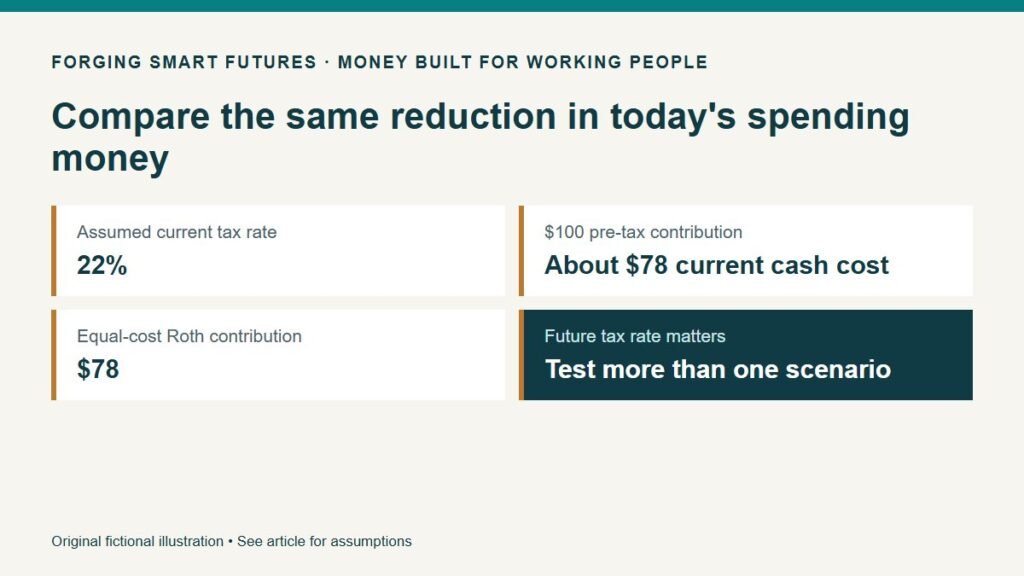
In a simplified fictional example, assume each additional pre-tax dollar reduces current federal income tax by 22 cents. Ignore state taxes, payroll taxes, credits, plan limits and other interactions. A $100 pre-tax contribution would reduce current spendable pay by about $78 under those assumptions. A $100 Roth contribution would reduce it by $100.
An equal-current-cash comparison therefore puts $100 into pre-tax savings against $78 into Roth savings. Comparing $100 in each account without accounting for that difference is not an equal household-budget comparison.
Suppose both amounts later double before distribution, solely to show the tax arithmetic. Pre-tax savings become $200 before withdrawal tax. At an assumed 22% withdrawal tax, $156 remains. Roth savings become $156 and, if the distribution qualifies, that amount is available without federal income tax. With equal tax rates and these simplified assumptions, the results match.
At a hypothetical 12% withdrawal tax, the pre-tax amount leaves $176; at 32%, it leaves $136. Those are scenarios, not predicted tax brackets or investment returns. Real decisions involve more than one flat tax rate.
Use changing pay to ask better questions
Compare a low-hours year, a normal year and a high-overtime year using total household income rather than your hourly wage alone. Ask whether a contribution changes a deduction, credit or other income-related item and whether the projected cash reduction fits the lean month.
If choosing pre-tax to make saving affordable, decide what happens to the current tax savings. Spending them and investing them produce different overall outcomes. If choosing Roth, verify that the larger current cash cost will not force new high-cost borrowing for routine bills.
You may be able to split regular contributions between the two options under your plan. That is a way to manage uncertainty, not proof that a fifty-fifty split fits everyone.
Keep the annual limits separate from the choice
Roth and pre-tax employee deferrals share applicable limits; choosing both does not double your allowance. The IRS announced a $24,500 regular employee deferral limit for 401(k) plans in 2026. Additional age-based and catch-up rules can apply and require separate checking, including any required Roth treatment. IRS 2026 retirement limits.
Confirm the rules and payroll implementation before making changes, especially if you changed employers during the year. An older comparison chart's contribution limits should not be reused as current figures.
Your next action
Ask payroll for an illustration of the same contribution under each option, then compare the reduction in take-home pay with your FSF variable-pay budget. Review your employer match separately and bring unresolved tax questions to a qualified professional. Existing planning resources are labeled on the Resources page.
General education, not individualized tax or investment advice. All numerical scenarios are fictional and simplified. No affiliate relationship or future return is promised.
Editorial attribution: Paul Foster
Published: September 10, 2026 Last reviewed: September 10, 2026
Sources & References
- https://www.irs.gov/retirement-plans/retirement-plans-faqs-on-designated-roth-accounts
- https://www.irs.gov/newsroom/401k-limit-increases-to-24500-for-2026-ira-limit-increases-to-7500
Put this into practice
Turn plan documents and old statements into specific next steps. Free Retirement checklist — no membership required.
Related decisions
- Changing Jobs? Compare Your Old 401(k) Options Before Moving Money
- Starting Retirement Saving at 45 or 55: Build a Plan From Today’s Numbers
- A Pension Estimate Is Not a Take-Home Retirement Budget
Expanded member resource: Workplace Retirement Organizer. Guided exercises with local save, reopen and print controls. Worksheet answers are not automatically calculated. Compare free resources and FSF membership benefits.
Human-reviewed, AI-assisted content; how FSF creates articles.