
Is That Certification Worth the Cost? Compare Time, Pay and Opportunity
The short answer
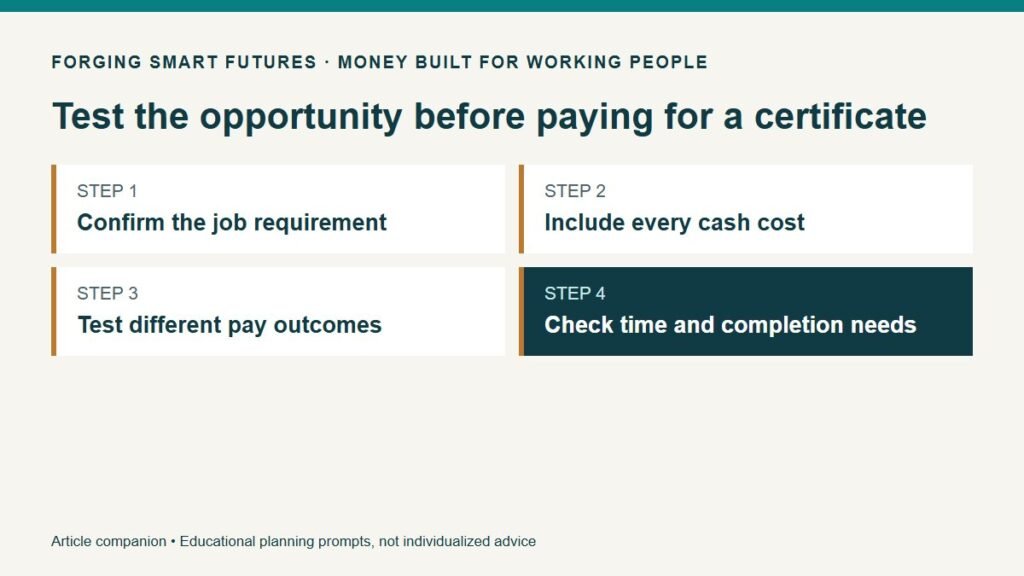
Identify the specific work the credential could help you obtain, verify who recognizes it and add the full cost of completing and maintaining it. Model more than one income outcome, including no raise. A course fee divided by an advertised salary increase is not enough to judge the decision.
The credential may have learning value even without an immediate pay increase. Keep that value separate from a claim that the purchase will pay for itself.
Work backward from the opportunity
Find the roles or assignments you want, then ask which qualifications are actually required or preferred. Check with the relevant employer, credential issuer or licensing authority. A training provider's sales page is not a substitute for those answers.
Record the credential's exact name, issuer, prerequisites, assessment and renewal conditions. Distinguish a course-completion certificate from a professional certification or a legally required license. This article does not establish the requirements for any trade or state.
The BLS Occupational Outlook Handbook describes occupations, entry pathways and pay information. Use it to orient your research, then verify the specific local opportunity. A national occupational figure is not a promised starting wage after a particular course.
Put every cash cost in the first estimate
| Fictional training cost | Amount |
|---|---|
| Course fee | $900 |
| Exam | $250 |
| Travel | $150 |
| Supplies | $100 |
| Total cash cost | $1,400 |
These are invented amounts, not current provider prices. Add retake fees, childcare, required equipment or renewal costs if they apply to the program you are considering. Ask what is included rather than assuming the advertised tuition covers the entire pathway.
Then count time: class hours, preparation, travel, testing and administration. If the fictional pathway requires 40 hours, that time needs a place in your actual schedule. Do not simply add forty hours of wages to cash costs unless you will lose those paid hours; record opportunity cost separately from money leaving the account.
Test three outcomes
Suppose a confirmed role change would eventually produce $100 more monthly take-home pay after additional work costs. Recovering the example's $1,400 cash outlay would take 14 months after the increase begins, ignoring financing costs, renewal costs and the value of time.
At $50 more per month, it would take 28 months. At no increase, there is no cash payback from earnings in this model. Those cases are assumptions, not probabilities.
Also include the wait before the benefit starts. If the increase begins four months after paying for training, the first case reaches its simplified cash payback about eighteen months after the initial payment. A delayed exam or hiring decision can extend that period.
For a credential used to obtain occasional jobs, count the extra net contribution from those jobs after their costs. Do not divide tuition by gross sales while leaving travel, materials and unpaid time out of the comparison.
Ask whether you can finish the program
Check the schedule against shifts, overtime demands and family obligations. Ask about attendance requirements, missed sessions, exam booking and the written refund policy. A lower price is not a bargain if the timetable makes completion unlikely for you.
If you need prerequisites, include their money and time too. Verify how long an exam authorization or course access lasts. Do not assume an extension, retake or transfer will be free.
Completion risk is not a reason to avoid learning. It is a reason to choose a workable pathway. A slower schedule or employer-supported option might fit better than a compressed course requiring time you do not have.
Read employer support carefully
If an employer offers reimbursement, confirm eligibility, approval timing, what costs are covered and when money is repaid. Separate an advance from reimbursement after successful completion. You may need to fund the gap even when the final net cost is lower.
Read any repayment conditions before accepting support. Get appropriate advice if an agreement is unclear. Do not assume reimbursement is unconditional or that a credential guarantees a promotion.
Ask directly: “If I complete this credential, which roles or pay changes would I become eligible for, and what other conditions apply?” Eligibility is useful information; it is still different from a commitment to change your pay.
Make a one-page decision record
Write the verified opportunity, total cash cost, time requirement, funding dates and three possible outcomes. Add the evidence source beside each major assumption. Mark unanswered questions rather than replacing them with optimistic numbers.
You can then decide whether to proceed, gather more information or choose a different route. Use the FSF budget planner to test the payment period before enrolling. The right question is not only whether the credential could help someday, but whether this pathway and timing fit the work and household you have now.
General education only, not individualized financial, investment, tax, legal or credit advice. Examples are fictional and depend on the stated assumptions. Prepared with AI assistance by FSF Editorial Team; reviewed for publication by the FSF publisher.
Editorial attribution: Paul Foster
Published: September 10, 2026 Last reviewed: September 10, 2026
Sources & References
Put this into practice
Compare written pay, time and benefit terms on the same basis. Free Work & Compensation checklist — no membership required.
Related decisions
- Higher Hourly Pay or Better Benefits? Compare Two Job Offers
- Build a Raise Request Around the Value of Your Work
- Compare Disability Coverage When Your Pay Depends on Physical Work
Expanded member resource: Total Compensation Decision Workbook. Guided exercises with local save, reopen and print controls. Worksheet answers are not automatically calculated. Compare free resources and FSF membership benefits.
Human-reviewed, AI-assisted content; how FSF creates articles.