
How to Use Overtime to Pay Down Debt Without Leaving Yourself Short
The short answer
Base an extra debt payment on cash that is actually available after upcoming obligations—not the gross overtime on your timesheet or everything showing in checking. Cover required payments, look beyond the next payday, and decide how much cash must remain before sending the extra amount.
A good overtime month can make a debt balance drop. It can also create an expensive loop: pay the card, discover that insurance is due, and put the insurance bill back on the card. The missing step is giving the extra paycheck a job before making the payment.
Start with the deposit, then check what it must cover
Use the settled take-home deposit. Your hourly rate multiplied by overtime hours does not account for payroll deductions, withholding or the costs of working those hours. If you drove farther, bought additional meals or paid for childcare, include those costs in the household plan.
Choose a planning window that reaches through the next reliable paycheck and any large bill just after it. Write down available cash, expected deposits, required bills, minimum debt payments and everyday essentials. Check dates as well as totals. A Friday deposit cannot fund a Thursday bill unless other cash covers the gap.
Our biweekly bill-calendar guide shows how to build that timeline. The variable-pay budgeting article helps separate a dependable baseline from a better-pay scenario.
A fictional extra-paycheck decision
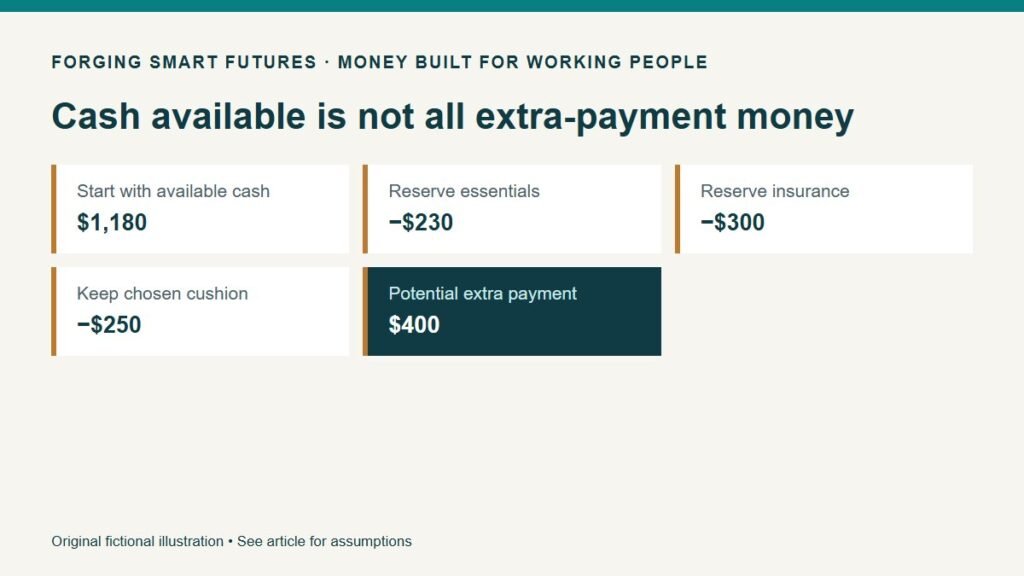
Suppose a maintenance technician has $1,180 available after the regular bills and debt minimums already included in this example. That is not all extra-payment money:
| Remaining job for the cash | Amount |
|---|---|
| Groceries and commuting before the next dependable deposit | $230 |
| Insurance bill due shortly after that deposit | $300 |
| Cash the household chooses to keep available | $250 |
| Potential extra debt payment | $400 |
The arithmetic is $1,180 − $230 − $300 − $250 = $400. This illustration does not prescribe a $250 emergency fund. It shows why the required cash reserve is a separate decision. A household with uncertain hours, medication costs or a vehicle repair pending may need to retain more.
If a new $160 work-related cost appears, the potential extra payment falls to $240. Sending $400 anyway would quietly turn a new expense into a future borrowing problem. If the result is negative, it is a funding gap to address, not permission to make an extra payment.
Decide which balance gets the extra payment
Once required payments are covered, two common approaches are targeting the smallest balance or the highest interest rate. The CFPB explains that the first can produce quicker account-level wins, while the second targets expensive debt. Keep required payments on the other accounts current. CFPB debt action plan.
Do not apply a ranking mechanically if you are behind on housing, essential utilities, a secured loan or another obligation with serious immediate consequences. Make a separate list of overdue accounts and contact the provider to understand available arrangements. A payoff strategy assumes enough money to meet the underlying obligations; it does not resolve an immediate shortage.
Before an extra payment, check the statement, payment instructions and any special terms. Record the amount and date, then verify it posted. Avoid assuming an extra payment replaces the next required payment or that every lender applies money identically.
Use a repeatable payday rule
Write a rule that fits your actual schedule: “After the deposit clears, I update the next-bill calendar, keep the cash needed for that window, and send the remaining planned amount to the selected debt.” That is more resilient than committing to an extra $400 every month because one month happened to include substantial overtime.
For a low-pay month, the extra amount may be zero. Keep that month visible rather than deleting it from the plan. When overtime returns, repeat the calculation using current balances and bills. If the required payments themselves no longer fit, contact creditors early rather than covering the gap with another assumed overtime shift.
Put the plan to work
Use the free checklists in FSF Resources to list obligations and next actions. Existing members can use the expanded planning resources through their resource library; compare the available tools before joining. Begin today with one question: after the next reliable payday and nearby bills are accounted for, how much of this deposit is genuinely unassigned?
General financial education, not individualized financial, investment, tax, legal or credit advice. Examples are fictional. No affiliate relationship or compensated product recommendation is included.
Editorial attribution: Paul Foster
Published: September 10, 2026 Last reviewed: September 10, 2026
Sources & References
- https://files.consumerfinance.gov/f/documents/cfpb_your-money-your-goals_debt-action-plan_tool_2018-11.pdf
Put this into practice
Put balances, dates and written terms in one usable plan. Free Debt & Credit checklist — no membership required.
Related decisions
- Debt Snowball or Avalanche When Your Extra Pay Changes Each Month?
- Balance Transfer or Consolidation Loan? Compare the Whole Payoff Job
- Should Your Next Overtime Check Go Toward Debt or Your 401(k)?
Expanded member resource: Debt Organization and Decision Workbook. Guided exercises with local save, reopen and print controls. Worksheet answers are not automatically calculated. Compare free resources and FSF membership benefits.
Human-reviewed, AI-assisted content; how FSF creates articles.