
Secured Card or Credit-Builder Loan When Cash Is Tight?
The short answer
A secured card usually ties up a cash deposit while you use and repay a credit line. A credit-builder loan generally holds the loan funds while you make payments. Compare what each takes out of your usable cash, not just its promise to help establish credit.
The CFPB describes both as possible ways to build a credit history. It emphasizes on-time payment and distinguishes them from debit or prepaid cards, which generally do not establish borrowing repayment history. CFPB credit-building guidance.
For someone rebuilding after a period of reduced hours, the wrong product can add a payment that the household cannot comfortably keep. No advertised score improvement should substitute for reading its actual terms.
Compare the cash that becomes unavailable
With a secured card, ask how much must be deposited, whether it earns anything, when it can be returned, and what happens on account closure. The deposit is not a monthly bill payment. Purchases still create a separate balance that must be paid under the card agreement.
With a credit-builder loan, ask when funds become accessible, the complete payment schedule, interest and fees, and the amount released after completion. Do not assume you receive every dollar of your payments back. Do not count held funds as emergency cash available next week.
For either product, ask which credit-reporting companies receive the account history. Obtain written information instead of relying on a broad “build credit” headline. Reporting and scoring outcomes are not identical promises.
A fictional comparison for a variable-pay worker
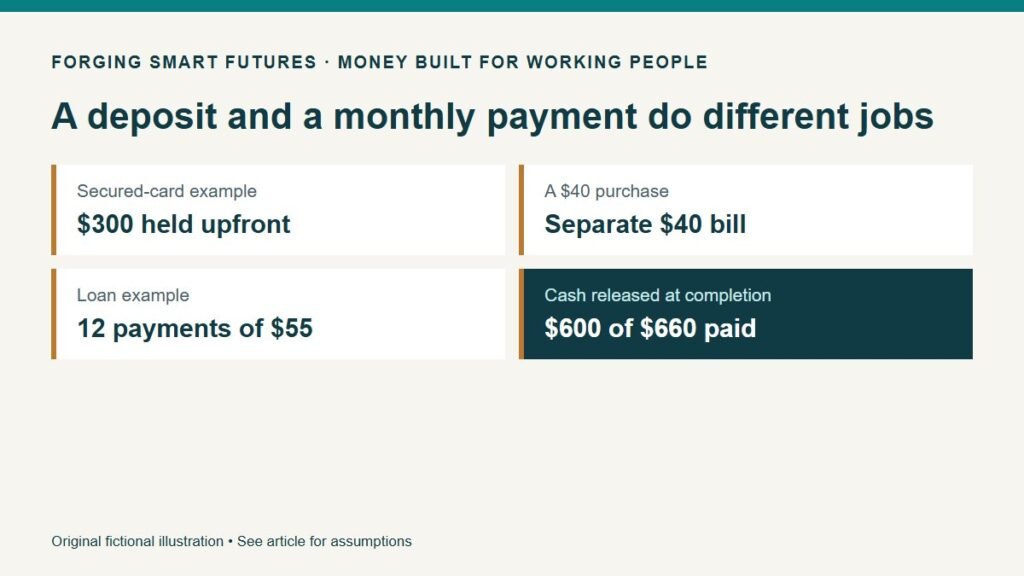
Imagine a worker with $700 of cash available after already-planned expenses. A secured card requires a $300 deposit. That leaves $400 usable before any new purchase. A $40 purchase on the card creates a separate $40 bill; it does not spend down the deposit as though the card were prepaid.
Now consider a different fictional offer: a credit-builder arrangement requires twelve $55 payments and releases $600 after completion. Total payments are $660, so the difference is $60 under these simplified terms, with no other fees or interest earned assumed. The first monthly payment is smaller than a $300 upfront deposit, but the worker must support eleven more payments afterward.
These are invented offers to make the timing visible. They are not a market comparison. One option uses more cash at the start; the other creates a repeated obligation. Either could be unsuitable if it uses money needed for groceries, commuting or an upcoming insurance bill.
Read fees as dollars and as conditions
List application, setup, annual, monthly, late and closure-related charges where applicable. Identify what is refundable and when. For cards, also review the purchase APR, grace-period terms and any extra services offered during application. For loans, read the amount financed and total of payments.
A small monthly fee is still recurring. For example, $8 monthly is $96 over a year, before other costs. Ask whether a less costly product can serve the same purpose; you do not need several new accounts simply because several are marketed as credit-building tools.
Make payment reliability the design requirement
Choose a due date and reminder process that fit the pay schedule where the provider allows it. If using automatic payments, understand the amount and timing and keep the funding account covered. Automation does not solve a deposit that arrives after the withdrawal.
Consider a small, predictable purchase instead of treating a new limit as spending room. Review each statement even when the activity seems routine. Keep a record of payments and check your credit reports for the account information you expected to see.
If ordinary obligations already exceed reliable income, adding another financial product may be the wrong immediate task. Organizing bills and correcting report errors can be useful without purchasing a credit-building service.
Start with the FSF bill-calendar guide and free Debt & Credit checklist in Resources. Before applying, be able to answer: what money is locked up, what payment is due, what does it cost, and what exactly will be reported?
General financial education, not individualized financial, investment, tax, legal or credit advice. No credit-score result is guaranteed. Examples are fictional; no affiliate relationship is included.
Editorial attribution: Paul Foster
Published: September 10, 2026 Last reviewed: September 10, 2026
Sources & References
- https://www.consumerfinance.gov/ask-cfpb/what-are-some-ways-to-start-or-rebuild-a-good-credit-history-en-2155/
Put this into practice
Put balances, dates and written terms in one usable plan. Free Debt & Credit checklist — no membership required.
Related decisions
- Medical Bill You Cannot Pay? Review It Before Choosing Financing
- Credit Freeze or Credit Monitoring: What Each One Actually Does
- Check Your Credit Before You Need the Next Work Vehicle
Expanded member resource: Debt Organization and Decision Workbook. Guided exercises with local save, reopen and print controls. Worksheet answers are not automatically calculated. Compare free resources and FSF membership benefits.
Human-reviewed, AI-assisted content; how FSF creates articles.