
Check Your Credit Before You Need the Next Work Vehicle
The short answer
Review your credit reports before shopping for a vehicle, investigate information you do not recognize and compare financing on the same loan amount and term. A credit score alone cannot tell you whether a payment fits a low-overtime month.
For a worker whose next shift depends on reliable transport, a breakdown can turn financing into an emergency decision. Checking credit while the current vehicle still runs gives you time to organize records and questions.
Use reports as an inspection, not a verdict
The CFPB recommends reviewing credit reports and disputing inaccurate information before applying for an auto loan. Lenders also consider income, debts, the loan amount, term, down payment and vehicle. A better-looking score does not guarantee approval or a particular rate. CFPB auto-loan rate factors.
Start from the official links in that CFPB guidance rather than a credit-monitoring advertisement. For each report, note the report date, accounts you recognize, balances or payment histories that seem wrong, and unfamiliar inquiries or addresses. An unfamiliar company name may be a lender's reporting name; verify it before concluding fraud.
Keep copies privately. Do not email full reports to a dealership salesperson or paste account numbers into a public AI tool. Create a separate comparison sheet that contains only the facts needed for your decision.
Make a record for each disputed item
Write down what the report says, why you believe it is wrong and which document supports your position. Keep the original document and a dated copy of whatever you submit. Follow the credit-reporting company's dispute process and the CFPB's dispute instructions, including contacting the company that supplied the disputed information. Track the response and check the resulting report rather than assuming a submitted dispute has changed it.
There is no promise that accurate negative information can be removed or that a correction will increase a particular score. Avoid making a vehicle commitment dependent on a guessed future score. If identity theft is suspected, use official recovery guidance before sending more applications.
Compare the loan and the household separately
Ask each lender for the amount financed, APR, term, required payment, fees and total payments. Identify financed add-ons instead of letting them disappear inside a monthly payment. Obtain actual written offers; an advertised rate is not your approval.
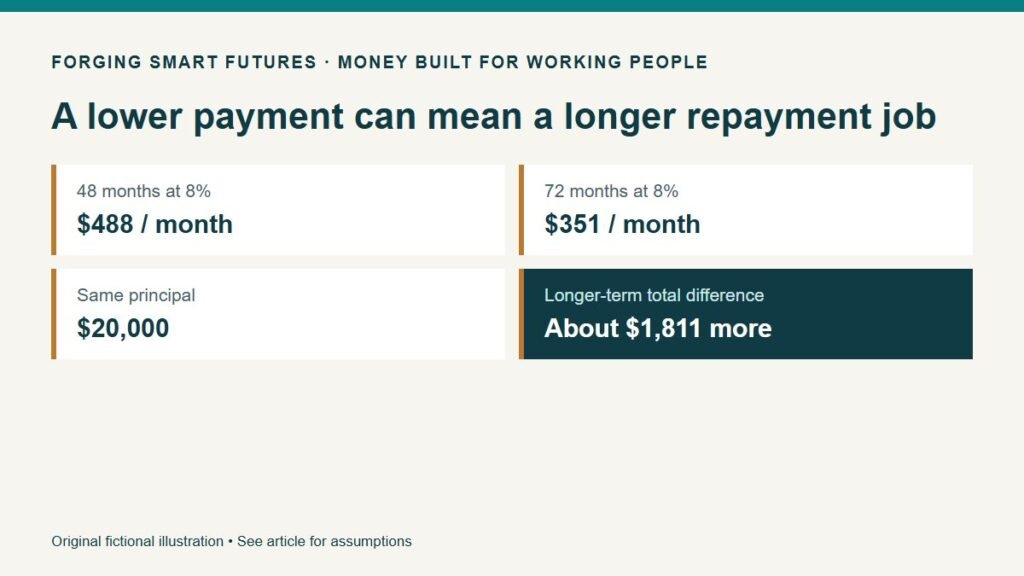
Here is an original fictional comparison with no fees, a $20,000 principal, fixed rates, monthly payments and no early repayment:
| Scenario | Approximate monthly payment | Approximate total payments |
|---|---|---|
| 8% over 48 months | $488.26 | $23,436 |
| 8% over 72 months | $350.66 | $25,248 |
The longer term lowers the modeled payment by about $138 but adds about $1,811 to total payments. Totals use the unrounded calculated payment; actual lender schedules round installments and may adjust the last one. The example changes only the term, not the car, down payment or rate.
Now add insurance, fuel, maintenance and registration to your household plan. If your hours fall, the lender's payment is still due. Use a dependable income scenario, then a lower-pay scenario; the maximum offered by a lender is not a household spending target.
Build a small pre-shopping file
Keep four items together: your report-review notes, a list of unresolved questions, written financing offers and a household cost comparison. Before a dealership visit, write the maximum total commitment your plan supports and which assumptions would make you stop.
Ask whether an initial quote involves a credit inquiry and how long its terms last. The CFPB recommends concentrating auto-loan shopping in a limited period because scoring treatment of inquiries varies. Do not interpret that as permission to apply for unrelated types of credit at the same time.
For the cash-flow side, use FSF's cost-of-going-to-work guide and free checklists in Resources. The immediate action is simple: review the records before a vehicle emergency makes the decision for you.
General financial education, not individualized financial, investment, tax, legal or credit advice. The loan comparison is fictional, not a rate quote. No affiliate relationship is included.
Editorial attribution: Paul Foster
Published: September 10, 2026 Last reviewed: September 10, 2026
Sources & References
- https://www.consumerfinance.gov/ask-cfpb/how-does-a-lender-decide-what-interest-rate-to-offer-me-on-an-auto-loan-en-765/
- https://www.consumerfinance.gov/ask-cfpb/how-do-i-dispute-an-error-on-my-credit-report-en-314/
Put this into practice
Put balances, dates and written terms in one usable plan. Free Debt & Credit checklist — no membership required.
Related decisions
- Secured Card or Credit-Builder Loan When Cash Is Tight?
- Medical Bill You Cannot Pay? Review It Before Choosing Financing
- Credit Freeze or Credit Monitoring: What Each One Actually Does
Expanded member resource: Debt Organization and Decision Workbook. Guided exercises with local save, reopen and print controls. Worksheet answers are not automatically calculated. Compare free resources and FSF membership benefits.
Human-reviewed, AI-assisted content; how FSF creates articles.