
How to Compare Business Bank Accounts for a Small Service Business
The short answer
Choose an account that supports how customers pay you and how you pay business bills at a cost you can sustain in a quiet month. Compare the actual fee schedule and service agreement using your expected transactions. A waived monthly fee is only one part of the decision.
Separating business and household money can make records easier. It does not, by itself, establish a liability shield, choose a tax treatment or make every expense deductible. IRS income and expense guidance.
Start with a transaction sketch
Estimate monthly customer deposits, cash deposits, checks, electronic transfers, card purchases and the lowest likely balance. Add any need for a local branch, weekend access, multiple users or accounting exports. A mobile service collecting cash has different needs from a remote freelancer receiving two electronic payments per month.
Separate the account from the payment processor. Card acceptance may involve another provider, another fee schedule and another payout timeline. “Business banking” on a website does not tell you which company holds funds or which agreement covers a delayed payment.
Test a normal month and a slow month
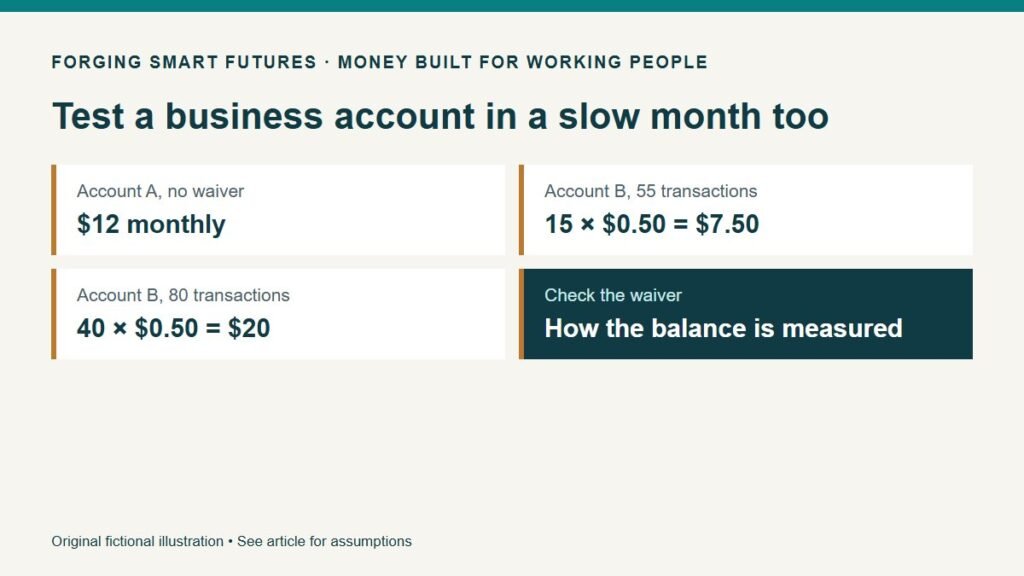
Consider two fictional offers. Account A charges $12 monthly unless a stated $1,500 minimum-balance condition is met. Account B has no monthly fee but charges $0.50 for each transaction above forty. Ignore other charges only for this simplified example.
With fifty-five counted transactions and no qualifying waiver, A costs $12 and B costs $7.50. At eighty transactions, B costs $20. If A's waiver is met, its monthly fee is zero, but verify exactly how the bank measures the qualifying balance. An average-balance test is different from a minimum-daily-balance test.
Do not keep cash unavailable for essential business bills solely to avoid a small fee without considering the tradeoff. If moving money to pay insurance causes a waiver to disappear, include that possibility in the low-balance scenario. These fictional prices are not current bank offers.
Read the operational details
| Need | Question for the provider |
|---|---|
| Cash deposits | Where can I deposit, what limits apply and what fees apply? |
| Customer checks | When might funds be available, and what holds or returned-item charges apply? |
| Paying suppliers | Which transfer methods, limits and deadlines fit the bills? |
| Shared access | Can another user have limited permissions without sharing my login? |
| Bookkeeping | Can I export usable transactions and retrieve older statements? |
| Closing or switching | What must happen to pending payments, statements and connected services? |
Read the provider's deposit-insurance explanation and identify the actual financial institution and account ownership arrangement. Do not assume every app balance has identical protection. If you cannot explain where money sits, resolve that before funding the account.
Match the account to the actual business
Ask what identification and business documents are required for your legal structure and ownership. SBA lists common account-opening documents, but the institution's requirements control the application. SBA launch guidance.
Use the correct business name and ownership information. Do not choose a different entity type merely to get past an application field. If you are still deciding how the business will be organized, settle that question with appropriate help before submitting inconsistent records.
Keep a dated comparison you can revisit
Save the fee schedule, offer date, assumptions and unresolved questions for each finalist. Calculate your expected monthly cost and a quieter-month cost. Include payment-processing costs separately, so they do not disappear into a vague “free banking” label.
After opening, reconcile the first statement against your estimate. A unexpected charge may reveal an overlooked condition or a transaction classification you misunderstood. Update the comparison before deciding the account was a bad choice.
Your next action
Sketch one realistic month of transactions before opening comparison tabs. Use the FSF startup-cost guide to place account and processing costs in the broader plan. Existing free and member resources are identified on the Resources page.
General education, not individualized banking, legal, tax or financial advice. All prices are fictional comparison inputs. FSF has not ranked or tested named accounts here and presents no affiliate relationship.
Editorial attribution: Paul Foster
Published: September 10, 2026 Last reviewed: September 10, 2026
Sources & References
- https://www.irs.gov/faqs/small-business-self-employed-other-business/income-expenses
- https://www.sba.gov/counseling/launch-your-business/
Put this into practice
Test demand and cash needs before committing to recurring costs. Free Starting a Business checklist — no membership required.
Related decisions
- Bookkeeping and Invoicing Software for Your First Service Business
- DIY Filing or a Business Formation Service? Know What You Are Buying
- Find Your First Service Customers Without Quitting Your Job
Expanded member resource: First Service Business Planning Workbook. Guided exercises with local save, reopen and print controls. Worksheet answers are not automatically calculated. Compare free resources and FSF membership benefits.
Human-reviewed, AI-assisted content; how FSF creates articles.