
DIY Filing or a Business Formation Service? Know What You Are Buying
The short answer
Separate three questions: which structure fits your circumstances, which filings and ongoing duties apply, and who will prepare the paperwork. A filing service may help with administration. Buying a package does not by itself resolve legal, tax, ownership or insurance questions.
If there are multiple owners, meaningful liability concerns, unusual ownership arrangements or uncertainty about the right structure, get qualified advice before treating a cheap filing package as the whole decision. This article does not select an entity for you.
Choose the structure before the filing package
Common structures include sole proprietorships, partnerships and corporations; LLCs are created under state law, and federal tax treatment is a separate question. The IRS outlines the common forms and their tax context. Do not treat “LLC” and “S corporation” as interchangeable labels. IRS business structures
| Question | Why it belongs before filing |
|---|---|
| Who owns and controls the business? | Multiple owners need clear decisions about authority, money and departures. |
| What could go wrong in the work? | Liability, insurance and contractual risk should be understood. |
| Where will it operate and sell? | Registration, licensing and taxes depend on location and activity. |
| How will it be taxed and maintained? | A formation fee is not the entire ongoing administrative cost. |
Get qualified legal or tax input when the choice is unclear, particularly for multiple owners, significant liability or specialized arrangements. Buying a template does not establish that it fits your situation.
Compare the same scope
Write down exactly what each option includes: preparing the formation document, submitting it, paying government fees, providing a registered-agent service if applicable, obtaining copies, supplying templates or sending reminders. Identify who reviews your answers and what happens if an application is rejected.
SBA explains that business structure affects matters such as liability, taxes and paperwork. State requirements and your facts determine the details. SBA launch guidance.
A marketing label such as “complete business setup” is not a checklist of every permit, tax registration, license, insurance need or contractual obligation. Start with official state and local sources, then compare the provider's written scope against what your activity requires.
Separate government charges from service charges
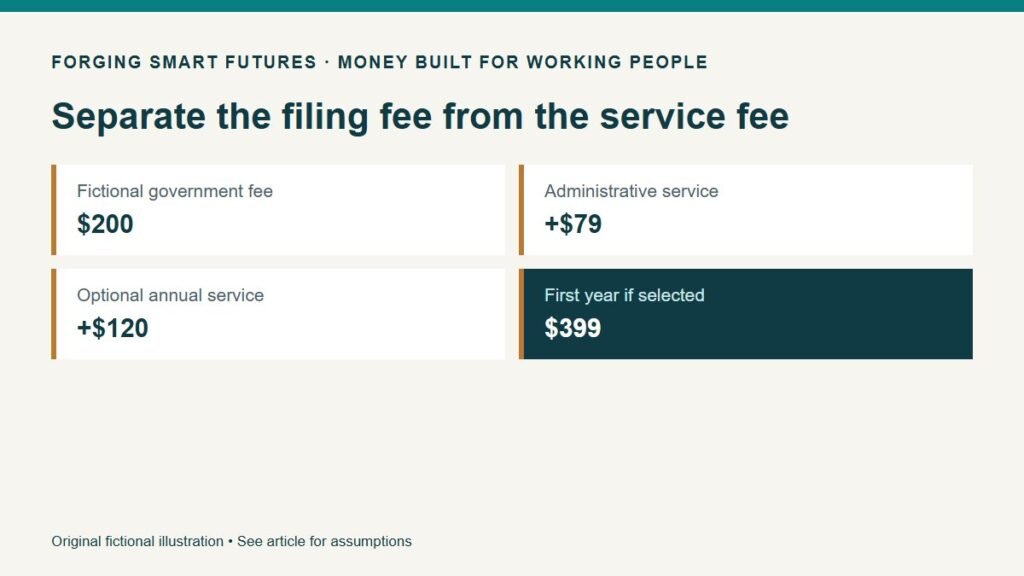
In a fictional state-filing example, the required government fee is $200. Provider A charges $79 for assistance plus that same $200, making $279 upfront. An optional address or agent-related service costs $120 per year. If selected, the first-year total becomes $399 before other charges.
DIY submission would still involve the $200 government fee in this example. It is misleading to compare the provider's advertised $79 with zero, or to compare its $399 package with a DIY figure that ignores a service you actually need. These amounts illustrate a method; they are not a state's fee schedule or a provider offer.
For each optional item, ask whether it is required for your situation, whether you can reasonably handle it yourself, whether it renews and how cancellation works. Save the terms shown when ordering.
Recognize free official steps
The IRS issues employer identification numbers directly without charging an application fee. Paying someone to assist may be a service choice; it is not an IRS fee. The IRS also advises forming an entity with the state first when that applies. Check eligibility and instructions on the official page. IRS EIN application guidance.
Do not enter owner identity information into a lookalike site simply because it appears above the official result. Verify the organization, the address of the website and what permission you are giving the service to act for you.
Plan the work after filing
Keep the accepted filing, ownership documents and agency notices in a place you can retrieve. Record ongoing obligations from official sources with the responsible person and due date. A reminder subscription may help you remember; it does not remove your responsibility to verify the obligation or act on it.
Open accounts and sign agreements using accurate legal information. Do not describe the business as licensed, insured or professionally authorized merely because formation paperwork was accepted. Those are separate questions.
Avoid letting an annual renewal hide in a formation bundle you no longer understand. Review the provider statement and the reason for each service before renewal, while making sure any legally required role or address remains properly maintained.
Build an evidence checklist
The SBA launch guide covers structure, registration, tax IDs, licensing and business banking. Use the relevant government authority for the actual requirement and keep the response or official page with a date. SBA launch guidance
Check business-name availability and whether an assumed name/DBA filing is needed. A domain purchase does not register a legal entity or establish trademark rights. Check licenses, permits, zoning and home-business restrictions for the work and location. Do not assume there is one general permit that covers every activity.
Identify applicable federal, state and local tax questions, including sales-tax collection and filing where relevant. A county or city may have a relevant requirement without every jurisdiction imposing the same tax. Record “confirmed not applicable” separately from “not researched.”
Make the startup budget show timing
Separate required prelaunch spending, optional improvements, recurring costs and cash needed while waiting for customers to pay. Include insurance quotes, equipment, supplies, website/domain, payment processing and records systems where applicable.
Fictional example: $450 of required setup, $700 of equipment, $150 of supplies and $600 of operating cash make a $1,900 initial funding plan. A $500 optional branding package increases it to $2,400. Deferring the optional item can reduce the initial commitment; it does not remove the $1,900 need or establish that sales will occur.
Use actual quotes. Record deposits and remaining balances so a low deposit is not mistaken for the full cost. Stress-test a slower start and compare that with the household money you can afford to put at risk.
Set up how a customer becomes a completed order
Write a clear scope, price method, payment timing, cancellation/return approach and delivery standard suitable for the business. Confirm the payment provider supports your activity and understand fees, holds and disputes. Keep collected taxes and customer obligations visible in records.
A basic website should explain the offer, service area, contact method and next step accurately. It does not need to imply a larger operation than exists. Test an inquiry and the payment workflow without creating an unintended live charge.
Leave launch with records you can maintain
Create a folder for approvals, contracts, receipts, insurance and renewal dates. Assign each recurring filing or review to a person and calendar date. Keep unresolved requirements out of a “ready to launch” status.
Use startup-cost planning, business insurance questions. FSF's proposed document builder is future work; this checklist does not provide a finished operating agreement or replace jurisdiction-specific review.
Choose by complexity, not embarrassment
DIY can be reasonable when you understand the official instructions and the underlying decisions are straightforward. Paid administrative assistance can be useful when it saves meaningful time or helps manage filings. Professional advice serves a different need when the decision itself is uncertain.
Write the unresolved questions before buying: ownership percentages, decision rights, liability exposure, tax treatment, operating locations and future changes. Bring those questions to an appropriately qualified professional rather than guessing in a dropdown menu.
Your next action
Build a first-year and renewal-year cost comparison using actual written offers. Put those costs into the FSF startup-cost plan, then use the Resources page to find currently available free and member planning materials.
General education, not individualized legal, tax or financial advice. Examples are fictional. FSF does not claim a formation-service affiliation or that any entity guarantees protection.
Editorial attribution: Paul Foster
Published: September 10, 2026 Last reviewed: September 18, 2026
Sources & References
- https://www.sba.gov/counseling/launch-your-business/
- https://www.irs.gov/businesses/small-businesses-self-employed/get-an-employer-identification-number
Put this into practice
Test demand and cash needs before committing to recurring costs. Free Starting a Business checklist — no membership required.
Related decisions
- Find Your First Service Customers Without Quitting Your Job
- A Profitable Month Can Still Run Out of Cash: Understand Receivables
- Business Insurance Quotes for a Small Service Company: Questions to Compare
Expanded member resource: First Service Business Planning Workbook. Guided exercises with local save, reopen and print controls. Worksheet answers are not automatically calculated. Compare free resources and FSF membership benefits.
Human-reviewed, AI-assisted content; how FSF creates articles.