
Company Stock in Your Retirement Plan: Your Job and Savings Can Share a Risk
The short answer
Look at employer stock as an investment exposure, separate from your loyalty to the company. Your wages already depend on the employer. A large investment in the same company can mean that a business setback affects income and savings at the same time.
FINRA identifies employer stock and overlapping holdings as sources of concentration risk. Owning several accounts or funds does not necessarily remove exposure to the same company or industry. FINRA concentration-risk guidance.
Find the exposure before choosing an action
List direct employer shares in the retirement plan, shares held elsewhere and relevant holdings inside funds where you can identify them. Keep unvested awards and options distinct from vested, currently owned shares; their conditions and values are not interchangeable.
Use current statements and dates. A balance from last quarter and a current account total can produce a misleading percentage. If a fund's complete holdings are unavailable, record the uncertainty rather than inventing an exact exposure.
Also note household dependence on the employer. Two earners working for the same company, a company-linked pension or a local housing market dependent on one plant can create other connections. Do not simply add those items as though each were liquid stock; recognize them as separate risks to discuss.
Calculate a simple concentration percentage
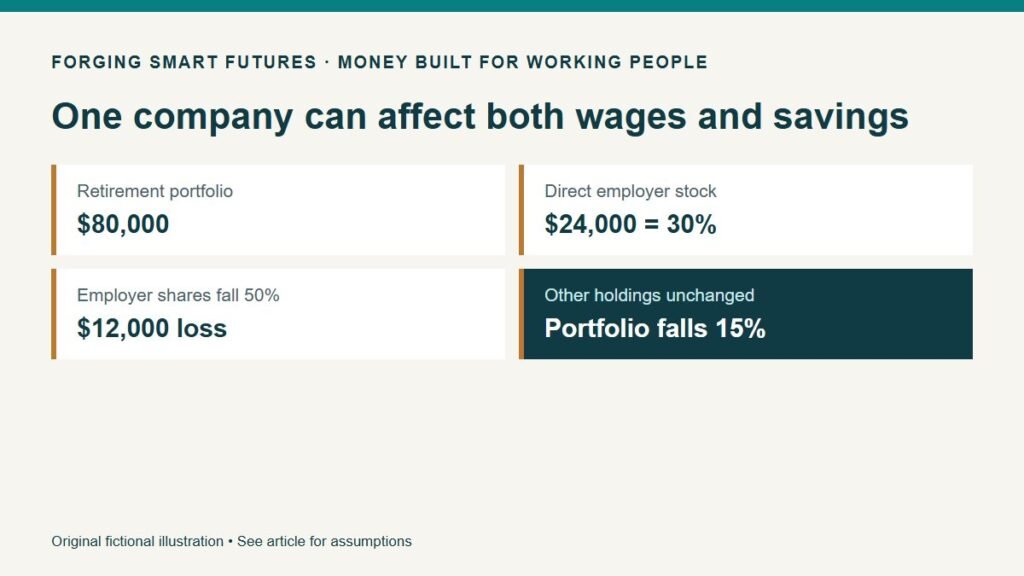
In a fictional $80,000 retirement portfolio, $24,000 is direct employer stock. That is 30% of the portfolio. The other $56,000 is in different investments.
If the employer stock falls 50% while the other holdings are unchanged, the direct-stock portion falls to $12,000 and the total becomes $68,000. The portfolio loss is $12,000, or 15% of its original value. The unchanged-other-holdings assumption is only a teaching device; real markets may move together.
If overtime disappears at the same time, the household may also have less money available to invest or cover expenses. That does not prove a specific company will fail. It explains why familiarity with your workplace is not the same as diversification.
Separate the match from the holding decision
Ask whether employer contributions arrive as cash or shares, when they vest and what diversification or sale rules apply. The value of receiving a contribution and the decision to continue holding one concentrated investment are different questions.
Do not assume you can immediately sell every award or transfer every plan asset. Restrictions, blackout periods, plan provisions and tax rules can affect the available actions. Confirm the rules through official plan and company channels before giving instructions.
Avoid making a tax-sensitive move casually
Employer stock in a retirement plan can involve specialized tax considerations when distributed or rolled over. This article does not evaluate those treatments. Before a large sale, distribution or rollover, get advice based on the actual account and stock records, rather than relying on a coworker's transaction.
Ask the professional to explain the proposed action, costs, taxes, alternatives and how the remaining portfolio would look. A recommendation to diversify should still be implemented thoughtfully; it does not require pretending every route has identical consequences.
Set a review rule you understand
Write the current exposure, your concerns, permitted actions and the questions still open. There is no universal employer-stock percentage prescribed here. A suitable allocation depends on the wider plan, obligations, time horizon and ability to bear losses.
Revisit the inventory when shares vest, an employer contribution arrives, the stock price moves sharply or your job situation changes. Do not judge exposure only by what you originally contributed; a rising stock can become a larger share of the portfolio without another purchase.
Keep emergency money separate from a plan that assumes employer stock can always be sold at a favorable price. The FSF emergency-savings guide addresses the household cash side of a reduction in hours.
Your next action
Calculate the direct employer-stock percentage using balances from the same date, then identify any additional exposure and restrictions. Review FSF's match guide for contribution questions and the Resources page for existing planning materials.
General education, not individualized investment, tax or legal advice. The loss scenario is fictional, not a forecast. No employer security or affiliate relationship is endorsed.
Editorial attribution: Paul Foster
Published: September 10, 2026 Last reviewed: September 10, 2026
Sources & References
- https://www.finra.org/investors/insights/concentration-risk
Put this into practice
Prepare better questions before choosing an account or investment. Free Investing checklist — no membership required.
Related decisions
- Investing During a Market Drop When Your Overtime Has Also Disappeared
- Your First Investing Steps When There Is Finally Room in the Paycheck
- Compare Brokerage Accounts When You Are Starting Small
Expanded member resource: Investing Foundations Research Workbook. Guided exercises with local save, reopen and print controls. Worksheet answers are not automatically calculated. Compare free resources and FSF membership benefits.
A simple portfolio framework: Our Bogleheads-style investing guide explains broad diversification, low costs, Fidelity fund examples and the limits of historical returns. Compare your own assumptions in its free scenario explorer.
Human-reviewed, AI-assisted content; how FSF creates articles.