
Your First Investing Steps When There Is Finally Room in the Paycheck
The short answer
Give the money a purpose and time horizon before choosing an investment. Check near-term cash needs, expensive debt and workplace benefits; understand the account you will use; then learn what the investment holds, costs and can lose. Starting small does not require skipping those steps.
If your income includes overtime, the first question is whether the apparent spare money will still be spare during a normal-pay month. The FSF overtime budget guide can help separate repeatable room from a temporary high paycheck.
Divide the next dollar by when you may need it
Write down the purpose: next month's repair, a possible hours cut, a home purchase or retirement many years away. Money needed soon has a different job from money that can remain invested through market declines.
The SEC's preparedness checklist highlights high-interest debt, emergency savings, diversification, risk tolerance and checking investment professionals. It does not select an account or portfolio for your household. Investor.gov preparedness checklist.
Do not turn that checklist into a universal instruction to ignore an employer benefit. If a workplace plan is available, obtain its eligibility, contribution, match and vesting terms and consider them alongside the household's cash needs. Our 401(k) match guide explains why the actual plan documents matter.
Use a lean-pay rehearsal
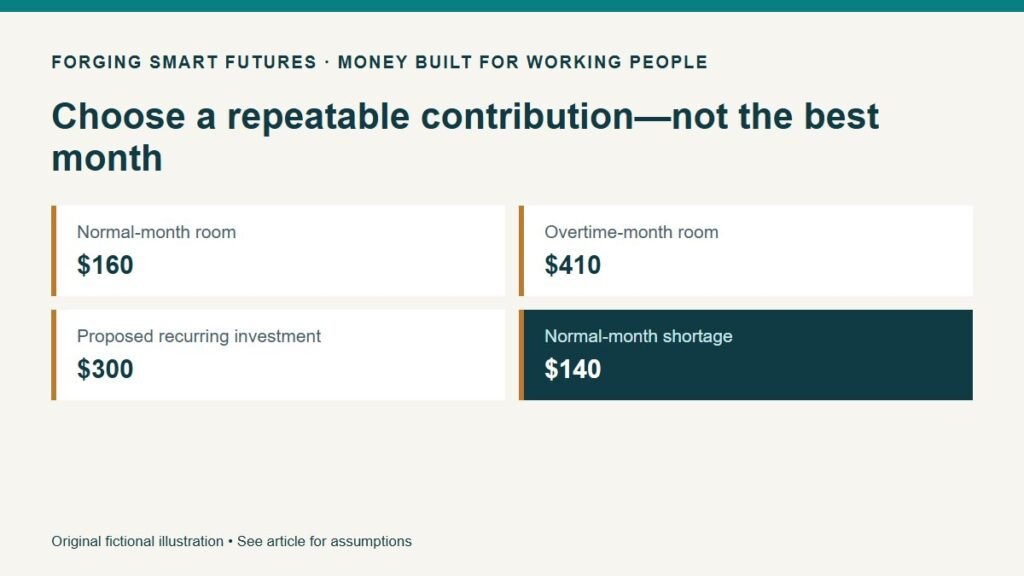
In this fictional exercise, a technician has $160 left in a normal month after essentials, required debt payments and planned reserves. A good overtime month leaves $410. Scheduling a recurring $300 investment because it fits the better month would exceed normal-month room by $140.
Instead, the worker could test a smaller planned amount and decide separately what to do with occasional extra money. This is an illustration of cash-flow design, not a recommended contribution. A lower-pay scenario may reveal that even the smaller amount needs adjustment.
Before automating anything, rehearse the withdrawal date on the bill calendar. Check whether an annual expense has been omitted. The goal is to avoid investing money that must immediately be borrowed back at a cost.
Write two rules instead of one optimistic target
The first rule covers a recurring amount that survives your baseline-pay scenario. The second covers additional income only after necessary obligations and reserves have been checked. Both amounts may be zero while you resolve a gap. Review workplace match terms separately so you understand what a contribution change affects.
Test a weaker month before automating
Run the plan with overtime removed and with one ordinary irregular expense added. Can the contribution still happen without borrowing for necessary bills? If not, revise the amount or timing. An automatic transfer can be convenient while still being too large for the account balance on transfer day.
For employer payroll contributions, ask how changes take effect and review the plan documents. A percentage-of-pay election behaves differently from a fixed-dollar transfer from checking. Match formulas, vesting and any true-up provisions are plan-specific; do not assume they work like a coworker's previous employer.
Avoid turning every extra paycheck into a market decision
Once a suitable plan is chosen, distinguish the contribution decision from guessing what markets will do next week. Write down the goal, time horizon and reason for the chosen approach. Revisit that plan when circumstances change, not simply because a social post predicts a winner.
Keep a record of contributions across accounts and check current IRS eligibility and limits where relevant. Provider automation does not establish eligibility. IRS IRA information
Use the overtime budget for the baseline and 401(k) match guide for workplace questions. A small, understood plan is more useful than an ambitious rule that forces you to undo it whenever your hours change.
Distinguish the account from what is inside
An account is the arrangement through which you hold cash or investments. The investment is what the money actually buys. Moving cash into an account does not by itself tell you whether it has been invested, what return it earns or what risk it has.
Ask the provider: where does uninvested cash sit, what fees apply, what can I buy, and how do I confirm a purchase? If the account has tax advantages, verify its current eligibility, contribution and withdrawal rules before funding it. This introductory article intentionally does not supply a one-size-fits-all account order or annual tax limit.
Read the first statement. Locate contributions, cash, holdings, fees and account value. A transaction confirmation and a current account balance answer different questions. Keep both where you can find them later.
Choose a learning task before a purchase
Pick one candidate investment and answer five questions in plain English: what does it own; why would its value change; could I need the money during a decline; what will I pay; and how does it fit the goal? If you cannot explain the investment without repeating its sales page, do more research before placing the order.
Diversification can reduce dependence on one holding but does not remove market risk. Several funds may hold many of the same companies. Counting account icons is not the same as understanding what you own.
Avoid comparing your starting amount with a coworker's screenshot. It may omit deposits, withdrawals, losses, borrowed money and the period measured. Your first useful milestone is a process you understand and can afford to repeat.
A first-month checklist
Write the goal and time horizon; review the low-pay budget; gather workplace-plan documents if relevant; compare account costs; research the intended investment; and schedule a statement review after the first transaction. Keep unanswered questions visible instead of filling them with assumptions.
The free Investing checklist in FSF Resources provides a place to organize next steps. Expanded member resources add planning exercises, not personalized investment selection or management.
General financial education, not individualized investment, financial, tax, legal or credit advice. Investing involves risk, including loss. Examples are fictional. No affiliate relationship is included.
Editorial attribution: Paul Foster
Published: September 10, 2026 Last reviewed: September 18, 2026
Sources & References
- https://www.investor.gov/introduction-investing/general-resources/investor-preparedness-checklist
Put this into practice
Prepare better questions before choosing an account or investment. Free Investing checklist — no membership required.
Related decisions
- Compare Brokerage Accounts When You Are Starting Small
- What an Index Fund Actually Owns—and Why That Matters to Your First Portfolio
- Small Investment Fees Can Become a Large Career-Long Cost
Expanded member resource: Investing Foundations Research Workbook. Guided exercises with local save, reopen and print controls. Worksheet answers are not automatically calculated. Compare free resources and FSF membership benefits.
A simple portfolio framework: Our Bogleheads-style investing guide explains broad diversification, low costs, Fidelity fund examples and the limits of historical returns. Compare your own assumptions in its free scenario explorer.
Human-reviewed, AI-assisted content; how FSF creates articles.