
Lease or Buy a Vehicle When Work Puts on Heavy Mileage?
The short answer
Estimate actual annual mileage and compare the full cost over the same period, including what you own or owe at the end. A lease's smaller monthly payment can conceal mileage charges, upfront cash or restrictions that do not fit a long commute or field-service route.
The FTC explains that leases can include mileage limits, excess-mileage charges, wear standards and costly early termination. Review the written agreement rather than choosing by the advertised payment. FTC financing and leasing guide.
Estimate miles from the real schedule
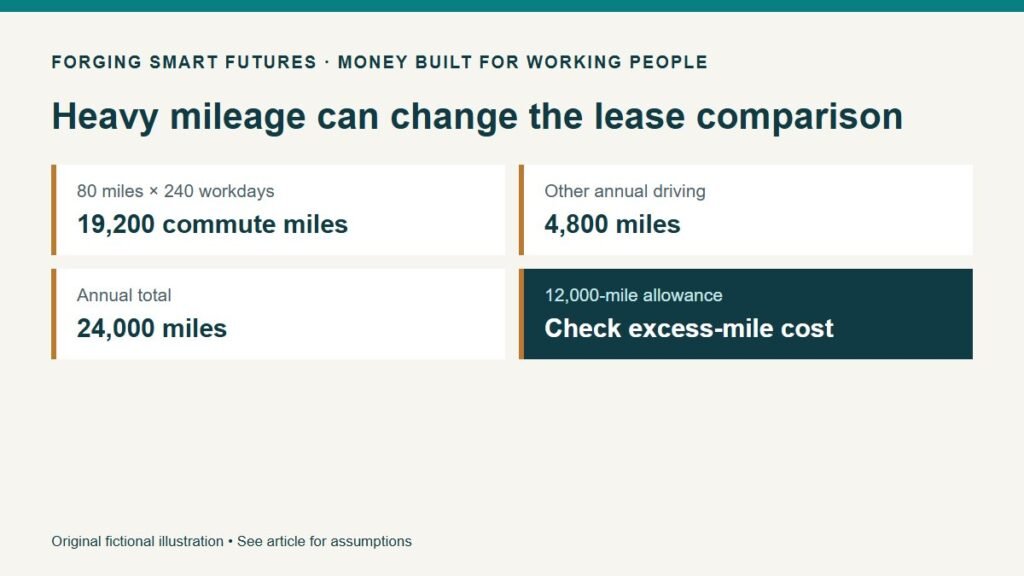
In a fictional year, commuting eighty miles round trip on 240 workdays creates 19,200 miles. Another 4,800 miles for household driving brings the total to 24,000. Add customer visits or other driving only if not already included.
If a lease allows 12,000 miles annually, that scenario exceeds the allowance by 12,000 miles each year. Over three years, the excess is 36,000 miles. At a fictional twenty-cent charge per excess mile, the potential charge is $7,200.
Actual contracts may calculate mileage differently and offer different arrangements. Use the permitted total and exact rate in the quote. A plan to drive less is credible only if it changes the actual commute or work pattern.
Put lease cash on a common timeline
Suppose a fictional thirty-six-month lease requires $2,000 upfront plus thirty-six payments of $350. Scheduled cash is $14,600 before tax, fees, insurance, maintenance, excess mileage and other charges. Adding the illustrative $7,200 excess-mileage amount raises it to $21,800 before those other costs.
Confirm whether an advertised amount due at signing already includes the first payment. This example explicitly treats the $2,000 as additional to all thirty-six payments; do not double-count a first payment in a real quote.
Record the cost of ending early, returning the vehicle and any option to buy. Do not assume a purchase option removes all prior costs or guarantees a favorable price.
Compare a purchase without ignoring the asset
For a financed purchase, list down payment, payments during the comparison period, operating costs and the loan balance at the end. Estimate the vehicle's resale value separately and mark it uncertain. The difference between value and remaining debt affects the end position.
It is not a fair economic comparison to count all purchase payments as lost cost while ignoring the vehicle, or to treat the expected resale value as guaranteed cash. For household affordability, however, the scheduled payment still has to be made even if some principal builds equity.
Use the same vehicle needs and time period when possible. Comparing a basic used vehicle purchase with a premium new lease may answer a different question from lease versus buy alone.
Check work use and condition requirements
Ask whether the lease, financing agreement and insurance permit the intended business use, modifications, equipment storage or towing. Do not assume ordinary commuting and commercial use are treated identically.
Include expected wear from tools, work sites and mileage. A vehicle needed to earn income also needs a downtime plan. Warranty coverage, maintenance responsibilities and a replacement vehicle during repairs should be checked in writing rather than inferred from “new vehicle.”
Test a change in work
What happens if you change sites, your commute doubles or you leave the role? A purchase can also be costly to exit, especially if the loan exceeds the vehicle's value. A lease can impose its own early-exit terms. Put both possibilities into the comparison.
Run the payment on normal take-home pay without overtime. Work-related use does not make an unaffordable payment affordable, and tax treatment should not be guessed from a salesperson's statement.
Your next action
Track a representative week of driving and build the annual estimate before requesting comparable written offers. Use the FSF cost-of-going-to-work guide and variable-pay budget. Existing planning tools are labeled on the Resources page.
General education, not individualized vehicle, insurance, tax or financial advice. All terms and prices are fictional. No vehicle, lender or affiliate relationship is endorsed.
Editorial attribution: Paul Foster
Published: September 10, 2026 Last reviewed: September 10, 2026
Sources & References
- https://consumer.ftc.gov/articles/financing-or-leasing-car
Put this into practice
Compare the full commitment against a lower-income month. Free Major Financial Decisions checklist — no membership required.
Related decisions
- Term Life Insurance When Your Family Depends on Your Paycheck
- What a Truck Really Costs Beyond the Monthly Payment
- Rent or Buy When Your Income Depends on Overtime?
Expanded member resource: Big Purchase and Household Decision Workbook. Guided exercises with local save, reopen and print controls. Worksheet answers are not automatically calculated. Compare free resources and FSF membership benefits.
Human-reviewed, AI-assisted content; how FSF creates articles.